



 Chat with AI
Exam 12: Moisture, Clouds, and Precipitation

Exam 1: Matter and Minerals60 Questions
Exam 2: Rocks: Materials of the Solid Earth63 Questions
Exam 3: Landscapes Fashioned by Water68 Questions
Exam 4: Glacial and Arid Landscapes64 Questions
Exam 5: Plate Tectonics: A Scientific Revolution Unfolds64 Questions
Exam 6: Restless Earth: Earthquakes, Geologic Structures, and Mountain Building67 Questions
Exam 7: Volcanoes and Other Igneous Activity64 Questions
Exam 8: Geologic Time70 Questions
Exam 9: Oceans: The Last Frontier65 Questions
Exam 10: The Restless Ocean65 Questions
Exam 11: Heating the Atmosphere66 Questions
Exam 12: Moisture, Clouds, and Precipitation66 Questions
Exam 13: The Atmosphere in Motion68 Questions
Exam 14: Weather Patterns and Severe Weather66 Questions
Exam 15: The Nature of the Solar System67 Questions
Exam 16: Beyond Our Solar System66 Questions
Select questions type


Identify and label each of the cloud types (indicated by letters)in the accompanying figure.
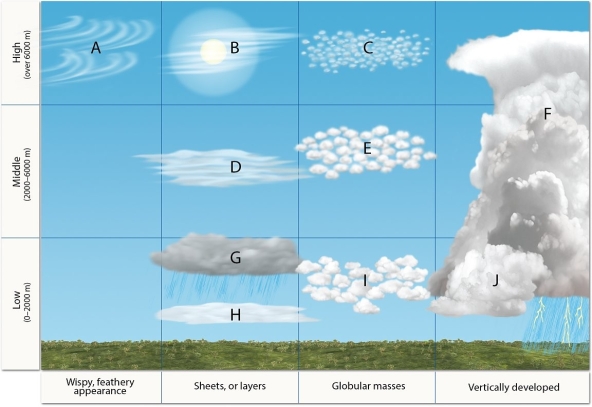
(Essay)
5.0/5  (67)
(67) The change of state from a gas to a liquid is called ________.
(Multiple Choice)
4.8/5 (80)
(80) "Frost" build up inside a household freezer is an example of which process?
(Multiple Choice)
4.7/5 (77)
(77) On a warm summer day, you go outside and feel fat, cold raindrops splashing on your hands. On a winter day, you go outside and notice fat, fluffy snowflakes piling up on top of your mittens. Compare and contrast the mechanisms by which these two kinds of precipitation were produced.
(Essay)
4.9/5 (74)
(74) Which of the following would NOT be associated with stable atmospheric conditions?
(Multiple Choice)
4.9/5 (66)
(66) After the proper wet bulb measuring procedure, the two thermometers on a sling psychrometer yield the same temperature. This indicates that ________.
(Multiple Choice)
4.9/5 (85)
(85) Any open container having a consistent cross-sectional area throughout can be used as a(n)________.
(Short Answer)
4.8/5 (85)
(85) 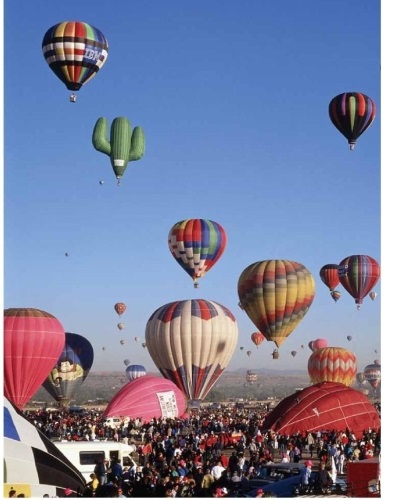 Examine the photo. Do these hot-air balloons illustrate absolute stability, absolute instability, or conditional instability? Explain.
 (Essay)
4.8/5 (83)
(83) On a specific day in the winter in St. Louis, Missouri it began snowing in the morning, the snow changed to rain by noon, and later in the afternoon sleet was falling. This later turned to snow, and by evening rain was freezing on bridges and roadways as glaze. Briefly explain how such a sequence of precipitation might occur.
(Essay)
4.8/5 (77)
(77) 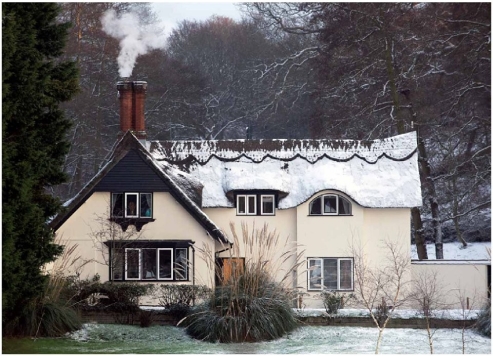 Examine the photo. Explain how the relative humidity inside the house compares to the relative humidity outside the house on this particular day.
 (Essay)
4.9/5 (75)
(75) ________ occurs when warm air is forced up and over a mass of cooler air.
(Short Answer)
4.9/5 (76)
(76) ________ occurs when moist air has an environmental lapse rate between the dry and wet adiabatic rates. Simply, the air is stable for an unsaturated parcel or air, but becomes unstable if the parcel of air be forced high enough for it be become saturated.
(Short Answer)
4.8/5 (85)
(85) On average, snow takes up about ten times as much volume than the same water falling as rain.
(True/False)
4.9/5 (66)
(66) Radar is capable of measuring how much precipitation is falling in a given location from as much as several hundred kilometers' distance away.
(True/False)
4.9/5 (81)
(81) The collision-coalescence process generates big raindrops that sweep up smaller cloud droplets, thus growing bigger. Potentially, they grow so large that frictional drag from the surrounding air causes the raindrop to break apart into a larger number of smaller droplets.
(True/False)
4.8/5 (81)
(81) ________ clouds that form sheets or layers that cover much of the sky.
(Short Answer)
4.9/5 (75)
(75) Why is the vertical movement of air critical to the formation of clouds and precipitation? What role do adiabatic temperature changes play in these processes?
(Essay)
4.9/5 (70)
(70) 
Filters
- Essay(0)
- Multiple Choice(0)
- Short Answer(0)
- True False(0)
- Matching(0)