



 Chat with AI
Exam 5: Plate Tectonics: A Scientific Revolution Unfolds

Exam 1: Matter and Minerals60 Questions
Exam 2: Rocks: Materials of the Solid Earth63 Questions
Exam 3: Landscapes Fashioned by Water68 Questions
Exam 4: Glacial and Arid Landscapes64 Questions
Exam 5: Plate Tectonics: A Scientific Revolution Unfolds64 Questions
Exam 6: Restless Earth: Earthquakes, Geologic Structures, and Mountain Building67 Questions
Exam 7: Volcanoes and Other Igneous Activity64 Questions
Exam 8: Geologic Time70 Questions
Exam 9: Oceans: The Last Frontier65 Questions
Exam 10: The Restless Ocean65 Questions
Exam 11: Heating the Atmosphere66 Questions
Exam 12: Moisture, Clouds, and Precipitation66 Questions
Exam 13: The Atmosphere in Motion68 Questions
Exam 14: Weather Patterns and Severe Weather66 Questions
Exam 15: The Nature of the Solar System67 Questions
Exam 16: Beyond Our Solar System66 Questions
Select questions type


The temperature below which magnetic material can retain a permanent magnetization is called the ________.
(Multiple Choice)
4.9/5  (74)
(74) The ________ is an example of a modern convergent boundary where two continents meet.
(Multiple Choice)
4.9/5 (80)
(80) 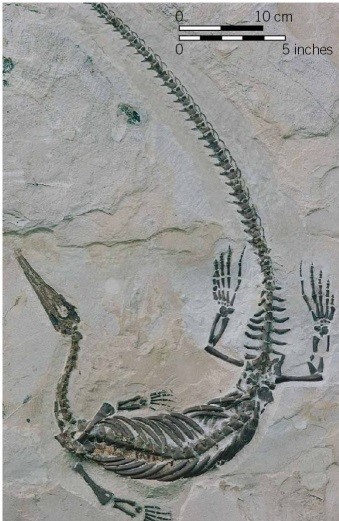 Examine the image. It shows ________, a freshwater reptile whose fossils Alfred Wegener cited as evidence of continental drift.
 (Short Answer)
4.9/5 (90)
(90) The plate tectonics model has been verified by multiple lines of evidence.
(True/False)
4.7/5 (82)
(82) What evidence did Alfred Wegener use to support his hypothesis of continental drift? What additional evidence was added later (post-World War II)that suggested seafloor spreading? How do these two ideas unite to form the theory of plate tectonics?
(Essay)
4.7/5 (86)
(86) The oldest rocks on the seafloor are much younger than the oldest rocks on the continents.
(True/False)
4.9/5 (75)
(75) The rate of seafloor spreading is, on the average, about two or three meters per year.
(True/False)
4.9/5 (74)
(74) You are dropped off by helicopter at a site on the land. You are told that it is a plate boundary. Almost immediately, you feel an earthquake. You look around and note the absence of volcanoes, but you notice an offset stream channel, and find a vertical fault with two kinds of rock on either side of it. What sort of plate boundary are you most likely on?
(Multiple Choice)
4.8/5 (71)
(71) Imagine that you were given a ship equipped with a device that could measure how deep the water is. You are asked to use this ship to find a subduction zone. What would you look for as you sailed around the world's oceans?
(Multiple Choice)
4.7/5 (74)
(74) A global positioning system (GPS)locator at site A reveals that it is moving at 2.1 centimeters per year to the east. A second GPS locator is tracking site B, which is moving at 2.0 centimeters per year to the west. What sort of plate boundary is this?
(Multiple Choice)
4.8/5 (75)
(75) ________ was a supercontinent that existed in the late Paleozoic era of geologic time.
(Short Answer)
4.8/5 (66)
(66) Continental rifts are associated with ________ plate boundaries.
(Multiple Choice)
4.9/5 (86)
(86) 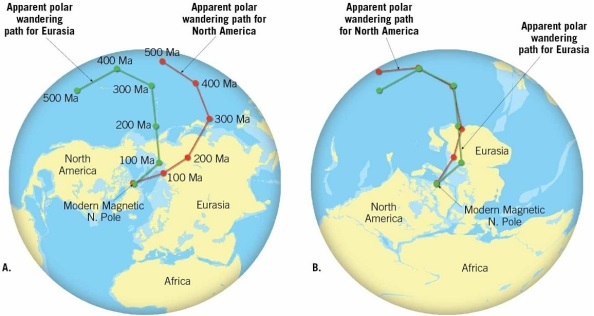 Which of these two sets of apparent polar wander paths shows the "fixed continent" model and which shows the "plate tectonics" model? Explain.
 (Essay)
4.9/5 (93)
(93) In general, rocks of the continental crust are less dense than rocks of the oceanic crust.
(True/False)
4.9/5 (87)
(87) The ________ is weaker and less rigid than the overlying lithosphere.
(Short Answer)
4.8/5 (87)
(87) Linear, magnetic patterns associated with mid-ocean ridges are configured as ________.
(Multiple Choice)
4.8/5 (82)
(82) 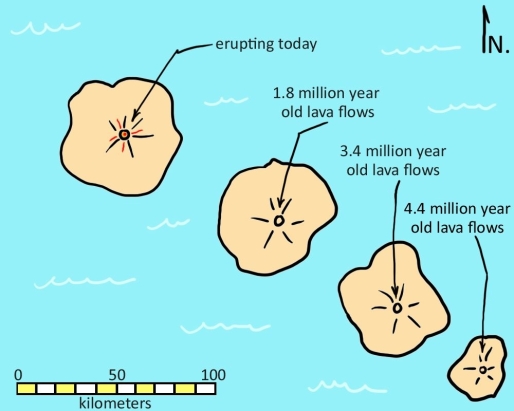 Examine this map of the Lutgens Archipelago, a chain of hotspot-related islands atop the Tarbuck Plate in the Tasa Sea. Use the information given to determine the (a)direction and (b)rate of movement of the Tarbuck Plate.
 (Essay)
4.9/5 (79)
(79) 
Filters
- Essay(0)
- Multiple Choice(0)
- Short Answer(0)
- True False(0)
- Matching(0)