



 Chat with AI
Exam 5: Plate Tectonics: A Scientific Revolution Unfolds

Exam 1: Matter and Minerals60 Questions
Exam 2: Rocks: Materials of the Solid Earth63 Questions
Exam 3: Landscapes Fashioned by Water68 Questions
Exam 4: Glacial and Arid Landscapes64 Questions
Exam 5: Plate Tectonics: A Scientific Revolution Unfolds64 Questions
Exam 6: Restless Earth: Earthquakes, Geologic Structures, and Mountain Building67 Questions
Exam 7: Volcanoes and Other Igneous Activity64 Questions
Exam 8: Geologic Time70 Questions
Exam 9: Oceans: The Last Frontier65 Questions
Exam 10: The Restless Ocean65 Questions
Exam 11: Heating the Atmosphere66 Questions
Exam 12: Moisture, Clouds, and Precipitation66 Questions
Exam 13: The Atmosphere in Motion68 Questions
Exam 14: Weather Patterns and Severe Weather66 Questions
Exam 15: The Nature of the Solar System67 Questions
Exam 16: Beyond Our Solar System66 Questions
Select questions type


The ________ is Earth's outermost rocky layer that is broken into plates.
(Short Answer)
4.9/5  (79)
(79) ________ was an aquatic reptile that lived in South America and Africa during the Permian period.
(Multiple Choice)
4.8/5 (88)
(88) When new oceanic lithosphere is generated at an oceanic ridge, what happens to the plate it's attached to?
(Multiple Choice)
4.9/5 (62)
(62) Among the following choices, the closest match for the East Pacific Rise is ________.
(Multiple Choice)
4.7/5 (81)
(81) Plates move at about the same rate your fingernails grow, a few centimeters per year.
(True/False)
4.7/5 (93)
(93) Alfred Wegener included all of the following lines of evidence as supporting his "continental drift" hypothesis except one. Which was NOT part of Wegener's evidence?
(Multiple Choice)
4.8/5 (78)
(78) The South Atlantic basin is widening by seafloor spreading. Africa and South America are moving ________.
(Short Answer)
4.8/5 (71)
(71) Some kind of ________ (upward movement of less dense material and downward movement of more dense material)appears to drive the motion of plates.
(Short Answer)
4.8/5 (74)
(74) Match the items with the correct descriptions.
Correct Answer: Verified
Premises:
Responses:
(Matching)
4.9/5 (79)
(79) In the early part of the twentieth century, ________ argued forcefully for the idea of continental drift.
(Multiple Choice)
4.7/5 (80)
(80) 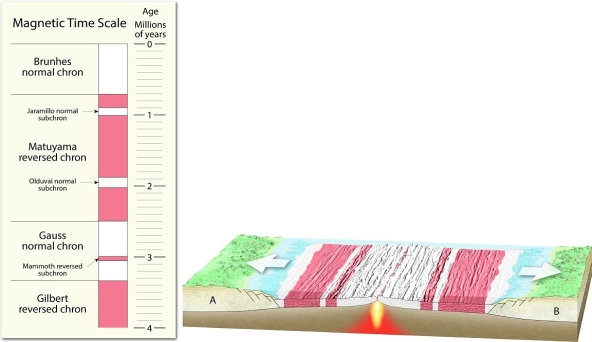 Examine the cross-section through a hypothetical ocean basin. Use the magnetic time scale at left to determine when continents A and B separated from one another. Justify your answer.
 (Essay)
4.8/5 (79)
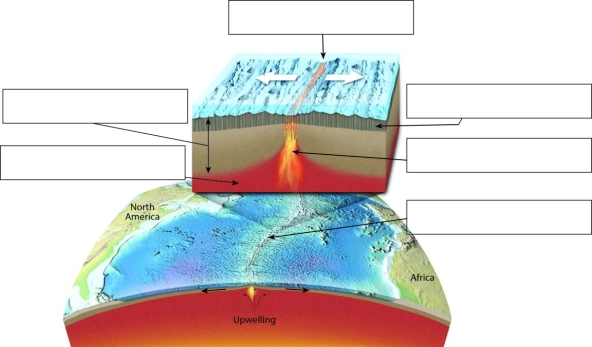
(79) Label each of the features associated with this divergent plate boundary.
(Essay)
4.7/5 (74)
(74) How wide would an ocean basin be if it formed due to the breakup of a supercontinent 200 million years ago and had an oceanic ridge in the middle that spread at a rate of 2.5 centimeters per year (25 kilometers per million years)?
(Essay)
4.9/5 (70)
(70) 
Filters
- Essay(0)
- Multiple Choice(0)
- Short Answer(0)
- True False(0)
- Matching(0)