



 Chat with AI
Exam 2: Rocks: Materials of the Solid Earth

Exam 1: Matter and Minerals60 Questions
Exam 2: Rocks: Materials of the Solid Earth63 Questions
Exam 3: Landscapes Fashioned by Water68 Questions
Exam 4: Glacial and Arid Landscapes64 Questions
Exam 5: Plate Tectonics: A Scientific Revolution Unfolds64 Questions
Exam 6: Restless Earth: Earthquakes, Geologic Structures, and Mountain Building67 Questions
Exam 7: Volcanoes and Other Igneous Activity64 Questions
Exam 8: Geologic Time70 Questions
Exam 9: Oceans: The Last Frontier65 Questions
Exam 10: The Restless Ocean65 Questions
Exam 11: Heating the Atmosphere66 Questions
Exam 12: Moisture, Clouds, and Precipitation66 Questions
Exam 13: The Atmosphere in Motion68 Questions
Exam 14: Weather Patterns and Severe Weather66 Questions
Exam 15: The Nature of the Solar System67 Questions
Exam 16: Beyond Our Solar System66 Questions
Select questions type


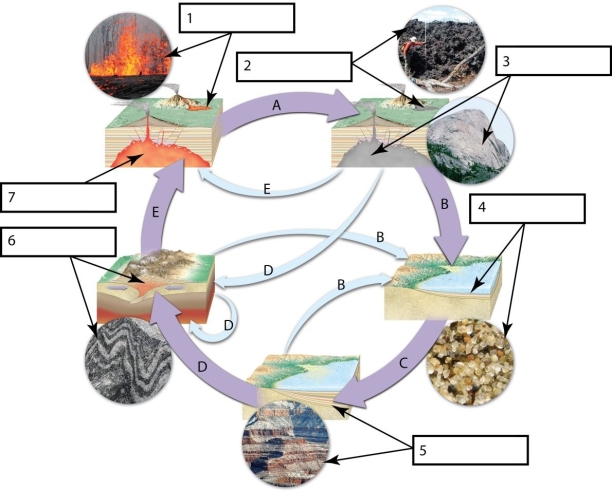
Label each process or set of processes (lettered arrows)and Earth materials (numbered boxes).
(Essay)
4.7/5  (90)
(90) Chemical sedimentary rocks form when ________ in solution precipitate out mineral matter.
(Short Answer)
4.9/5 (88)
(88) Match the items in the first column with the correct descriptions in the second column.
A)Reactions that take place, often facilitated by water, to new produce products, mainly clay minerals, which are stable at Earth's surface.
B)The reaction of a substance (often a metal ion)with oxygen. Rust is an example.
C)The breaking of rock into smaller pieces.
D)When water freezes, it expands in volume. Water-filled cracks can be enlarged when this new ice exerts outward pressure on the walls of the fracture.
E)The expansion of rocks that formed under high confining pressure, once they are uplifted and exposed at Earth's surface producing fractures that are broadly curved and parallel to the land surface.
F)Pressure that is unequal in different directions, such as results from the convergence of tectonic plates (mountain-building)
G)A substance that forms when carbon dioxide in the air combines with water. It is an important agent of chemical weathering.
H)Pressure that is equal in every direction, such as results from the burial of sediments
-1)Differential stress
2)Confining pressure
3)Frost wedging
4)Sheeting
5)Oxidation
6)Carbonic acid
7)Mechanical weathering
8)Chemical weathering
(Short Answer)
4.8/5 (73)
(73) 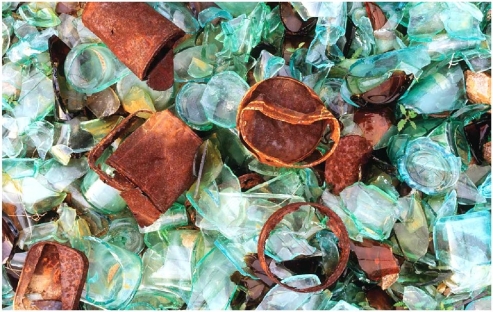 How are the two main categories of weathering represented in this image that shows human-made objects?
 (Essay)
4.9/5 (77)
(77) Why would intrusive rocks chemically weather more quickly than extrusive rocks? Why would mafic rocks chemically weather more easily than felsic rocks?
(Essay)
4.7/5 (83)
(83) Because of its rock cleavage, slate makes a better roofing material than rock gypsum.
(True/False)
5.0/5 (73)
(73) Rocks that contain crystals that are roughly equal in size and can be identified with the unaided eye are said to exhibit a ________ texture.
(Multiple Choice)
4.9/5 (88)
(88) Which igneous texture is characterized by two distinctively different crystal sizes?
(Multiple Choice)
5.0/5 (68)
(68) An igneous rock that cools rapidly is likely to have ________ crystals.
(Multiple Choice)
4.8/5 (72)
(72) To transform an igneous rock into a sedimentary rock, which of the following processes must take place?
(Multiple Choice)
4.9/5 (74)
(74) When a granite pluton (formed deep underground)is uplifted and exposed at the surface, it may undergo sheeting to form a(n)________.
(Short Answer)
4.9/5 (86)
(86) In contact metamorphism, ________ is the dominant agent of change.
(Short Answer)
4.9/5 (85)
(85) Detrital sedimentary rocks are classified and named principally on the basis of ________.
(Multiple Choice)
4.9/5 (60)
(60) 
Filters
- Essay(0)
- Multiple Choice(0)
- Short Answer(0)
- True False(0)
- Matching(0)