



 Chat with AI
Exam 13: Lower Gi System

Exam 1: Terminology, Positioning, and Imaging Principles199 Questions
Exam 2: Chest102 Questions
Exam 3: Abdomen92 Questions
Exam 4: Upper Limb107 Questions
Exam 5: Humerus and Shoulder Girdle80 Questions
Exam 6: Lower Limb110 Questions
Exam 7: Femur and Pelvic Girdle80 Questions
Exam 8: Cervical and Thoracic Spine84 Questions
Exam 9: Lumbar Spine, Sacrum, and Coccyx75 Questions
Exam 10: Bony Thoraxsternum and Ribs67 Questions
Exam 11: Cranium, Facial Bones, and Paranasal Sinuses181 Questions
Exam 12: Biliary Tract and Upper Gastrointestinal System127 Questions
Exam 13: Lower Gi System83 Questions
Exam 14: Urinary System and Venipuncture100 Questions
Exam 15: Trauma, Mobile, and Surgical Radiography108 Questions
Exam 16: Pediatric Radiography72 Questions
Exam 17: Angiography and Interventional Procedures72 Questions
Exam 18: Computed Tomography103 Questions
Exam 19: Special Radiographic Procedures69 Questions
Exam 20: Diagnostic and Therapeutic Modalities208 Questions
Select questions type


A patient comes to radiology with a history of rectocele.Which of the following procedures best demonstrates this condition?
(Multiple Choice)
4.8/5  (76)
(76) What is the term for the three bands of muscle that pull the large intestine into pouches?
(Multiple Choice)
4.8/5 (82)
(82) Match each of the definitions or descriptions with the corresponding pathologic indication for the small bowel series.(Use each option only once.)
-Common parasitic infection of the small intestine
(Multiple Choice)
4.7/5 (79)
(79) What is another term for the AP axial projection taken during a barium enema procedure?
(Multiple Choice)
4.9/5 (75)
(75) A twisting of the intestine on its own mesentery is termed:
(Multiple Choice)
4.9/5 (79)
(79) During a colostomy barium enema, a double-contrast retention enema tip is used.
(True/False)
5.0/5 (84)
(84) A single-stage, double-contrast barium enema involves instilling both the negative and positive contrast media at the same time.
(True/False)
4.8/5 (84)
(84) Match each of the definitions or descriptions with the corresponding pathologic indication for the small bowel series.(Use each option only once.)
-Chronic inflammatory disease of the GI tract
(Multiple Choice)
4.9/5 (73)
(73) A patient comes to radiology for a barium enema (BE).He has a possible fistula extending from the rectum to the urinary bladder.Which one of the following projections and/or positions would best demonstrate the fistula?
(Multiple Choice)
4.9/5 (85)
(85) Which of the following pathologic conditions is best demonstrated with evacuative proctography?
(Multiple Choice)
4.7/5 (71)
(71) Which part of the small intestine has the largest diameter?
(Multiple Choice)
4.9/5 (71)
(71) Match each of the definitions or descriptions with the corresponding pathologic indication for the small bowel series.(Use each option only once.)
-Inflammation of the intestine
(Multiple Choice)
4.9/5 (67)
(67) Match each of the definitions or descriptions with the corresponding pathologic indication for the small bowel series.(Use each option only once.)
-Patient with lactose or sucrose sensitivities
(Multiple Choice)
4.8/5 (85)
(85) Meckel diverticulum is best diagnosed with a radionuclide (nuclear medicine) scan.
(True/False)
4.8/5 (72)
(72) During a single-contrast barium enema, the radiologist detects a possible defect within the right colic flexure.Which of the following projections and/or positions best demonstrates this region of the colon?
(Multiple Choice)
4.8/5 (78)
(78) Central ray and image receptor centering for a 1-hour small bowel radiograph should be:
(Multiple Choice)
5.0/5 (75)
(75) Match each of the definitions or descriptions with the corresponding pathologic indication for the small bowel series.(Use each option only once.)
-Obstruction of the small intestine
(Multiple Choice)
4.8/5 (79)
(79) Which of the following structures is not considered part of the colon?
(Multiple Choice)
5.0/5 (75)
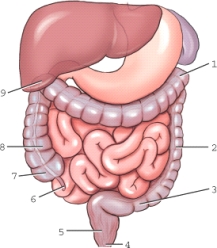
(75) 

Filters
- Essay(0)
- Multiple Choice(0)
- Short Answer(0)
- True False(0)
- Matching(0)