



 Chat with AI
Exam 10: Bony Thoraxsternum and Ribs

Exam 1: Terminology, Positioning, and Imaging Principles199 Questions
Exam 2: Chest102 Questions
Exam 3: Abdomen92 Questions
Exam 4: Upper Limb107 Questions
Exam 5: Humerus and Shoulder Girdle80 Questions
Exam 6: Lower Limb110 Questions
Exam 7: Femur and Pelvic Girdle80 Questions
Exam 8: Cervical and Thoracic Spine84 Questions
Exam 9: Lumbar Spine, Sacrum, and Coccyx75 Questions
Exam 10: Bony Thoraxsternum and Ribs67 Questions
Exam 11: Cranium, Facial Bones, and Paranasal Sinuses181 Questions
Exam 12: Biliary Tract and Upper Gastrointestinal System127 Questions
Exam 13: Lower Gi System83 Questions
Exam 14: Urinary System and Venipuncture100 Questions
Exam 15: Trauma, Mobile, and Surgical Radiography108 Questions
Exam 16: Pediatric Radiography72 Questions
Exam 17: Angiography and Interventional Procedures72 Questions
Exam 18: Computed Tomography103 Questions
Exam 19: Special Radiographic Procedures69 Questions
Exam 20: Diagnostic and Therapeutic Modalities208 Questions
Select questions type


It is a safe practice to decrease the SID to 30 inches (77 cm) for the oblique sternum projection.
(True/False)
4.8/5  (85)
(85) A patient enters the ED with an injury to the left anterior lower ribs.Which of the following projections should be taken to demonstrate the involved area?
(Multiple Choice)
4.7/5 (63)
(63) A young female patient from the emergency department (ED) is brought to radiology for rib examination.She is able to sit up or stand for the procedure.She indicates that the region of pain is to the right anterior-to-mid axillary region.Which rib projections should be performed to minimize the effective dose to this patient?
(Multiple Choice)
4.8/5 (78)
(78) 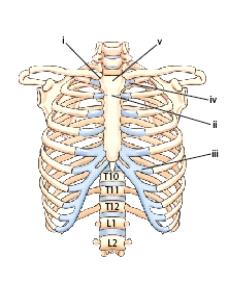
Which condition of the sternum is often termed "funnel chest"?
(Multiple Choice)
4.8/5 (87)
(87) The widest aspect of the bony thorax generally occurs at the level of:
(Multiple Choice)
4.9/5 (72)
(72) The tubercle portion of a typical rib articulates with the vertebral facet/demifacet.
(True/False)
4.9/5 (75)
(75) An ambulatory patient enters the ED with a possible injury to the right upper posterior ribs.Which of the following positioning routines should be taken to demonstrate the involved area?
(Multiple Choice)
4.7/5 (84)
(84) Which of the following positions will best demonstrate the axillary portion of the left ribs?
(Multiple Choice)
4.9/5 (70)
(70) Which of the following landmarks can be palpated to locate the upper margin of the sternum on the obese patient?
(Multiple Choice)
4.9/5 (78)
(78) Which disease or condition may be associated with postoperative complications of open heart surgery?
(Multiple Choice)
4.7/5 (83)
(83) The use of 125 kV is recommended for AP and PA projections of the ribs to reduce skin dose.
(True/False)
4.7/5 (85)
(85) Which aspect of the rib articulates with the thoracic vertebral body?
(Multiple Choice)
4.8/5 (73)
(73) What is the recommended degree of obliquity for an RAO projection of the sternum for an asthenic (thin-chested) type of patient?
(Multiple Choice)
4.9/5 (65)
(65) In the erect adult bony thorax, the posterior or vertebral end of a typical rib is ____ higher than or more superior to the anterior portion.
(Multiple Choice)
4.7/5 (98)
(98) Which of the following conditions may occur with trauma to the ribs?
(Multiple Choice)
4.8/5 (75)
(75) Which of the following positioning considerations does NOT apply for a study of the lower ribs?
(Multiple Choice)
4.9/5 (77)
(77) What kV range (digital systems) is recommended for an AP projection of the ribs found below the diaphragm?
(Multiple Choice)
4.7/5 (75)
(75) Both bony and soft tissue anatomy may be evaluated by CT for pathology involving the sternum or the sternoclavicular joints.
(True/False)
4.9/5 (81)
(81) 
Filters
- Essay(0)
- Multiple Choice(0)
- Short Answer(0)
- True False(0)
- Matching(0)