



 Chat with AI
Exam 7: Femur and Pelvic Girdle

Exam 1: Terminology, Positioning, and Imaging Principles199 Questions
Exam 2: Chest102 Questions
Exam 3: Abdomen92 Questions
Exam 4: Upper Limb107 Questions
Exam 5: Humerus and Shoulder Girdle80 Questions
Exam 6: Lower Limb110 Questions
Exam 7: Femur and Pelvic Girdle80 Questions
Exam 8: Cervical and Thoracic Spine84 Questions
Exam 9: Lumbar Spine, Sacrum, and Coccyx75 Questions
Exam 10: Bony Thoraxsternum and Ribs67 Questions
Exam 11: Cranium, Facial Bones, and Paranasal Sinuses181 Questions
Exam 12: Biliary Tract and Upper Gastrointestinal System127 Questions
Exam 13: Lower Gi System83 Questions
Exam 14: Urinary System and Venipuncture100 Questions
Exam 15: Trauma, Mobile, and Surgical Radiography108 Questions
Exam 16: Pediatric Radiography72 Questions
Exam 17: Angiography and Interventional Procedures72 Questions
Exam 18: Computed Tomography103 Questions
Exam 19: Special Radiographic Procedures69 Questions
Exam 20: Diagnostic and Therapeutic Modalities208 Questions
Select questions type


What type of CR angle must be used for an AP axial (Taylor method) "outlet" projection for a male patient?
(Multiple Choice)
4.8/5  (81)
(81) Which of the labeled structures is the body of the ischium? 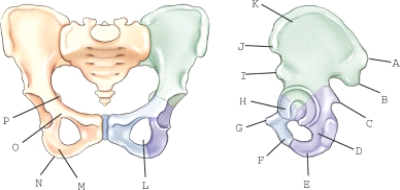
(Multiple Choice)
4.8/5 (79)
(79) Match the correct disease or condition with the corresponding pathologic description. (Use each choice only once.)
-A disease producing extensive calcification of the longitudinal ligament of the spinal column
(Multiple Choice)
4.9/5 (68)
(68) 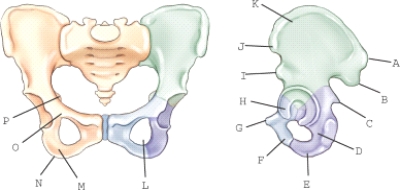
A common condition of the femur that develops in elderly patients, leading to frequent fractures of the hip (proximal femur), is:
(Multiple Choice)
4.9/5 (87)
(87) Which of the following conditions will produce the radiographic sign referred to as "bamboo spine"?
(Multiple Choice)
5.0/5 (70)
(70) Match the correct disease or condition with the corresponding pathologic description. (Use each choice only once.)
-A fracture resulting from a severe blow to one side of the pelvis
(Multiple Choice)
4.8/5 (76)
(76) A radiograph of an AP pelvis demonstrates that the right obturator foramen is foreshortened but the left foramen is open.Which one of the following positioning errors is present on this radiograph?
(Multiple Choice)
4.8/5 (100)
(100) Match the correct disease or condition with the corresponding pathologic description. (Use each choice only once.)
-A malignant tumor of the cartilage
(Multiple Choice)
4.9/5 (87)
(87) Which of the following imaging modalities can be performed on a newborn to assess hip joint stability during movement?
(Multiple Choice)
4.8/5 (76)
(76) Select the correct gender to correspond with the following pelvic characteristics.Wider and shallow general shape of pelvis:
(Multiple Choice)
5.0/5 (82)
(82) Only a small part of the lesser trochanter, if any, will be visible on a well-positioned axiolateral (inferosuperior) lateral hip.
(True/False)
4.9/5 (90)
(90) Using the hip localization method, the femoral head can be located:
(Multiple Choice)
4.9/5 (77)
(77) Match the correct disease or condition with the corresponding pathologic description. (Use each choice only once.)
-Now referred to as "developmental dysplasia of the hip"
(Multiple Choice)
4.8/5 (94)
(94) A radiograph of an AP pelvis reveals that the left obturator foramen is more open or elongated as compared with the right.What is the specific positioning error present on this radiograph?
(Multiple Choice)
4.8/5 (82)
(82) A radiograph of an AP pelvis reveals that the lesser trochanters are not visualized.This pelvis projection was performed for nontraumatic reasons.What should the technologist do (if anything) to correct this on the repeat exposure?
(Multiple Choice)
4.8/5 (89)
(89) 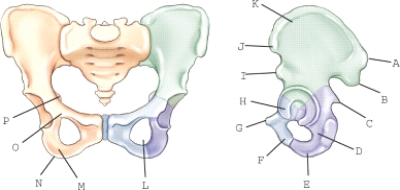
Which of the following conditions will produce shortening of the epiphyses but widening of the epiphyseal plate?
(Multiple Choice)
4.8/5 (72)
(72) Cephalopelvimetry is still commonly performed in the United States.
(True/False)
4.9/5 (75)
(75) 
Filters
- Essay(0)
- Multiple Choice(0)
- Short Answer(0)
- True False(0)
- Matching(0)