



 Chat with AI
Exam 14: Environmental Hazards and Human Health

Exam 1: Environmental Problems, Their Causes, and Sustainability89 Questions
Exam 2: Science, Matter, and Energy107 Questions
Exam 3: Ecosystems: What Are They and How Do They Work177 Questions
Exam 4: Biodiversity and Evolution94 Questions
Exam 5: Biodiversity, Species Interactions, and Population Control93 Questions
Exam 6: The Human Population and Urbanization126 Questions
Exam 7: Climate and Biodiversity137 Questions
Exam 8: Sustaining Biodiversity: the Species Approach103 Questions
Exam 9: Sustaining Biodiversity: the Ecosystem Approach84 Questions
Exam 10: Food, Soil, and Pest Management120 Questions
Exam 11: Water Resources and Water Pollution133 Questions
Exam 12: Geology and Nonrenewable Mineral Resources99 Questions
Exam 13: Energy110 Questions
Exam 14: Environmental Hazards and Human Health97 Questions
Exam 15: Air Pollution, Climate Change, and Ozone Depletion136 Questions
Exam 16: Solid and Hazardous Waste100 Questions
Exam 17: Environmental Economics, Politics, and Worldviews97 Questions
Select questions type


Which one of the following infectious diseases has been on the rise since 1990 and kills about 1.8 million people per year?
(Multiple Choice)
4.8/5  (73)
(73) A person experiencing dizziness after using a strong household cleaner is showing
(Multiple Choice)
4.9/5 (61)
(61) Which of the following infectious diseases is not among the four most deadly?
(Multiple Choice)
4.9/5 (85)
(85) Which environmental problem is among the five leading causes of death worldwide?
(Multiple Choice)
4.7/5 (84)
(84) You are an aquatic biologist studying a small lake. a.The stream that drains into this lake runs by croplands.You are detecting a pesticide called atrazine in the insects and worms that live in the lake.The predatory birds such as herons and egrets have very high concentrations of atrazine in their blood. The birds prey on the frogs and small fish. What process explains the high atrazine level in the birds?
(Multiple Choice)
4.7/5 (78)
(78) Since 1900, and especially since 1950, the incidence of infectious diseases and the death rates from such disease has been greatly reduced.
a.Recalling discussions from previous chapters, what other significant events have occurred since about 1950? Do you think these events are correlated? If so, what process is driving it?
(Essay)
4.8/5 (76)
(76) You were recently hired by WHO (World Health Organization) to investigate the current status of swine flu outbreaks in a certain part of the United States. a.Your job title would most likely be
(Multiple Choice)
4.7/5 (77)
(77) Hormonally active agents (HAAs) are a category of chemical hazards that can
(Multiple Choice)
4.9/5 (84)
(84) Match the items below with their correct description from the list a through f.
-heroin
(Multiple Choice)
5.0/5 (84)
(84) Which of the following is not one of the major types of hazard?
(Multiple Choice)
4.9/5 (92)
(92) Viral diseases are particularly difficult to combat because they
(Multiple Choice)
4.9/5 (80)
(80) 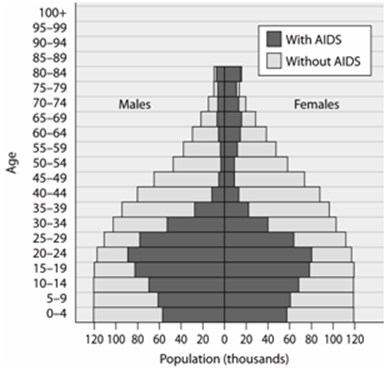 -How many more men between 20 and 24 years of age would live if AIDS could be eradicated?
 (Short Answer)
4.9/5 (68)
(68) Match the items below with their correct description from the list a through f.
-nicotine
(Multiple Choice)
4.8/5 (72)
(72) All chemicals in commercial use were screened for toxicity before they were deemed acceptable for use.
(True/False)
4.9/5 (85)
(85) If you typically consume large amounts of processed foods, and certain wines, which category of chemical hazard is introduced into your system?
(Multiple Choice)
4.9/5 (83)
(83) 
Filters
- Essay(0)
- Multiple Choice(0)
- Short Answer(0)
- True False(0)
- Matching(0)