



 Chat with AI
Exam 5: Biodiversity, Species Interactions, and Population Control

Exam 1: Environmental Problems, Their Causes, and Sustainability89 Questions
Exam 2: Science, Matter, and Energy107 Questions
Exam 3: Ecosystems: What Are They and How Do They Work177 Questions
Exam 4: Biodiversity and Evolution94 Questions
Exam 5: Biodiversity, Species Interactions, and Population Control93 Questions
Exam 6: The Human Population and Urbanization126 Questions
Exam 7: Climate and Biodiversity137 Questions
Exam 8: Sustaining Biodiversity: the Species Approach103 Questions
Exam 9: Sustaining Biodiversity: the Ecosystem Approach84 Questions
Exam 10: Food, Soil, and Pest Management120 Questions
Exam 11: Water Resources and Water Pollution133 Questions
Exam 12: Geology and Nonrenewable Mineral Resources99 Questions
Exam 13: Energy110 Questions
Exam 14: Environmental Hazards and Human Health97 Questions
Exam 15: Air Pollution, Climate Change, and Ozone Depletion136 Questions
Exam 16: Solid and Hazardous Waste100 Questions
Exam 17: Environmental Economics, Politics, and Worldviews97 Questions
Select questions type


Factors that act to limit the growth of populations are collectively called

Free
(Multiple Choice)
4.8/5  (78)
(78) Correct Answer: Verified
D
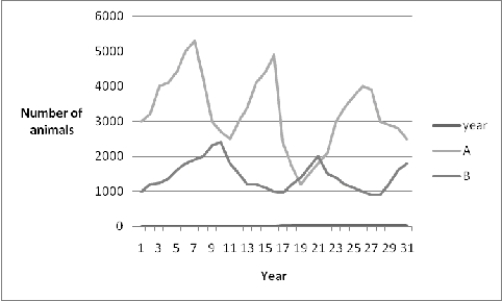 The graph above shows the census count for two animal species, A and B, over a 31 year period.
a.Animal A and animal B have a predator-prey relationship.
-What description would apply to the predator species in the graph above if the prey species were its only source of food? What assumptions could we make about that predator species if this were the case?
The graph above shows the census count for two animal species, A and B, over a 31 year period.
a.Animal A and animal B have a predator-prey relationship.
-What description would apply to the predator species in the graph above if the prey species were its only source of food? What assumptions could we make about that predator species if this were the case?Free
(Essay)
4.8/5 (83)
(83) Correct Answer:Verified
VerifiedThe predator species would be described as a specialist.
a.The specialist predator would be more prone to extinction than a generalist predator that relied on several sources of food.
Match the items listed below with the appropriate choice
 -On the exponential growth of reindeer figure, choose the portion of the graph that represents the number of reindeer that can be sustained indefinitely in a given area.
Free
(Short Answer)
4.9/5 (89)
(89) Correct Answer:Verified
VerifiedA
Match the items listed below with the appropriate choice
 -On the ecological succession figure, choose the letter that represents the step in which shrubs grow.
 (Short Answer)
4.9/5 (80)
(80) The ecological process that would result in a localized change in species composition following a severe volcanic eruption would best be described as ____________________.
(Short Answer)
4.8/5 (76)
(76) Insect-eating warblers reduce interspecific competition by which of the following?
(Multiple Choice)
4.9/5 (84)
(84) You are an evolutionary entomologist. a.You have observed beetles that can raise their abdomens and give off a defensive chemical that generally repels predators.
You discover a new species of beetle that raises its abdomen in a threatening way similar to the first species, but no defensive chemical is given off.
You are most likely to characterize this defensive strategy as a form of
(Multiple Choice)
4.8/5 (80)
(80) There are ____________________ limits to population growth in nature.
(Short Answer)
4.8/5 (83)
(83) Prey are least likely to defend themselves against predators by
(Multiple Choice)
4.9/5 (84)
(84) Inertia is not a feature of grassland ecosystems, but resilience is.
(True/False)
4.8/5 (78)
(78) The human population can maintain an exponential growth rate indefinitely because of technology.
(True/False)
4.8/5 (78)
(78) Match the items listed below with the appropriate choice
-A tiny fish called a wrasse lives in and around the mouth of sharks.
a.It cleans up the debris left after the shark eats flesh, and it gains protection by living in the shark's mouth.
(Multiple Choice)
4.9/5 (72)
(72) 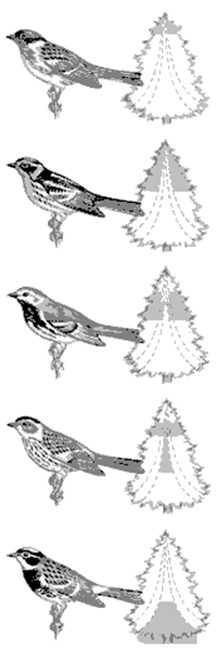 -As indicated in this image, when different species of warblers inhabit the same area, is food competition reduced?
 (Short Answer)
4.9/5 (73)
(73) Carrying capacity is the population size (or density) at which the environment is saturated.
(True/False)
4.9/5 (75)
(75) Match the items listed below with the appropriate choice
-Sea lampreys attach themselves to fish such as trout.
(Multiple Choice)
4.9/5 (88)
(88) A relationship in which a member of one species obtains its nourishment by living on, in, or near a member of another species over an extended time is best labeled
(Multiple Choice)
4.8/5 (77)
(77) 
Filters
- Essay(0)
- Multiple Choice(0)
- Short Answer(0)
- True False(0)
- Matching(0)