



 Chat with AI
Exam 14: Environmental Hazards and Human Health

Exam 1: Environmental Problems, Their Causes, and Sustainability89 Questions
Exam 2: Science, Matter, and Energy107 Questions
Exam 3: Ecosystems: What Are They and How Do They Work177 Questions
Exam 4: Biodiversity and Evolution94 Questions
Exam 5: Biodiversity, Species Interactions, and Population Control93 Questions
Exam 6: The Human Population and Urbanization126 Questions
Exam 7: Climate and Biodiversity137 Questions
Exam 8: Sustaining Biodiversity: the Species Approach103 Questions
Exam 9: Sustaining Biodiversity: the Ecosystem Approach84 Questions
Exam 10: Food, Soil, and Pest Management120 Questions
Exam 11: Water Resources and Water Pollution133 Questions
Exam 12: Geology and Nonrenewable Mineral Resources99 Questions
Exam 13: Energy110 Questions
Exam 14: Environmental Hazards and Human Health97 Questions
Exam 15: Air Pollution, Climate Change, and Ozone Depletion136 Questions
Exam 16: Solid and Hazardous Waste100 Questions
Exam 17: Environmental Economics, Politics, and Worldviews97 Questions
Select questions type


Match the items below with their correct description from the list a through f.
-mercury
(Multiple Choice)
4.8/5  (80)
(80) Human reliability is generally ____ technology reliability.
(Multiple Choice)
4.7/5 (72)
(72) Match the items below with their correct description from the list a through f.
-codeine
(Multiple Choice)
4.8/5 (86)
(86) The strategy that would contribute most to longer lifespan would be
(Multiple Choice)
4.8/5 (72)
(72) Because populations of mosquitoes are expected to expand to different parts of the planet due to climate change, the incidence of ____________________ is expected to spread to warm temperate areas of the globe.
(Short Answer)
4.9/5 (81)
(81) Compare and contrast the greatest threats to human health on our planet, in order of their impact, noting the degree to which we have control over the cause.
(Essay)
4.7/5 (75)
(75) During the mid-1900s, the spread of malaria decreased sharply from
(Multiple Choice)
4.9/5 (84)
(84) 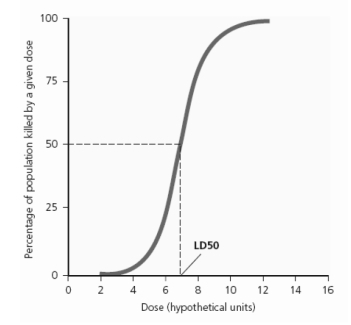 -What purpose does a graph such as this one serve in our challenge of evaluating hazardous chemicals?
 (Essay)
4.7/5 (87)
(87) The U.S. a.Environmental Protection Agency currently recommends that regulators assume children face a risk ____ times that of adults when exposed to carcinogenic chemicals.
(Multiple Choice)
4.9/5 (82)
(82) Only water-soluble toxins can accumulate in body tissues and cells.
(True/False)
4.9/5 (77)
(77) 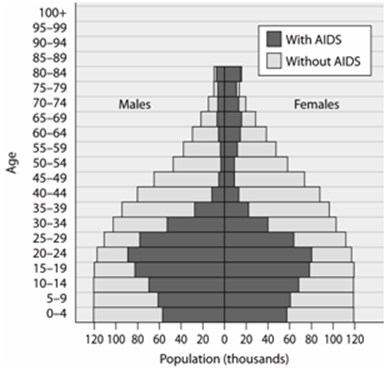 -How many more women between 20 and 24 years of age would live if AIDS were eradicated?
 (Short Answer)
4.8/5 (82)
(82) The reason mercury is so persistent in the environment or living organisms is that it is an element and thus cannot be broken down or degraded.
(True/False)
4.7/5 (88)
(88)
-On this graph, what dose in hypothetical units did it take to kill 25% of the population?
-On this graph, what dose in hypothetical units did it take to kill 25% of the population? (Short Answer)
4.7/5 (79)
(79) All of the following are considered to be biological hazards except
(Multiple Choice)
4.7/5 (74)
(74) 
Filters
- Essay(0)
- Multiple Choice(0)
- Short Answer(0)
- True False(0)
- Matching(0)