



 Chat with AI
Exam 1: Environmental Problems, Their Causes, and Sustainability

Exam 1: Environmental Problems, Their Causes, and Sustainability89 Questions
Exam 2: Science, Matter, and Energy107 Questions
Exam 3: Ecosystems: What Are They and How Do They Work177 Questions
Exam 4: Biodiversity and Evolution94 Questions
Exam 5: Biodiversity, Species Interactions, and Population Control93 Questions
Exam 6: The Human Population and Urbanization126 Questions
Exam 7: Climate and Biodiversity137 Questions
Exam 8: Sustaining Biodiversity: the Species Approach103 Questions
Exam 9: Sustaining Biodiversity: the Ecosystem Approach84 Questions
Exam 10: Food, Soil, and Pest Management120 Questions
Exam 11: Water Resources and Water Pollution133 Questions
Exam 12: Geology and Nonrenewable Mineral Resources99 Questions
Exam 13: Energy110 Questions
Exam 14: Environmental Hazards and Human Health97 Questions
Exam 15: Air Pollution, Climate Change, and Ozone Depletion136 Questions
Exam 16: Solid and Hazardous Waste100 Questions
Exam 17: Environmental Economics, Politics, and Worldviews97 Questions
Select questions type


Government subsidies can actually encourage companies to conduct business in ways that result in environmental degradation.
(True/False)
4.9/5  (79)
(79) Which of the following is a major factor contributing to the degradation of natural capital associated with the pricing of consumable goods?
(Multiple Choice)
4.8/5 (78)
(78) Which of the following terms encompasses all of the others?
(Multiple Choice)
4.8/5 (68)
(68) Why should the Environmental Protection Agency (EPA) of the United States be concerned with ecological tipping points for certain environmental problems?
(Essay)
4.7/5 (79)
(79) Root causes of unsustainability include all of the following except
(Multiple Choice)
4.8/5 (93)
(93) Recycling nonrenewable metallic resources takes much less energy, water, and other resources and produces less pollution and environmental degradation than exploiting virgin metallic resources.
(True/False)
4.7/5 (84)
(84) In order for the social changes to occur that will produce sustainable economies, fully 50% of the population of a country must support the change.
(True/False)
4.7/5 (84)
(84) A worldview that holds that we can and should manage the Earth for our own benefit but that we also have an ethical responsibility to be caring stewards is called the
(Multiple Choice)
4.7/5 (62)
(62) Natural capital is comprised of natural resources and natural ____________________.
(Short Answer)
4.8/5 (95)
(95) About ____ of the world's human population lives in the developing countries.
(Multiple Choice)
4.9/5 (89)
(89) The IPAT model of environmental impact takes into consideration population size, technology, and ____________________.
(Short Answer)
4.7/5 (74)
(74) Explain how the IPAT model and the ecological footprint model emphasize different aspects of how natural resources are affected by unsustainable use.
(Essay)
4.7/5 (87)
(87) If we make a commitment to more sustainable lifestyles and economies now, scientific evidence indicates it will take how long to fully implement the changes?
(Multiple Choice)
4.9/5 (74)
(74) 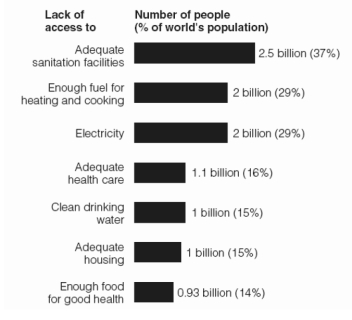 -What percentage of the world's population does not have adequate sanitation?
 (Short Answer)
4.9/5 (64)
(64) Clearly describe how wealth and affluence can have both harmful and beneficial environmental effects.
(Essay)
4.7/5 (78)
(78) A set of organisms within a defined area interacting with one another and with their environment of living and non-living matter is called a(n)
(Multiple Choice)
4.7/5 (85)
(85) The three principles of sustainability are chemical cycling, reliance on solar energy, and ____________________.
(Short Answer)
5.0/5 (82)
(82) 
Filters
- Essay(0)
- Multiple Choice(0)
- Short Answer(0)
- True False(0)
- Matching(0)