



 Chat with AI
Exam 1: Environmental Problems, Their Causes, and Sustainability

Exam 1: Environmental Problems, Their Causes, and Sustainability89 Questions
Exam 2: Science, Matter, and Energy107 Questions
Exam 3: Ecosystems: What Are They and How Do They Work177 Questions
Exam 4: Biodiversity and Evolution94 Questions
Exam 5: Biodiversity, Species Interactions, and Population Control93 Questions
Exam 6: The Human Population and Urbanization126 Questions
Exam 7: Climate and Biodiversity137 Questions
Exam 8: Sustaining Biodiversity: the Species Approach103 Questions
Exam 9: Sustaining Biodiversity: the Ecosystem Approach84 Questions
Exam 10: Food, Soil, and Pest Management120 Questions
Exam 11: Water Resources and Water Pollution133 Questions
Exam 12: Geology and Nonrenewable Mineral Resources99 Questions
Exam 13: Energy110 Questions
Exam 14: Environmental Hazards and Human Health97 Questions
Exam 15: Air Pollution, Climate Change, and Ozone Depletion136 Questions
Exam 16: Solid and Hazardous Waste100 Questions
Exam 17: Environmental Economics, Politics, and Worldviews97 Questions
Select questions type


Developing countries can be classified as moderately developed, middle-income, or as ____________________, least developed.
(Short Answer)
4.8/5  (75)
(75) It has been estimated that humanity's global ecological footprint exceeds the Earth's biological capacity by about ____________________.
(Short Answer)
4.9/5 (78)
(78) The per capita ecological footprint is the average ecological footprint of an individual in a given country or area.
(True/False)
4.9/5 (69)
(69) ____________________ are functions of nature, such as purification of air and water, that support life and human economies.
(Short Answer)
4.8/5 (85)
(85) Pesticides blown from agricultural lands into the air is an example of ____________________ pollution.
(Short Answer)
4.9/5 (66)
(66) Which of the following would best be categorized as a perpetual resource?
(Multiple Choice)
4.9/5 (85)
(85) 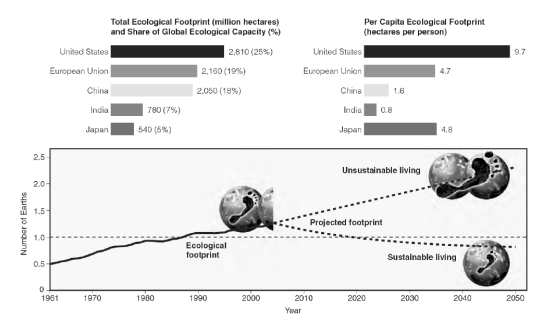 -Is India's per capita ecological footprint greater than that of Japan?
 (Essay)
4.8/5 (87)
(87) The action of processing plastic or aluminum cans into another usable product is called ____________________.
(Short Answer)
4.9/5 (72)
(72) Nutrient recycling is a vital natural service carried out by which natural resource?
(Multiple Choice)
4.9/5 (81)
(81)
-What can be interpreted about the ecological footprints of the United States from the above graphs?
-What can be interpreted about the ecological footprints of the United States from the above graphs? (Essay)
4.9/5 (84)
(84)
-What is the significance of this difference between India and Japan?
-What is the significance of this difference between India and Japan? (Essay)
4.8/5 (82)
(82) Which of the following best describes the concept of environmental degradation?
(Multiple Choice)
4.9/5 (95)
(95) All of the following are potentially renewable resources except
(Multiple Choice)
4.9/5 (92)
(92) If industry managers ask the question "How can my company avoid producing polluting air exhaust from my factory?" they are seeking pollution prevent, which is preferable to pollution cleanup.
(True/False)
4.9/5 (89)
(89) The IPAT model states that the key factor in environmental impact in
(Multiple Choice)
4.9/5 (92)
(92) Perpetual resources exist in a fixed quantity or stock in the Earth's crust.
(True/False)
5.0/5 (94)
(94) Which of the following is not among the three scientific principles of sustainability?
(Multiple Choice)
4.9/5 (76)
(76) ____________________ are materials and energy in nature that are essential or useful to humans.
(Short Answer)
4.8/5 (88)
(88) A single, identifiable source of pollution is called a(n) ____________________.
(Short Answer)
4.9/5 (76)
(76) 
Filters
- Essay(0)
- Multiple Choice(0)
- Short Answer(0)
- True False(0)
- Matching(0)