



 Chat with AI
Exam 1: Environmental Problems, Their Causes, and Sustainability

Exam 1: Environmental Problems, Their Causes, and Sustainability89 Questions
Exam 2: Science, Matter, and Energy107 Questions
Exam 3: Ecosystems: What Are They and How Do They Work177 Questions
Exam 4: Biodiversity and Evolution94 Questions
Exam 5: Biodiversity, Species Interactions, and Population Control93 Questions
Exam 6: The Human Population and Urbanization126 Questions
Exam 7: Climate and Biodiversity137 Questions
Exam 8: Sustaining Biodiversity: the Species Approach103 Questions
Exam 9: Sustaining Biodiversity: the Ecosystem Approach84 Questions
Exam 10: Food, Soil, and Pest Management120 Questions
Exam 11: Water Resources and Water Pollution133 Questions
Exam 12: Geology and Nonrenewable Mineral Resources99 Questions
Exam 13: Energy110 Questions
Exam 14: Environmental Hazards and Human Health97 Questions
Exam 15: Air Pollution, Climate Change, and Ozone Depletion136 Questions
Exam 16: Solid and Hazardous Waste100 Questions
Exam 17: Environmental Economics, Politics, and Worldviews97 Questions
Select questions type


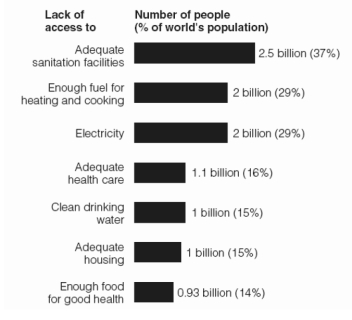 -If poverty stricken people in developing countries engage in activities that degrade valuable natural resources, which two statistics do you think are driving those actions?
 (Essay)
4.7/5  (66)
(66) Which of the following is a form of natural capital gained directly or indirectly as a result of solar energy?
(Multiple Choice)
4.8/5 (76)
(76) Which of the following best depicts what is meant by an ecological footprint?
(Multiple Choice)
4.8/5 (79)
(79) ____________________ is the ability of the Earth's various natural systems and human cultural systems and economies to survive and adapt to changing environmental conditions indefinitely.
(Short Answer)
4.7/5 (80)
(80) Which of the following is a social movement dedicated to the protection of the Earth's natural capital?
(Multiple Choice)
4.8/5 (86)
(86) An ecological ____________________is an irreversible shift in the behavior of a natural system.
(Short Answer)
4.9/5 (89)
(89) The United States has the world's largest per capita ecological footprint.
(True/False)
4.7/5 (87)
(87) Which of the following areas of study are not important in the study of environmental science?
(Multiple Choice)
4.8/5 (93)
(93) In an environmentally sustainable society, most affluent citizens work to decrease their consumption of products.
(True/False)
4.8/5 (84)
(84) Which of the following would be categorized as a non-renewable resource?
(Multiple Choice)
4.8/5 (69)
(69) Which of the following is an environmental benefit of affluence and wealth?
(Multiple Choice)
4.9/5 (71)
(71) Rapid population growth and associated poverty are primarily occurring in developing countries and have little impact on environmental degradation.
(True/False)
4.8/5 (68)
(68) If a country's ecological footprint is larger than its biological capacity to replenish its renewable resources and absorb the resulting waste and pollution:
(Multiple Choice)
4.8/5 (72)
(72) We can say that biodiversity is a factor in maintaining life on this planet.
(True/False)
4.9/5 (70)
(70) Which of the following categories of resources can be degraded if used beyond sustainable yield?
(Multiple Choice)
4.9/5 (84)
(84) Evidence that we are living unsustainably includes which of the following?
(Multiple Choice)
5.0/5 (85)
(85) When we exceed a renewable resource's natural replacement rate, the available supply begins to shrink through a process known as ____________________.
(Short Answer)
4.8/5 (89)
(89) An environmentally sustainable society must be based on policies that provide for economic growth and development.
(True/False)
4.9/5 (84)
(84) 
Filters
- Essay(0)
- Multiple Choice(0)
- Short Answer(0)
- True False(0)
- Matching(0)