



 Chat with AI
Exam 18: Amazing Ice: Glaciers and Ice Ages

Exam 1: The Earth in Context71 Questions
Exam 2: The Way the Earth Works: Plate Tectonics125 Questions
Exam 3: Patterns in Nature: Minerals60 Questions
Exam 4: Up From the Inferno: Magma and Igneous Rocks64 Questions
Exam 5: The Wrath of Vulcan: Volcanic Eruptions60 Questions
Exam 6: Pages of Earths Past: Sedimentary Rocks66 Questions
Exam 7: Metamorphism: a Process of Change61 Questions
Exam 8: A Violent Pulse: Earthquakes60 Questions
Exam 9: Crags, cracks, and Crumples: Crustal Deformation and Mountain Building60 Questions
Exam 10: Deep Time: How Old Is Old60 Questions
Exam 11: A Biography of Earth66 Questions
Exam 12: Riches in Rock: Energy and Mineral Resources70 Questions
Exam 13: Unsafe Ground: Landslides and Other Mass Movements60 Questions
Exam 14: Streams and Floods: the Geology of Running Water56 Questions
Exam 15: Restless Realm: Oceans and Coasts57 Questions
Exam 16: A Hidden Reserve: Groundwater54 Questions
Exam 17: Dry Regions: the Geology of Deserts60 Questions
Exam 18: Amazing Ice: Glaciers and Ice Ages60 Questions
Exam 19: Global Change in the Earth System60 Questions
Exam 20: Rock Groups25 Questions
Exam 21: A Surface Veneer: Sediments and Soils25 Questions
Exam 22: The Rock Cycle25 Questions
Exam 23: The Earths Interior Revisited: Insights From Geophysics25 Questions
Exam 24: Memories of Past Life: Fossils and Evolution25 Questions
Exam 25: An Introduction to Landscapes and the Hydrologic Cycle25 Questions
Select questions type


Silt-sized particles transported hundreds of km or more and deposited in sometimes thick layers during the ice ages are ____________.
(Multiple Choice)
4.9/5  (85)
(85) Mars has polar ice caps that differ from the Earth's Antarctic ice cap in that ____________.
(Multiple Choice)
4.8/5 (69)
(69) An important long-term factor determining whether glacial ice will form on the continents may be the proportion of which gas in the atmosphere?
(Multiple Choice)
4.9/5 (84)
(84) A boulder that is found in an unlikely place and/or has a different composition than the underlying or nearby rock is possibly a(n)___________.
(Multiple Choice)
4.7/5 (73)
(73) At the present,glaciers cover about ____________ of the surface of the continents.
(Multiple Choice)
4.9/5 (79)
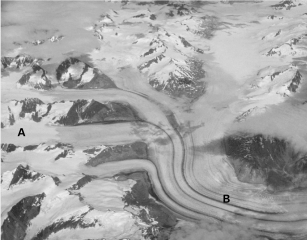
(79) 
The winds that form loess deposits exist because of ____________.
(Multiple Choice)
4.9/5 (81)
(81) Which of these processes contributes the most to the formation of ice-margin lakes?
(Multiple Choice)
4.7/5 (83)
(83) The first scientist to theorize the past presence of glaciers in Europe was ____________.
(Multiple Choice)
4.8/5 (93)
(93) In a glacier,which of the following decreases with increased depth into ice,and/or age of ice?
(Multiple Choice)
4.9/5 (91)
(91) Ice reflects solar radiation (sunlight)very well,whereas water absorbs it.As the Arctic sea ice cover shrinks year after year,what effect will this have on the amount of heat retained in the Arctic?
(Multiple Choice)
4.8/5 (73)
(73) The figure below shows the toe of a glacier.What is the gray feature that is between the two heavy black lines? 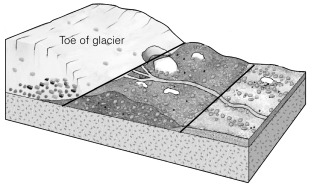
(Multiple Choice)
4.9/5 (65)
(65) In the glacier below,approximately how deep is the transition from brittle to ductile deformation? 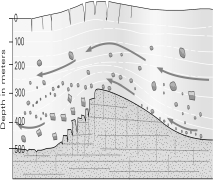
(Multiple Choice)
4.8/5 (79)
(79) The primary reason that glacial till is rarely bedded is that ____________.
(Multiple Choice)
4.8/5 (83)
(83) A glacier will advance from its source area if the rate of accumulation is greater than the rate of ____________.
(Multiple Choice)
4.9/5 (79)
(79) A bowl-shaped depression formed by a mountain glacier is termed a(n)____________.
(Multiple Choice)
4.8/5 (93)
(93) Keeping in mind that ice is a mineral,why can a glacier be considered a metamorphic rock?
(Multiple Choice)
4.9/5 (89)
(89) 
Filters
- Essay(0)
- Multiple Choice(0)
- Short Answer(0)
- True False(0)
- Matching(0)