



 Chat with AI
Exam 9: Crags, cracks, and Crumples: Crustal Deformation and Mountain Building

Exam 1: The Earth in Context71 Questions
Exam 2: The Way the Earth Works: Plate Tectonics125 Questions
Exam 3: Patterns in Nature: Minerals60 Questions
Exam 4: Up From the Inferno: Magma and Igneous Rocks64 Questions
Exam 5: The Wrath of Vulcan: Volcanic Eruptions60 Questions
Exam 6: Pages of Earths Past: Sedimentary Rocks66 Questions
Exam 7: Metamorphism: a Process of Change61 Questions
Exam 8: A Violent Pulse: Earthquakes60 Questions
Exam 9: Crags, cracks, and Crumples: Crustal Deformation and Mountain Building60 Questions
Exam 10: Deep Time: How Old Is Old60 Questions
Exam 11: A Biography of Earth66 Questions
Exam 12: Riches in Rock: Energy and Mineral Resources70 Questions
Exam 13: Unsafe Ground: Landslides and Other Mass Movements60 Questions
Exam 14: Streams and Floods: the Geology of Running Water56 Questions
Exam 15: Restless Realm: Oceans and Coasts57 Questions
Exam 16: A Hidden Reserve: Groundwater54 Questions
Exam 17: Dry Regions: the Geology of Deserts60 Questions
Exam 18: Amazing Ice: Glaciers and Ice Ages60 Questions
Exam 19: Global Change in the Earth System60 Questions
Exam 20: Rock Groups25 Questions
Exam 21: A Surface Veneer: Sediments and Soils25 Questions
Exam 22: The Rock Cycle25 Questions
Exam 23: The Earths Interior Revisited: Insights From Geophysics25 Questions
Exam 24: Memories of Past Life: Fossils and Evolution25 Questions
Exam 25: An Introduction to Landscapes and the Hydrologic Cycle25 Questions
Select questions type


Normal,reverse,and thrust are all examples of ____________ faults.
(Multiple Choice)
4.7/5  (65)
(65) Why do offshore volcanic arcs collide with and suture to an overriding plate?
(Multiple Choice)
4.9/5 (77)
(77) In a ____________ fault,the fault plane is less than 35° from horizontal and the hanging-wall block moves upward relative to the footwall block.
(Multiple Choice)
4.7/5 (86)
(86) Earthquakes only occur ____________ the brittle/ductile transition depth.
(Multiple Choice)
4.7/5 (86)
(86) Regions of continents that have not been subjected to orogeny during the past one billion years are termed ____________.
(Multiple Choice)
4.7/5 (74)
(74) In order to maintain isostasy,what must occur after new igneous rock is added to the crust (either on top of or intruded into)?
(Multiple Choice)
4.8/5 (67)
(67) Within a platform,sedimentary rocks always have a horizontal orientation.
(True/False)
4.7/5 (91)
(91) Nearly all of the present mountain ranges are the products of single orogenic events.
(True/False)
5.0/5 (75)
(75) Mt.Everest,the tallest mountain above sea level,is located on the continent of ____________.
(Multiple Choice)
4.8/5 (61)
(61) Why are blocks of wood floating in water a good analogy for mountains floating on the asthenosphere?
(Multiple Choice)
4.8/5 (87)
(87) Why might a geologist looking at exposed rock determine that the rock is undeformed?
(Multiple Choice)
4.9/5 (72)
(72) It is possible for offset along an oblique-slip fault to have both ____________ and ____________ components.
(Multiple Choice)
4.9/5 (77)
(77) On a geologic map,if the contacts between sedimentary rock units form a series of parallel lines,with the youngest unit in the center,the underlying structure is a(n)____________. 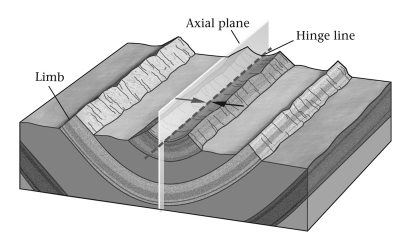
(Multiple Choice)
5.0/5 (91)
(91) Regions where Precambrian metamorphic rocks are exposed at the surface are termed ____________.
(Multiple Choice)
4.9/5 (85)
(85) Continental crust is typically 35 km thick,but may be up to ____________ thicker under mountain ranges.
(Multiple Choice)
4.9/5 (84)
(84) A geologist's compass differs from the more widely known orienteering compass in that the geologist's compass ____________. 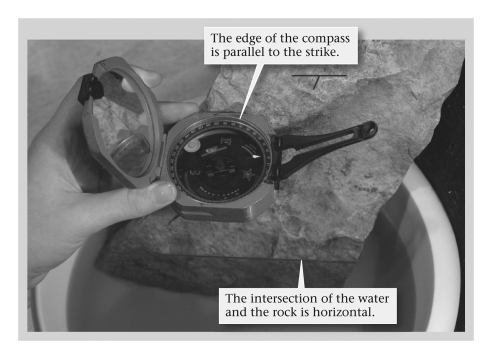
(Multiple Choice)
4.8/5 (79)
(79) A body of rock affected by tensile stress will likely undergo ____________.
(Multiple Choice)
4.9/5 (85)
(85) 
Filters
- Essay(0)
- Multiple Choice(0)
- Short Answer(0)
- True False(0)
- Matching(0)