



 Chat with AI
Exam 2: The Way the Earth Works: Plate Tectonics

Exam 1: The Earth in Context71 Questions
Exam 2: The Way the Earth Works: Plate Tectonics125 Questions
Exam 3: Patterns in Nature: Minerals60 Questions
Exam 4: Up From the Inferno: Magma and Igneous Rocks64 Questions
Exam 5: The Wrath of Vulcan: Volcanic Eruptions60 Questions
Exam 6: Pages of Earths Past: Sedimentary Rocks66 Questions
Exam 7: Metamorphism: a Process of Change61 Questions
Exam 8: A Violent Pulse: Earthquakes60 Questions
Exam 9: Crags, cracks, and Crumples: Crustal Deformation and Mountain Building60 Questions
Exam 10: Deep Time: How Old Is Old60 Questions
Exam 11: A Biography of Earth66 Questions
Exam 12: Riches in Rock: Energy and Mineral Resources70 Questions
Exam 13: Unsafe Ground: Landslides and Other Mass Movements60 Questions
Exam 14: Streams and Floods: the Geology of Running Water56 Questions
Exam 15: Restless Realm: Oceans and Coasts57 Questions
Exam 16: A Hidden Reserve: Groundwater54 Questions
Exam 17: Dry Regions: the Geology of Deserts60 Questions
Exam 18: Amazing Ice: Glaciers and Ice Ages60 Questions
Exam 19: Global Change in the Earth System60 Questions
Exam 20: Rock Groups25 Questions
Exam 21: A Surface Veneer: Sediments and Soils25 Questions
Exam 22: The Rock Cycle25 Questions
Exam 23: The Earths Interior Revisited: Insights From Geophysics25 Questions
Exam 24: Memories of Past Life: Fossils and Evolution25 Questions
Exam 25: An Introduction to Landscapes and the Hydrologic Cycle25 Questions
Select questions type


The lithosphere of the Earth is generally thinnest at and near ____________ plate boundaries.
(Multiple Choice)
4.8/5  (75)
(75) At a transform-plate boundary (shown below),two opposed plates ____________. 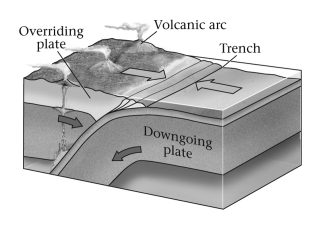
(Multiple Choice)
4.9/5 (92)
(92) According to the figure below,the Earth's magnetic reversals are likely due to ______________. 
(Multiple Choice)
4.8/5 (81)
(81) The oldest oceanic crust is approximately ____________ years old. 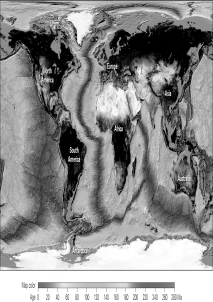
(Multiple Choice)
4.9/5 (71)
(71) Continental coastlines that occur within the interior of a tectonic plate are called ____________.
(Multiple Choice)
4.9/5 (81)
(81) Consult the figure below.The Wadati-Benioff zone is a belt of earthquakes found ____________. 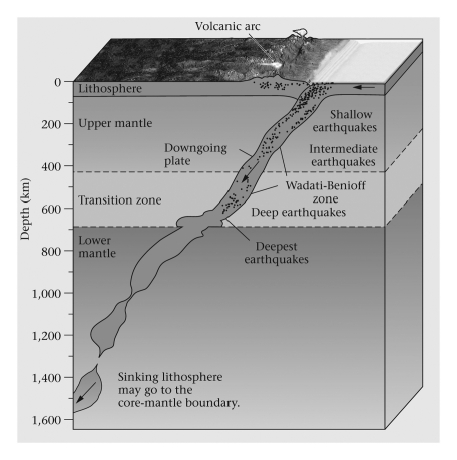
(Multiple Choice)
5.0/5 (74)
(74) Consult the figure below.Abundant swamps led to the formation of coal during the Late Paleozoic in which of the following places? 
(Multiple Choice)
4.8/5 (90)
(90) A great boost in sea-floor exploration and a greater understanding of sea-floor bathymetry were a result of _______________.
(Multiple Choice)
4.9/5 (69)
(69) Evidence of paleomagnetism can be found in _________________.
(Multiple Choice)
5.0/5 (76)
(76) Slab pull occurs because subducting slabs are ____________.
(Multiple Choice)
4.9/5 (81)
(81) Marine magnetic anomalies result from sea-floor spreading in conjunction with ____________.
(Multiple Choice)
4.9/5 (74)
(74) As lithosphere cools to the sides of a mid-ocean ridge,it begins to ____________.
(Multiple Choice)
4.8/5 (70)
(70) The term and concept of sea-floor spreading (see figure below)was developed by _____________. 
(Multiple Choice)
4.8/5 (83)
(83) The apparent tendency of the north (or south)magnetic pole to vary in position over time is termed ____________.
(Multiple Choice)
4.8/5 (76)
(76) Consult the figure below.Marine magnetic anomaly belts are widest when and where ____________. 
(Multiple Choice)
4.9/5 (77)
(77) Which of the following would NOT render the volcanoes on Hawaii's big island inactive?
(Multiple Choice)
4.9/5 (82)
(82) Deep-ocean trenches are found predominantly along the perimeter of the _____________ and can reach depths up to ____________,deep enough to swallow Mt.Everest.
(Multiple Choice)
4.9/5 (91)
(91) 
Filters
- Essay(0)
- Multiple Choice(0)
- Short Answer(0)
- True False(0)
- Matching(0)