



 Chat with AI
Exam 56: Conservation Biology and Global Change

Exam 1: Introduction: Evolution and Themes of Biology70 Questions
Exam 2: The Chemical Context of Life90 Questions
Exam 3: Water and Life80 Questions
Exam 4: Carbon and the Molecular Diversity of Life78 Questions
Exam 5: The Structure and Function of Large Biological Molecules117 Questions
Exam 6: A Tour of the Cell96 Questions
Exam 7: Membrane Structure and Function78 Questions
Exam 8: An Introduction to Metabolism88 Questions
Exam 9: Cellular Respiration and Fermentation117 Questions
Exam 10: Photosynthesis89 Questions
Exam 11: Cell Communication77 Questions
Exam 12: The Cell Cycle83 Questions
Exam 13: Meiosis and Sexual Life Cycles74 Questions
Exam 14: Mendel and the Gene Idea82 Questions
Exam 15: The Chromosomal Basis of Inheritance66 Questions
Exam 16: The Molecular Basis of Inheritance67 Questions
Exam 17: From Gene to Protein91 Questions
Exam 18: Regulation of Gene Expression107 Questions
Exam 19: Viruses53 Questions
Exam 20: Dna Tools and Biotechnology72 Questions
Exam 21: Genomes and Their Evolution52 Questions
Exam 22: Descent With Modification: a Darwinian View of Life63 Questions
Exam 23: The Evolution of Populations86 Questions
Exam 24: The Origin of Species71 Questions
Exam 25: The History of Life on Earth83 Questions
Exam 26: Phylogeny and the Tree of Life81 Questions
Exam 27: Bacteria and Archaea86 Questions
Exam 28: Protists84 Questions
Exam 29: Plant Diversity I: How Plants Colonized Land82 Questions
Exam 30: Plant Diversity Ii: the Evolution of Seed Plants110 Questions
Exam 31: Fungi97 Questions
Exam 32: An Overview of Animal Diversity82 Questions
Exam 33: An Introduction to Invertebrates101 Questions
Exam 34: The Origin and Evolution of Vertebrates117 Questions
Exam 35: Plant Structure, Growth, and Development75 Questions
Exam 36: Resource Acquisition and Transport in Vascular Plants89 Questions
Exam 37: Soil and Plant Nutrition91 Questions
Exam 38: Angiosperm Reproduction and Biotechnology94 Questions
Exam 39: Plant Responses to Internal and External Signals116 Questions
Exam 40: Basic Principles of Animal Form and Function86 Questions
Exam 41: Animal Nutrition73 Questions
Exam 42: Circulation and Gas Exchange100 Questions
Exam 43: The Immune System110 Questions
Exam 44: Osmoregulation and Excretion79 Questions
Exam 45: Hormones and the Endocrine System82 Questions
Exam 46: Animal Reproduction104 Questions
Exam 47: Animal Development98 Questions
Exam 48: Neurons, Synapses, and Signalling81 Questions
Exam 49: Nervous Systems73 Questions
Exam 50: Sensory and Motor Mechanisms91 Questions
Exam 51: Animal Behaviour79 Questions
Exam 52: An Introduction to Ecology and the Biosphere81 Questions
Exam 53: Population Ecology87 Questions
Exam 54: Community Ecology85 Questions
Exam 55: Ecosystems and Restoration Ecology89 Questions
Exam 56: Conservation Biology and Global Change75 Questions
Select questions type


What term did E. O. Wilson coin for our innate appreciation of wild environments and living organisms?
(Multiple Choice)
4.8/5  (64)
(64) One characteristic that distinguishes a population in an extinction vortex from most other populations is that
(Multiple Choice)
4.9/5 (80)
(80) The word triage originated during World War I and was first used by French doctors in prioritizing patients based on the severity of their wounds, because there were more wounded soldiers in need of urgent care than there were resources to treat them. Conservation biologists have to make similar determinations with degraded ecosystems. Which of the following is the most important consideration when it comes to managing for maintenance of biodiversity?
(Multiple Choice)
4.9/5 (64)
(64) To better comprehend the magnitude of current extinctions, it will be necessary to
(Multiple Choice)
4.8/5 (82)
(82) Which of the following nations has become a world leader in the establishment of zoned reserves?
(Multiple Choice)
4.8/5 (78)
(78) Which of the following groups is most threatened by global extinctions?
(Multiple Choice)
4.8/5 (84)
(84) Use the following figure to answer the questions below.
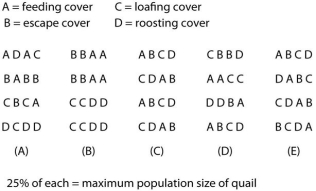 -Study the information above about quail habitats. Which of these represents the best quail habitat in terms of fragmentation and edge?
 (Multiple Choice)
4.8/5 (83)
(83) Suppose you attend a town meeting at which some experts tell the audience that they have performed a cost-benefit analysis of a proposed transit system that would probably reduce overall air pollution and fossil fuel consumption. The analysis, however, reveals that ticket prices will not cover the cost of operating the system when fuel, wages, and equipment are taken into account. As a biologist, you know that if ecosystem services had been included in the analysis the experts might have arrived at a different answer. Why are ecosystem services rarely included in economic analyses?
(Multiple Choice)
4.9/5 (80)
(80) Agricultural lands frequently require nutrient augmentation because
(Multiple Choice)
4.9/5 (83)
(83) We should care about loss in biodiversity in the populations of other species because of
(Multiple Choice)
5.0/5 (64)
(64) According to the U.S. Endangered Species Act (ESA), the difference between an endangered species and a threatened one is that
(Multiple Choice)
4.8/5 (74)
(74) For the following questions, match the statement with the appropriate term/phrase.
-This is caused by excessive nutrient runoff into aquatic ecosystems.
(Multiple Choice)
4.9/5 (71)
(71) If the sex ratio in a population is significantly different from 50:50, then which of the following will always be true?
(Multiple Choice)
4.7/5 (84)
(84) Which of the following strategies would most rapidly increase the genetic diversity of a population in an extinction vortex?
(Multiple Choice)
4.8/5 (76)
(76) Which of the following is consistent with forest fragmentation research?
(Multiple Choice)
4.8/5 (89)
(89) The primary difference between the small-population approach (S-PA)and the declining-population approach (D-PA)to biodiversity recovery is
(Multiple Choice)
4.8/5 (90)
(90) 
Filters
- Essay(0)
- Multiple Choice(0)
- Short Answer(0)
- True False(0)
- Matching(0)