



 Chat with AI
Exam 25: The History of Life on Earth

Exam 1: Introduction: Evolution and Themes of Biology70 Questions
Exam 2: The Chemical Context of Life90 Questions
Exam 3: Water and Life80 Questions
Exam 4: Carbon and the Molecular Diversity of Life78 Questions
Exam 5: The Structure and Function of Large Biological Molecules117 Questions
Exam 6: A Tour of the Cell96 Questions
Exam 7: Membrane Structure and Function78 Questions
Exam 8: An Introduction to Metabolism88 Questions
Exam 9: Cellular Respiration and Fermentation117 Questions
Exam 10: Photosynthesis89 Questions
Exam 11: Cell Communication77 Questions
Exam 12: The Cell Cycle83 Questions
Exam 13: Meiosis and Sexual Life Cycles74 Questions
Exam 14: Mendel and the Gene Idea82 Questions
Exam 15: The Chromosomal Basis of Inheritance66 Questions
Exam 16: The Molecular Basis of Inheritance67 Questions
Exam 17: From Gene to Protein91 Questions
Exam 18: Regulation of Gene Expression107 Questions
Exam 19: Viruses53 Questions
Exam 20: Dna Tools and Biotechnology72 Questions
Exam 21: Genomes and Their Evolution52 Questions
Exam 22: Descent With Modification: a Darwinian View of Life63 Questions
Exam 23: The Evolution of Populations86 Questions
Exam 24: The Origin of Species71 Questions
Exam 25: The History of Life on Earth83 Questions
Exam 26: Phylogeny and the Tree of Life81 Questions
Exam 27: Bacteria and Archaea86 Questions
Exam 28: Protists84 Questions
Exam 29: Plant Diversity I: How Plants Colonized Land82 Questions
Exam 30: Plant Diversity Ii: the Evolution of Seed Plants110 Questions
Exam 31: Fungi97 Questions
Exam 32: An Overview of Animal Diversity82 Questions
Exam 33: An Introduction to Invertebrates101 Questions
Exam 34: The Origin and Evolution of Vertebrates117 Questions
Exam 35: Plant Structure, Growth, and Development75 Questions
Exam 36: Resource Acquisition and Transport in Vascular Plants89 Questions
Exam 37: Soil and Plant Nutrition91 Questions
Exam 38: Angiosperm Reproduction and Biotechnology94 Questions
Exam 39: Plant Responses to Internal and External Signals116 Questions
Exam 40: Basic Principles of Animal Form and Function86 Questions
Exam 41: Animal Nutrition73 Questions
Exam 42: Circulation and Gas Exchange100 Questions
Exam 43: The Immune System110 Questions
Exam 44: Osmoregulation and Excretion79 Questions
Exam 45: Hormones and the Endocrine System82 Questions
Exam 46: Animal Reproduction104 Questions
Exam 47: Animal Development98 Questions
Exam 48: Neurons, Synapses, and Signalling81 Questions
Exam 49: Nervous Systems73 Questions
Exam 50: Sensory and Motor Mechanisms91 Questions
Exam 51: Animal Behaviour79 Questions
Exam 52: An Introduction to Ecology and the Biosphere81 Questions
Exam 53: Population Ecology87 Questions
Exam 54: Community Ecology85 Questions
Exam 55: Ecosystems and Restoration Ecology89 Questions
Exam 56: Conservation Biology and Global Change75 Questions
Select questions type


The following questions refer to the paragraph below.
A sediment core is removed from the floor of an inland sea. The sea has been in existence, off and on, throughout the entire time that terrestrial life has existed. Researchers wish to locate and study the terrestrial organisms fossilized in this core. The core is illustrated as a vertical column, with the top of the column representing the most recent strata and the bottom representing the time when land was first colonized by life.
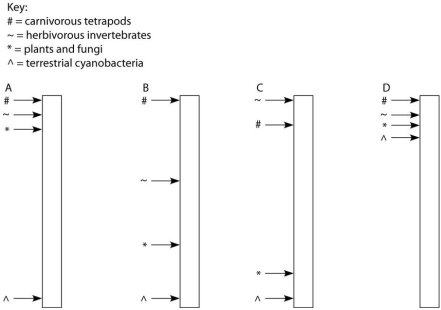 -If arrows indicate locations in the column where fossils of a particular type (see key above)first appear, then which core in the figure has the most accurate arrangement of fossils?
 (Multiple Choice)
4.9/5  (57)
(57) The following questions refer to the description below.
All animals with eyes or eyespots that have been studied so far share a gene in common. When mutated, the gene Pax-6 causes lack of eyes in fruit flies, tiny eyes in mice, and missing irises (and other eye parts) in humans. The sequence of Pax-6 in humans and mice is identical. There are so few sequence differences with fruit fly Pax-6 that the human/mouse version can cause eye formation in eyeless fruit flies, even though vertebrates and invertebrates last shared a common ancestor more than 500 million years ago.
-Fruit fly eyes are of the compound type, which is structurally very different from the camera-type eyes of mammals. Even the camera-type eyes of molluscs, such as octopi, are structurally quite different from those of mammals. Yet, fruit flies, octopi, and mammals possess very similar versions of Pax-6. The fact that the same gene helps produce very different types of eyes is most likely due to
(Multiple Choice)
4.9/5 (72)
(72) The snowball Earth hypothesis provides a possible explanation for the
(Multiple Choice)
4.7/5 (85)
(85) Use the following information to answer the questions below.
The following questions are based on the observation that several dozen different proteins comprise the prokaryotic flagellum and its attachment to the prokaryotic cell, producing a highly complex structure.
-Certain proteins of the complex motor that drives bacterial flagella are modified versions of proteins that had previously belonged to plasma membrane pumps. This evidence supports the claim that
(Multiple Choice)
4.9/5 (73)
(73) If the half-life of carbon-14 is about 5730 years, then a fossil that has one-sixteenth the normal proportion of carbon-14 to carbon-12 should be about how many years old?
(Multiple Choice)
4.8/5 (90)
(90) The following questions refer to the description below.
You were asked to give a presentation about fossils to a group of young students. You tell the students that the fossil record shows how organisms can change over time, but unfortunately the fossil record is incomplete. After your talk a student tells you that his pet salamander has died and he wants his salamander to be fossilized. The boy plans to lay his salamander on the grass and cover the salamander's body with leaves and twigs. You had told the class that a critical step in the fossilization process is the burial of an organism.
-Another student asks you why the fossil record is incomplete. Which statement(s)below provide the most likely explanation?
(Multiple Choice)
4.7/5 (76)
(76) Fossil evidence indicates that several kinds of flightless dinosaurs possessed feathers. If some of these feather-bearing dinosaurs incubated clutches of eggs in carefully constructed nests, this might be evidence supporting the claim that
(Multiple Choice)
4.9/5 (95)
(95) The following questions refer to the description and figure below.
The figure represents a cross section of the sea floor through a mid-ocean rift valley, with alternating patches of black and white indicating sea floor with reversed magnetic polarities. At the arrow labelled "I" (the rift valley), the igneous rock of the sea floor is so young that it can be accurately dated using carbon-14 dating. At the arrow labeled "III," however, the igneous rock is about 1 million years old, and potassium-40 dating is typically used to date such rocks. Note: The horizontal arrows indicate the direction of sea-floor spreading, away from the rift valley.
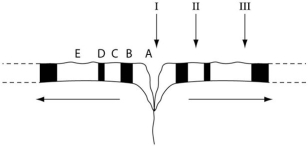 -Assuming that the rate of sea-floor spreading was constant during the 1-million-year period depicted above, what should be the approximate age of marine fossils found in undisturbed sedimentary rock immediately overlying the igneous rock at the arrow labelled "II"?
 (Multiple Choice)
4.7/5 (69)
(69) Adaptive radiations can be a direct consequence of four of the following five factors. Select the exception.
(Multiple Choice)
4.8/5 (91)
(91) Use the following figure to answer the questions below.
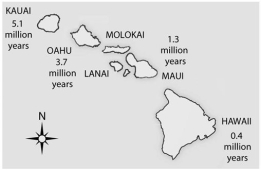 -Soon after the island of Hawaii rose above the sea surface (somewhat less than 1 million years ago), the evolution of life on this new island should have been most strongly influenced by
 (Multiple Choice)
4.9/5 (74)
(74) Which of these observations gives the most support to the endosymbiotic theory for the origin of eukaryotic cells?
(Multiple Choice)
4.8/5 (84)
(84) How were conditions on the early Earth of more than 3 billion years ago different from those on today's Earth?
(Multiple Choice)
4.8/5 (85)
(85) In the 5-7 million years that the hominid lineage has been diverging from its common ancestor with the great apes, dozens of hominid species have arisen, often with several species coexisting in time and space. As recently as 30000 years ago, Homo sapiens coexisted with Homo neanderthalensis. Both species had large brains and advanced intellects. The fact that these traits were common to both species is most easily explained by which of the following?
(Multiple Choice)
4.8/5 (87)
(87) The following questions refer to the description below.
You were asked to give a presentation about fossils to a group of young students. You tell the students that the fossil record shows how organisms can change over time, but unfortunately the fossil record is incomplete. After your talk a student tells you that his pet salamander has died and he wants his salamander to be fossilized. The boy plans to lay his salamander on the grass and cover the salamander's body with leaves and twigs. You had told the class that a critical step in the fossilization process is the burial of an organism.
-Which of the statement(s)below lends support to your claim about the fossilization process?
(Multiple Choice)
4.8/5 (84)
(84) What is thought to be the correct sequence of these events, from earliest to most recent, in the evolution of life on Earth? 1. origin of mitochondria
2. origin of multicellular eukaryotes
3. origin of chloroplasts
4. origin of cyanobacteria
5. origin of fungal-plant symbioses
(Multiple Choice)
4.9/5 (86)
(86) What evidence strongly suggests that RNA instead of DNA was the first genetic material?
(Multiple Choice)
4.8/5 (90)
(90) The following questions refer to this hypothetical situation.
A female fly, full of fertilized eggs, is swept by high winds to an island far out to sea. She is the first fly to arrive on this island, and the only fly to arrive in this way. Thousands of years later, her numerous offspring occupy the island, but none of them resembles her. There are, instead, several species, each of which eats only a certain type of food. None of the species can fly, for their flight wings are absent, and their balancing organs (in other words, halteres) are now used in courtship displays. The male members of each species bear modified halteres that are unique in appearance to their species. Females bear vestigial halteres. The ranges of all of the daughter species overlap.
-Which of these fly organs, as they exist in current fly populations, best fits the description of an exaptation?
(Multiple Choice)
4.8/5 (79)
(79) The following questions refer to the paragraph below.
A sediment core is removed from the floor of an inland sea. The sea has been in existence, off and on, throughout the entire time that terrestrial life has existed. Researchers wish to locate and study the terrestrial organisms fossilized in this core. The core is illustrated as a vertical column, with the top of the column representing the most recent strata and the bottom representing the time when land was first colonized by life.
-Which of the following reasons may explain why the sediment core lacks fossils of dragonflies with 3-feet wingspans? 1. This particular sediment core includes the correct stratum, but the part of the stratum captured by the core lacks such fossils.
2. The sea was not present at this site during the time that 3-feet dragonflies existed.
3. Dragonflies have no hard parts, such as exoskeletons, to fossilize.
4. The sediments containing these fossils at this site may have been eroded away during a time when the sea had receded from this site.
5. Dragonflies are terrestrial; therefore, fossils of terrestrial organisms should not be expected in the sediments of seas.
-Which of the following reasons may explain why the sediment core lacks fossils of dragonflies with 3-feet wingspans? 1. This particular sediment core includes the correct stratum, but the part of the stratum captured by the core lacks such fossils.
2. The sea was not present at this site during the time that 3-feet dragonflies existed.
3. Dragonflies have no hard parts, such as exoskeletons, to fossilize.
4. The sediments containing these fossils at this site may have been eroded away during a time when the sea had receded from this site.
5. Dragonflies are terrestrial; therefore, fossils of terrestrial organisms should not be expected in the sediments of seas. (Multiple Choice)
4.8/5 (73)
(73) Several scientific laboratories across the globe are involved in research concerning the origin of life on Earth. Which graph below, if the results were produced abiotically, would have the greatest promise for revealing important information about the origin of Earth's first genetic system?
(Multiple Choice)
4.8/5 (69)
(69) 
Filters
- Essay(0)
- Multiple Choice(0)
- Short Answer(0)
- True False(0)
- Matching(0)