



 Chat with AI
Exam 19: Viruses

Exam 1: Introduction: Evolution and Themes of Biology70 Questions
Exam 2: The Chemical Context of Life90 Questions
Exam 3: Water and Life80 Questions
Exam 4: Carbon and the Molecular Diversity of Life78 Questions
Exam 5: The Structure and Function of Large Biological Molecules117 Questions
Exam 6: A Tour of the Cell96 Questions
Exam 7: Membrane Structure and Function78 Questions
Exam 8: An Introduction to Metabolism88 Questions
Exam 9: Cellular Respiration and Fermentation117 Questions
Exam 10: Photosynthesis89 Questions
Exam 11: Cell Communication77 Questions
Exam 12: The Cell Cycle83 Questions
Exam 13: Meiosis and Sexual Life Cycles74 Questions
Exam 14: Mendel and the Gene Idea82 Questions
Exam 15: The Chromosomal Basis of Inheritance66 Questions
Exam 16: The Molecular Basis of Inheritance67 Questions
Exam 17: From Gene to Protein91 Questions
Exam 18: Regulation of Gene Expression107 Questions
Exam 19: Viruses53 Questions
Exam 20: Dna Tools and Biotechnology72 Questions
Exam 21: Genomes and Their Evolution52 Questions
Exam 22: Descent With Modification: a Darwinian View of Life63 Questions
Exam 23: The Evolution of Populations86 Questions
Exam 24: The Origin of Species71 Questions
Exam 25: The History of Life on Earth83 Questions
Exam 26: Phylogeny and the Tree of Life81 Questions
Exam 27: Bacteria and Archaea86 Questions
Exam 28: Protists84 Questions
Exam 29: Plant Diversity I: How Plants Colonized Land82 Questions
Exam 30: Plant Diversity Ii: the Evolution of Seed Plants110 Questions
Exam 31: Fungi97 Questions
Exam 32: An Overview of Animal Diversity82 Questions
Exam 33: An Introduction to Invertebrates101 Questions
Exam 34: The Origin and Evolution of Vertebrates117 Questions
Exam 35: Plant Structure, Growth, and Development75 Questions
Exam 36: Resource Acquisition and Transport in Vascular Plants89 Questions
Exam 37: Soil and Plant Nutrition91 Questions
Exam 38: Angiosperm Reproduction and Biotechnology94 Questions
Exam 39: Plant Responses to Internal and External Signals116 Questions
Exam 40: Basic Principles of Animal Form and Function86 Questions
Exam 41: Animal Nutrition73 Questions
Exam 42: Circulation and Gas Exchange100 Questions
Exam 43: The Immune System110 Questions
Exam 44: Osmoregulation and Excretion79 Questions
Exam 45: Hormones and the Endocrine System82 Questions
Exam 46: Animal Reproduction104 Questions
Exam 47: Animal Development98 Questions
Exam 48: Neurons, Synapses, and Signalling81 Questions
Exam 49: Nervous Systems73 Questions
Exam 50: Sensory and Motor Mechanisms91 Questions
Exam 51: Animal Behaviour79 Questions
Exam 52: An Introduction to Ecology and the Biosphere81 Questions
Exam 53: Population Ecology87 Questions
Exam 54: Community Ecology85 Questions
Exam 55: Ecosystems and Restoration Ecology89 Questions
Exam 56: Conservation Biology and Global Change75 Questions
Select questions type


Which of the following statements describes the lysogenic cycle of lambda (λ)phage?
(Multiple Choice)
4.9/5  (79)
(79) Which of the following is the best predictor of how much damage a virus causes?
(Multiple Choice)
4.8/5 (87)
(87) Refer to the treatments listed below to answer the following questions.
You isolate an infectious substance that is capable of causing disease in plants, but you do not know whether the infectious agent is a bacterium, virus, viroid, or prion. You have four methods at your disposal that you can use to analyze the substance in order to determine the nature of the infectious agent.
I. treating the substance with nucleases that destroy all nucleic acids and then determining whether it is still infectious
II. filtering the substance to remove all elements smaller than what can be easily seen under a light microscope
III. culturing the substance by itself on nutritive medium, away from any plant cells
IV. treating the sample with proteases that digest all proteins and then determining whether it is still infectious
-Which treatment would you use to determine if the agent is a prion?
(Multiple Choice)
4.8/5 (83)
(83) A bacterium is infected with an experimentally constructed bacteriophage composed of the T2 phage protein coat and T4 phage DNA. The new phages produced would have
(Multiple Choice)
5.0/5 (82)
(82) Use the following figure to answer the questions below.
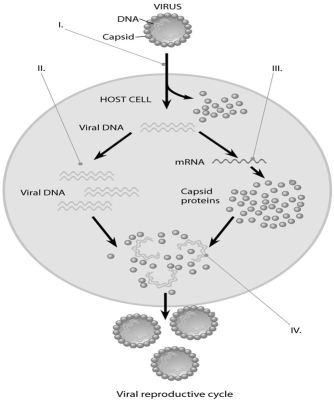 -In the figure, when new viruses are being assembled (IV), what mediates the assembly?
 (Multiple Choice)
4.8/5 (81)
(81) In many ways, the regulation of the genes of a particular group of viruses will be similar to the regulation of the host genes. Therefore, which of the following would you expect of the genes of the bacteriophage?
(Multiple Choice)
4.8/5 (69)
(69) Use the following information to answer the questions below.
Throughout history, human populations have been impacted by viral outbreaks. In the past 100 years we have seen several devastating epidemics and pandemics that have put people at risk. Worldwide, annual seasonal flu epidemics result in about three to five million cases of severe illness, and about 250 000 to 500 000 deaths annually. Most deaths associated with seasonal influenza in industrialized countries occur among people age 65 or older.
In 2009, a new strain of influenza, H1N1, entered the global scene. Within the year it had spread to 207 countries, infected 600 000 people, and killed 8000 worldwide. The pandemic alert was raised and a coordinated, concerted effort around the world was implemented to bring this flu under control. H1N1 is most likely a variation of the Spanish flu (also called H1N1); this flu was responsible for over 40 million deaths worldwide in the pandemic of 1918 (killing over 2.5% of the entire human population in one year).
-Which of the following characteristics, structures, or processes is common to both bacteria and viruses?
(Multiple Choice)
4.9/5 (91)
(91) Use the following information to answer the questions below.
Some viruses can be crystallized and their structures analyzed. One such virus is Desmodium, or yellow mottle virus, which infects beans. This is a member of the tymovirus group and has a single-stranded RNA genome of ~6300 nucleotides. Its virion is 25-30 nm in diameter, and is made up of 180 copies of a single capsid protein that self-associate to form each capsomere, which has icosahedral symmetry with 20 facets.
-In a cell-free system, what other components would you have to provide for this virus to express its genes?
(Multiple Choice)
4.8/5 (80)
(80) Use the following information to answer the next few questions.
Poliovirus is a positive-sense RNA virus of the picornavirus group. At its 5' end, the RNA genome has a viral protein (VPg) instead of a 5' cap. This is followed by a nontranslated leader sequence, and then a single long protein coding region (~7000 nucleotides), followed by a poly-A tail. Observations were made that used radioactive amino acid analogues. Short-period use of the radioactive amino acids result in labelling of only very long proteins, while longer periods of labelling result in several different short polypeptides.
-What conclusion is most consistent with the results of the radioactive labelling experiment?
(Multiple Choice)
4.8/5 (74)
(74) Use the following information to answer the few questions.
The herpes viruses are very important enveloped DNA viruses that cause disease in all vertebrate species and in some invertebrates such as oysters. Some of the human ones are herpes simplex (HSV) I and II, causing facial and genital lesions, and the varicella-zoster (VSV), causing chicken pox and shingles. Each of these three actively infect nervous tissue. Primary infections are fairly mild, but the virus is not then cleared from the host; rather, viral genomes are maintained in cells in a latent phase. The virus can then reactivate, replicate again, and be infectious to others.
-In electron micrographs of HSV infection, it can be seen that the intact virus initially reacts with cell surface proteoglycans, then with specific receptors. This is later followed by viral capsids docking with nuclear pores. Afterward, the capsids go from being full to being "empty." Which of the following best fits these observations?
(Multiple Choice)
4.9/5 (94)
(94) Viral genomes vary greatly in size and may include from four genes to several hundred genes. Which of the following viral features is most apt to correlate with the size of the genome?
(Multiple Choice)
4.9/5 (73)
(73) The spread of viral disease in a human population occurs through which means?
(Multiple Choice)
4.9/5 (89)
(89) Which of the following accounts for someone who has had a herpesvirus-mediated cold sore or genital sore getting flare-ups for the rest of his or her life?
(Multiple Choice)
4.8/5 (82)
(82) Most molecular biologists think that viruses originated from fragments of cellular nucleic acid. Which of the following observations supports this theory?
(Multiple Choice)
4.9/5 (76)
(76) Antiviral drugs that have become useful are usually associated with which of the following properties?
(Multiple Choice)
4.8/5 (65)
(65) The country or region hit hardest during the outbreak of SARS in 2002-2003 was
(Multiple Choice)
4.8/5 (75)
(75) The SARS outbreak in 2003 resulted in ________ deaths in Canada.
(Multiple Choice)
4.7/5 (70)
(70) Use the following information to answer the questions below.
Throughout history, human populations have been impacted by viral outbreaks. In the past 100 years we have seen several devastating epidemics and pandemics that have put people at risk. Worldwide, annual seasonal flu epidemics result in about three to five million cases of severe illness, and about 250 000 to 500 000 deaths annually. Most deaths associated with seasonal influenza in industrialized countries occur among people age 65 or older.
In 2009, a new strain of influenza, H1N1, entered the global scene. Within the year it had spread to 207 countries, infected 600 000 people, and killed 8000 worldwide. The pandemic alert was raised and a coordinated, concerted effort around the world was implemented to bring this flu under control. H1N1 is most likely a variation of the Spanish flu (also called H1N1); this flu was responsible for over 40 million deaths worldwide in the pandemic of 1918 (killing over 2.5% of the entire human population in one year).
-With H1N1, most deaths occurred under the age of 65. Why might this have been the case?
(Multiple Choice)
4.8/5 (81)
(81) To cause a human pandemic, the H5N1 avian flu virus would have to
(Multiple Choice)
4.7/5 (74)
(74) 
Filters
- Essay(0)
- Multiple Choice(0)
- Short Answer(0)
- True False(0)
- Matching(0)