



 Chat with AI
Exam 13: Meiosis and Sexual Life Cycles

Exam 1: Introduction: Evolution and Themes of Biology70 Questions
Exam 2: The Chemical Context of Life90 Questions
Exam 3: Water and Life80 Questions
Exam 4: Carbon and the Molecular Diversity of Life78 Questions
Exam 5: The Structure and Function of Large Biological Molecules117 Questions
Exam 6: A Tour of the Cell96 Questions
Exam 7: Membrane Structure and Function78 Questions
Exam 8: An Introduction to Metabolism88 Questions
Exam 9: Cellular Respiration and Fermentation117 Questions
Exam 10: Photosynthesis89 Questions
Exam 11: Cell Communication77 Questions
Exam 12: The Cell Cycle83 Questions
Exam 13: Meiosis and Sexual Life Cycles74 Questions
Exam 14: Mendel and the Gene Idea82 Questions
Exam 15: The Chromosomal Basis of Inheritance66 Questions
Exam 16: The Molecular Basis of Inheritance67 Questions
Exam 17: From Gene to Protein91 Questions
Exam 18: Regulation of Gene Expression107 Questions
Exam 19: Viruses53 Questions
Exam 20: Dna Tools and Biotechnology72 Questions
Exam 21: Genomes and Their Evolution52 Questions
Exam 22: Descent With Modification: a Darwinian View of Life63 Questions
Exam 23: The Evolution of Populations86 Questions
Exam 24: The Origin of Species71 Questions
Exam 25: The History of Life on Earth83 Questions
Exam 26: Phylogeny and the Tree of Life81 Questions
Exam 27: Bacteria and Archaea86 Questions
Exam 28: Protists84 Questions
Exam 29: Plant Diversity I: How Plants Colonized Land82 Questions
Exam 30: Plant Diversity Ii: the Evolution of Seed Plants110 Questions
Exam 31: Fungi97 Questions
Exam 32: An Overview of Animal Diversity82 Questions
Exam 33: An Introduction to Invertebrates101 Questions
Exam 34: The Origin and Evolution of Vertebrates117 Questions
Exam 35: Plant Structure, Growth, and Development75 Questions
Exam 36: Resource Acquisition and Transport in Vascular Plants89 Questions
Exam 37: Soil and Plant Nutrition91 Questions
Exam 38: Angiosperm Reproduction and Biotechnology94 Questions
Exam 39: Plant Responses to Internal and External Signals116 Questions
Exam 40: Basic Principles of Animal Form and Function86 Questions
Exam 41: Animal Nutrition73 Questions
Exam 42: Circulation and Gas Exchange100 Questions
Exam 43: The Immune System110 Questions
Exam 44: Osmoregulation and Excretion79 Questions
Exam 45: Hormones and the Endocrine System82 Questions
Exam 46: Animal Reproduction104 Questions
Exam 47: Animal Development98 Questions
Exam 48: Neurons, Synapses, and Signalling81 Questions
Exam 49: Nervous Systems73 Questions
Exam 50: Sensory and Motor Mechanisms91 Questions
Exam 51: Animal Behaviour79 Questions
Exam 52: An Introduction to Ecology and the Biosphere81 Questions
Exam 53: Population Ecology87 Questions
Exam 54: Community Ecology85 Questions
Exam 55: Ecosystems and Restoration Ecology89 Questions
Exam 56: Conservation Biology and Global Change75 Questions
Select questions type


Which of the following is an example of alternation of generations?
(Multiple Choice)
4.9/5  (90)
(90) Use the following information to answer the next questions.
There is a group of invertebrate animals called rotifers, among which a particular group of species reproduces, as far as is known, only asexually. These rotifers, however, have survived a long evolutionary history without evidence of having been overcome by excessive mutations.
-Since the rotifers develop from eggs, but asexually, what can you predict?
(Multiple Choice)
4.9/5 (71)
(71) How do cells at the completion of meiosis compare with cells that have replicated their DNA and are just about to begin meiosis?
(Multiple Choice)
4.8/5 (82)
(82) If a horticulturist breeding gardenias succeeds in having a single plant with a particularly desirable set of traits, which of the following would be her most probable and efficient route to establishing a line of such plants?
(Multiple Choice)
4.8/5 (64)
(64) Whether during mitosis or meiosis, sister chromatids are held together by proteins referred to as cohesins. Such molecules must have which of the following properties?
(Multiple Choice)
4.8/5 (64)
(64) The somatic cells of a particular shrub (the privet shrub)each contain 46 chromosomes. They are obviously very different than human cells, yet have the same number of chromosomes. Which of the following is true?
(Multiple Choice)
4.9/5 (88)
(88) A triploid cell contains three sets of chromosomes. If a cell of a usually diploid species with 42 chromosomes per cell is triploid, this cell would be expected to have which of the following?
(Multiple Choice)
4.8/5 (66)
(66) Refer to the drawings below of a single pair of homologous chromosomes as they might appear during various stages of either mitosis or meiosis, and answer the following questions.
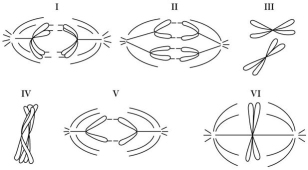 -Which diagram(s)represent anaphase II of meiosis?
 (Multiple Choice)
4.8/5 (73)
(73) To view and analyze human chromosomes in a dividing cell, which of the following is/are required?
(Multiple Choice)
4.8/5 (69)
(69) After telophase I of meiosis, the chromosomal makeup of each daughter cell is
(Multiple Choice)
4.7/5 (77)
(77) In sexual reproduction, the reduction division stage is known as
(Multiple Choice)
4.7/5 (73)
(73) Which of the following is true of a species that has a chromosome number of 2n = 16?
(Multiple Choice)
4.8/5 (82)
(82) Which of the following best describes the frequency of crossing over in mammals?
(Multiple Choice)
4.9/5 (75)
(75) A cell divides to produce two daughter cells that are genetically different.
(Multiple Choice)
5.0/5 (81)
(81) For the following questions, match the key event of meiosis with the stages listed below.
I. Prophase I V. Prophase II
II. Metaphase I VI. Metaphase II
III. Anaphase I VII. Anaphase II
IV. Telophase I VIII. Telophase II
-Synaptonemal complexes form or are still present.
(Multiple Choice)
4.7/5 (76)
(76) Which of the following can utilize both mitosis and meiosis in the correct circumstances?
(Multiple Choice)
4.7/5 (91)
(91) Refer to the life cycles illustrated in the figure below to answer the following questions.
 -Which of the life cycles is typical for most fungi and some protists?
 (Multiple Choice)
4.8/5 (81)
(81) 
Filters
- Essay(0)
- Multiple Choice(0)
- Short Answer(0)
- True False(0)
- Matching(0)