



 Chat with AI
Exam 8: An Introduction to Metabolism

Exam 1: Introduction: Evolution and Themes of Biology70 Questions
Exam 2: The Chemical Context of Life90 Questions
Exam 3: Water and Life80 Questions
Exam 4: Carbon and the Molecular Diversity of Life78 Questions
Exam 5: The Structure and Function of Large Biological Molecules117 Questions
Exam 6: A Tour of the Cell96 Questions
Exam 7: Membrane Structure and Function78 Questions
Exam 8: An Introduction to Metabolism88 Questions
Exam 9: Cellular Respiration and Fermentation117 Questions
Exam 10: Photosynthesis89 Questions
Exam 11: Cell Communication77 Questions
Exam 12: The Cell Cycle83 Questions
Exam 13: Meiosis and Sexual Life Cycles74 Questions
Exam 14: Mendel and the Gene Idea82 Questions
Exam 15: The Chromosomal Basis of Inheritance66 Questions
Exam 16: The Molecular Basis of Inheritance67 Questions
Exam 17: From Gene to Protein91 Questions
Exam 18: Regulation of Gene Expression107 Questions
Exam 19: Viruses53 Questions
Exam 20: Dna Tools and Biotechnology72 Questions
Exam 21: Genomes and Their Evolution52 Questions
Exam 22: Descent With Modification: a Darwinian View of Life63 Questions
Exam 23: The Evolution of Populations86 Questions
Exam 24: The Origin of Species71 Questions
Exam 25: The History of Life on Earth83 Questions
Exam 26: Phylogeny and the Tree of Life81 Questions
Exam 27: Bacteria and Archaea86 Questions
Exam 28: Protists84 Questions
Exam 29: Plant Diversity I: How Plants Colonized Land82 Questions
Exam 30: Plant Diversity Ii: the Evolution of Seed Plants110 Questions
Exam 31: Fungi97 Questions
Exam 32: An Overview of Animal Diversity82 Questions
Exam 33: An Introduction to Invertebrates101 Questions
Exam 34: The Origin and Evolution of Vertebrates117 Questions
Exam 35: Plant Structure, Growth, and Development75 Questions
Exam 36: Resource Acquisition and Transport in Vascular Plants89 Questions
Exam 37: Soil and Plant Nutrition91 Questions
Exam 38: Angiosperm Reproduction and Biotechnology94 Questions
Exam 39: Plant Responses to Internal and External Signals116 Questions
Exam 40: Basic Principles of Animal Form and Function86 Questions
Exam 41: Animal Nutrition73 Questions
Exam 42: Circulation and Gas Exchange100 Questions
Exam 43: The Immune System110 Questions
Exam 44: Osmoregulation and Excretion79 Questions
Exam 45: Hormones and the Endocrine System82 Questions
Exam 46: Animal Reproduction104 Questions
Exam 47: Animal Development98 Questions
Exam 48: Neurons, Synapses, and Signalling81 Questions
Exam 49: Nervous Systems73 Questions
Exam 50: Sensory and Motor Mechanisms91 Questions
Exam 51: Animal Behaviour79 Questions
Exam 52: An Introduction to Ecology and the Biosphere81 Questions
Exam 53: Population Ecology87 Questions
Exam 54: Community Ecology85 Questions
Exam 55: Ecosystems and Restoration Ecology89 Questions
Exam 56: Conservation Biology and Global Change75 Questions
Select questions type


Whenever energy is transformed, there is always an increase in the
(Multiple Choice)
4.8/5  (71)
(71) Which of the following statements is true concerning catabolic pathways?
(Multiple Choice)
4.7/5 (93)
(93) The following questions are based on the reaction A + B ↔ C + D shown in the figure below.
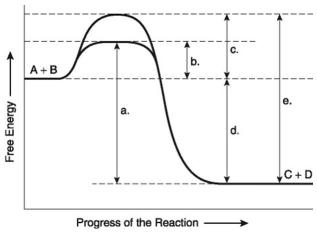 -Which of the following represents the difference between the free-energy content of the reaction and the free-energy content of the products in the figure above?
 (Multiple Choice)
4.8/5 (83)
(83) When ATP releases some energy, it also releases inorganic phosphate. What purpose does this serve (if any)in the cell?
(Multiple Choice)
4.9/5 (77)
(77) Use the following figure to answer the questions below.
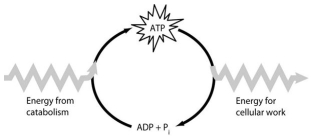 -How do cells use the ATP cycle shown in the figure?
 (Multiple Choice)
4.8/5 (99)
(99) Use the following information to answer the questions below.
A series of enzymes catalyze the reaction X → Y → Z → A. Product A binds to the enzyme that converts X to Y at a position remote from its active site. This binding decreases the activity of the enzyme.
-With respect to the enzyme that converts X to Y, substance A functions as
(Multiple Choice)
4.7/5 (87)
(87) The following questions are based on the reaction A + B ↔ C + D shown in the figure below.
-Which of the following in the figure above would be the same in either an enzyme-catalyzed or a noncatalyzed reaction?
-Which of the following in the figure above would be the same in either an enzyme-catalyzed or a noncatalyzed reaction? (Multiple Choice)
4.9/5 (80)
(80) An important group of peripheral membrane proteins are enzymes such as the phospholipases that cleave the head groups of phospholipids. What properties must these enzymes exhibit?
(Multiple Choice)
4.7/5 (81)
(81) Which term most precisely describes the cellular process of breaking down large molecules into smaller ones?
(Multiple Choice)
4.9/5 (86)
(86) The following questions are based on the reaction A + B ↔ C + D shown in the figure below.
-Which of the following represents the ΔG of the reaction in the figure above?
-Which of the following represents the ΔG of the reaction in the figure above? (Multiple Choice)
4.9/5 (82)
(82) When glucose monomers are joined together by glycosidic linkages to form a cellulose polymer, the changes in free energy, total energy, and entropy are as follows
(Multiple Choice)
4.8/5 (92)
(92) Use the following figure to answer the questions below.
 Rate of an enzyme-catalyzed reaction as a function of varying reactant
concentration, with the concentration of enzyme constant.
-In the figure, why does the reaction rate plateau at higher reactant concentrations?
Rate of an enzyme-catalyzed reaction as a function of varying reactant
concentration, with the concentration of enzyme constant.
-In the figure, why does the reaction rate plateau at higher reactant concentrations? (Multiple Choice)
4.8/5 (83)
(83) The following questions are based on the reaction A + B ↔ C + D shown in the figure below.
-Which of the following represents the activation energy needed for the enzyme-catalyzed reverse reaction, C + D → A + B, in the figure above?
-Which of the following represents the activation energy needed for the enzyme-catalyzed reverse reaction, C + D → A + B, in the figure above? (Multiple Choice)
4.9/5 (68)
(68) Which of the following is true for all exergonic reactions?
(Multiple Choice)
4.9/5 (87)
(87) Use the following information to answer the questions below.
 Activity of various enzymes at various temperatures (a) and at various pH (b).
-Which curve(s)on the graphs may represent the temperature and pH profiles of an enzyme taken from a bacterium that lives in a mildly alkaline hot springs at temperatures of 70°C or higher?
Activity of various enzymes at various temperatures (a) and at various pH (b).
-Which curve(s)on the graphs may represent the temperature and pH profiles of an enzyme taken from a bacterium that lives in a mildly alkaline hot springs at temperatures of 70°C or higher? (Multiple Choice)
4.8/5 (94)
(94) During a laboratory experiment, you discover that an enzyme-catalyzed reaction has a ∆G of -20 kcal/mol. If you double the amount of enzyme in the reaction, what will be the ∆G for the new reaction?
(Multiple Choice)
5.0/5 (81)
(81) A solution of starch at room temperature does not readily decompose to form a solution of simple sugars because
(Multiple Choice)
5.0/5 (94)
(94) 
Filters
- Essay(0)
- Multiple Choice(0)
- Short Answer(0)
- True False(0)
- Matching(0)