



 Chat with AI
Exam 12: Evolution of Low-Mass Stars

Exam 1: Thinking Like an Astronomer54 Questions
Exam 2: Patterns in the Skymotions of Earth and the Moon65 Questions
Exam 3: Laws of Motion59 Questions
Exam 4: Light and Telescopes62 Questions
Exam 5: The Formation of Stars and Planets50 Questions
Exam 6: Terrestrial Worlds in the Inner Solar System53 Questions
Exam 7: Atmospheres of Venus, earth, and Mars54 Questions
Exam 8: The Giant Planets62 Questions
Exam 9: Small Bodies of the Solar System64 Questions
Exam 10: Measuring the Stars57 Questions
Exam 11: Our Star: the Sun58 Questions
Exam 12: Evolution of Low-Mass Stars64 Questions
Exam 13: Evolution of High-Mass Stars60 Questions
Exam 14: Measuring Galaxies51 Questions
Exam 15: Our Galaxy: the Milky Way53 Questions
Exam 16: The Evolution of the Universe55 Questions
Exam 17: Formation of Structure50 Questions
Exam 18: Life in the Universe55 Questions
Select questions type


The evolutionary cutoff between low- and high-mass stars occurs at approximately:
(Multiple Choice)
4.9/5  (73)
(73) What is the shortest phase of evolution for a 1 solar mass star that we can visibly see?
(Essay)
4.9/5 (86)
(86) Which point on the figure below represents the location on the H-R diagram where the star is expelling mass creating a planetary nebula? 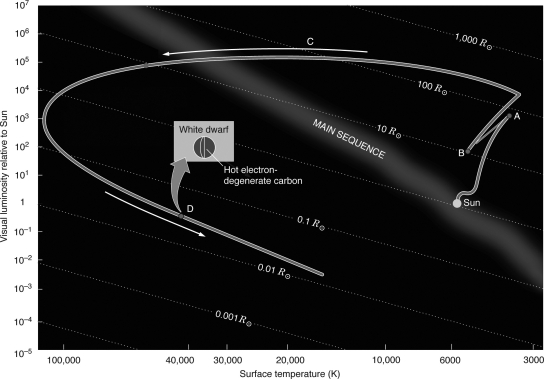
(Multiple Choice)
4.9/5 (74)
(74) A single 1-M¤ star will eventually eject significant amounts of which of the following chemical elements into the interstellar medium?
(Multiple Choice)
4.8/5 (78)
(78) When the Sun becomes an AGB star,its radius will be approximately 100 R¤.If its mass at this point will be approximately the same as it is now,how will its surface gravity as an AGB star compare to its current surface gravity as a main-sequence star? Note that g = GM/R².
(Essay)
4.7/5 (67)
(67) When a low-mass star becomes an AGB star and has a temperature of 3300 K,in which wavelength range will it shine the brightest?
(Multiple Choice)
4.9/5 (72)
(72) In what two ways does temperature affect the rate of nuclear reactions?
(Essay)
4.7/5 (94)
(94) How many times longer does a 1.0-M¤ main-sequence star live compared to a 2.1-M¤ main-sequence star?
(Essay)
4.8/5 (88)
(88) As a main-sequence star burns its core supply of hydrogen,what happens?
(Multiple Choice)
4.7/5 (85)
(85) What factor is most important in determining a star's position on the main sequence and subsequent evolution?
(Multiple Choice)
4.8/5 (74)
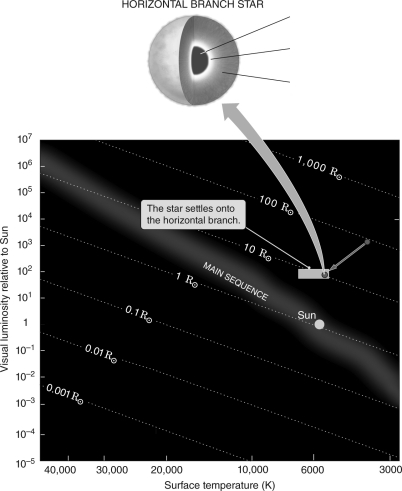
(74) Label the various regions of a horizontal branch star in the figure below.
(Essay)
4.9/5 (85)
(85) The Ring Nebula (image below)is a planetary nebula that currently has a radius of 0.4 pc and an expansion velocity of 250 km/s.Approximately how long ago did its parent star die and eject its outer layers? 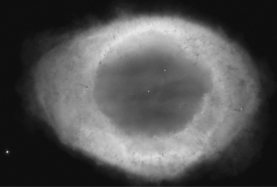
(Multiple Choice)
4.9/5 (92)
(92) Asymptotic giant branch (AGB)stars have high mass-loss rates because they:
(Multiple Choice)
4.9/5 (85)
(85) 
Filters
- Essay(0)
- Multiple Choice(0)
- Short Answer(0)
- True False(0)
- Matching(0)