



 Chat with AI
Exam 12: Evolution of Low-Mass Stars

Exam 1: Thinking Like an Astronomer54 Questions
Exam 2: Patterns in the Skymotions of Earth and the Moon65 Questions
Exam 3: Laws of Motion59 Questions
Exam 4: Light and Telescopes62 Questions
Exam 5: The Formation of Stars and Planets50 Questions
Exam 6: Terrestrial Worlds in the Inner Solar System53 Questions
Exam 7: Atmospheres of Venus, earth, and Mars54 Questions
Exam 8: The Giant Planets62 Questions
Exam 9: Small Bodies of the Solar System64 Questions
Exam 10: Measuring the Stars57 Questions
Exam 11: Our Star: the Sun58 Questions
Exam 12: Evolution of Low-Mass Stars64 Questions
Exam 13: Evolution of High-Mass Stars60 Questions
Exam 14: Measuring Galaxies51 Questions
Exam 15: Our Galaxy: the Milky Way53 Questions
Exam 16: The Evolution of the Universe55 Questions
Exam 17: Formation of Structure50 Questions
Exam 18: Life in the Universe55 Questions
Select questions type


One star in a binary will almost always become a red giant before the other because:

Free
(Multiple Choice)
4.8/5  (82)
(82) Correct Answer: Verified
C
What would you need to measure for a planetary nebula (see the image below)to determine how long ago its parent star died? 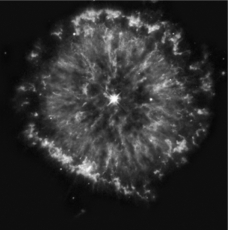
Free
(Multiple Choice)
4.9/5 (87)
(87) Correct Answer:Verified
VerifiedD
As a solar-type star evolves off the main sequence,its:
Free
(Multiple Choice)
4.9/5 (82)
(82) Correct Answer:Verified
VerifiedC
When helium fusion begins in the core of a red giant star,the situation quickly gets out of control because electron-degeneracy pressure does not respond to changes in:
(Multiple Choice)
4.9/5 (86)
(86) What types of chemical elements can low-mass stars contribute to the enrichment of the interstellar medium,and how are they produced?
(Essay)
4.8/5 (67)
(67) A 1-M¤ star in a binary system could create the following chemical element and eject it into the interstellar medium:
(Multiple Choice)
4.7/5 (89)
(89) The figure below shows the H-R diagram of stars from the cluster 47 Tucanae.Explain what the main-sequence turnoff is and how it can be used to determine the age of the cluster.
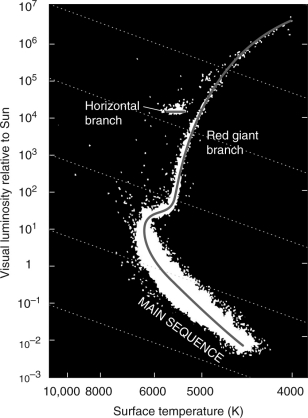
(Essay)
4.9/5 (69)
(69) During which phase of the evolution of a low-mass star does it have two separate regions of nuclear burning occurring in its interior?
(Multiple Choice)
4.9/5 (81)
(81) Helium burns in the core of a horizontal branch star via ________ and produces ________.
(Multiple Choice)
4.8/5 (71)
(71) What occurs if a white dwarf exceeds the Chandrasekhar limit?
(Multiple Choice)
4.9/5 (81)
(81) How can the core of a star be degenerate with respect to the electrons but nondegenerate with respect to the nuclei?
(Essay)
5.0/5 (78)
(78) Suppose you measured H-R diagrams for the two star clusters pictured below. 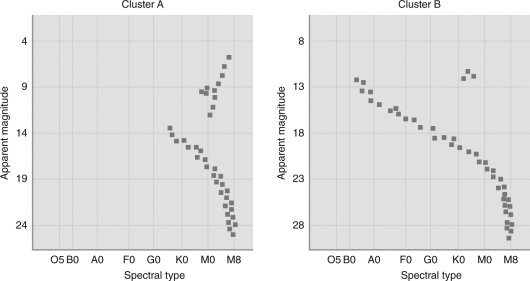 Which of the following statements is TRUE?
 (Multiple Choice)
5.0/5 (84)
(84) As a red giant star evolves,hydrogen shell burning proceeds increasingly faster due to:
(Multiple Choice)
4.9/5 (63)
(63) Suppose you observe three star clusters.Cluster 1 has a main-sequence turnoff point at spectral type G,cluster 2 has a turnoff point at spectral type A,and cluster 3 has a turnoff point at spectral type B.Which cluster is youngest and which is oldest? Explain why.What is the approximate age of the oldest cluster?
(Essay)
4.8/5 (75)
(75) In a white dwarf,what is the source of pressure that halts its contraction as it cools?
(Multiple Choice)
4.9/5 (76)
(76) Using the figure below,describe how the composition of the Sun varies by radius over time.
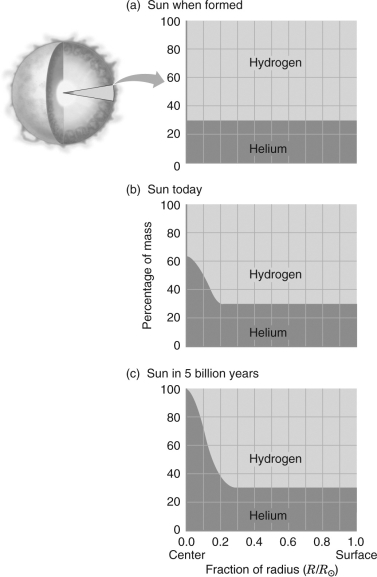
(Essay)
4.9/5 (81)
(81) A star's surface temperature during the horizontal branch phase is determined primarily by its:
(Multiple Choice)
4.8/5 (78)
(78) 
Filters
- Essay(0)
- Multiple Choice(0)
- Short Answer(0)
- True False(0)
- Matching(0)