



 Chat with AI
Exam 11: Our Star: the Sun

Exam 1: Thinking Like an Astronomer54 Questions
Exam 2: Patterns in the Skymotions of Earth and the Moon65 Questions
Exam 3: Laws of Motion59 Questions
Exam 4: Light and Telescopes62 Questions
Exam 5: The Formation of Stars and Planets50 Questions
Exam 6: Terrestrial Worlds in the Inner Solar System53 Questions
Exam 7: Atmospheres of Venus, earth, and Mars54 Questions
Exam 8: The Giant Planets62 Questions
Exam 9: Small Bodies of the Solar System64 Questions
Exam 10: Measuring the Stars57 Questions
Exam 11: Our Star: the Sun58 Questions
Exam 12: Evolution of Low-Mass Stars64 Questions
Exam 13: Evolution of High-Mass Stars60 Questions
Exam 14: Measuring Galaxies51 Questions
Exam 15: Our Galaxy: the Milky Way53 Questions
Exam 16: The Evolution of the Universe55 Questions
Exam 17: Formation of Structure50 Questions
Exam 18: Life in the Universe55 Questions
Select questions type


The solar spectrum (see the image below)is an example of a(n)________ spectrum. 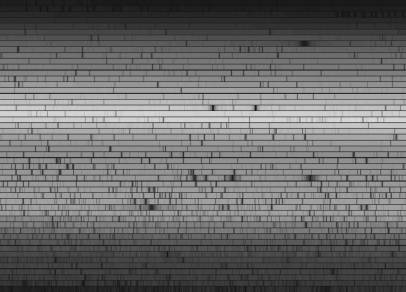

Free
(Multiple Choice)
5.0/5  (68)
(68) Correct Answer: Verified
B
When,during its 11-year cycle,is the Sun most luminous? What might this have to do with the Maunder Minimum?
Free
(Essay)
4.9/5 (97)
(97) Correct Answer:Verified
VerifiedThe Sun is most luminous during solar maxima,when the number of sunspots on its surface is at maximum.During the Maunder Minimum,few sunspots were seen on the Sun,implying that it was a bit less luminous than today and caused Earth to be a bit colder than it is today.
In the proton-proton chain,the net reaction is that four hydrogen nuclei are converted to one helium nucleus and ________ are released.
(Multiple Choice)
4.8/5 (69)
(69) Light from the photosphere of the Sun reaches Earth approximately ________ times faster than photons released by fusion in the Sun's core.
(Multiple Choice)
4.8/5 (83)
(83) Examine the figure below.The interior zones of the Sun are distinguished by: 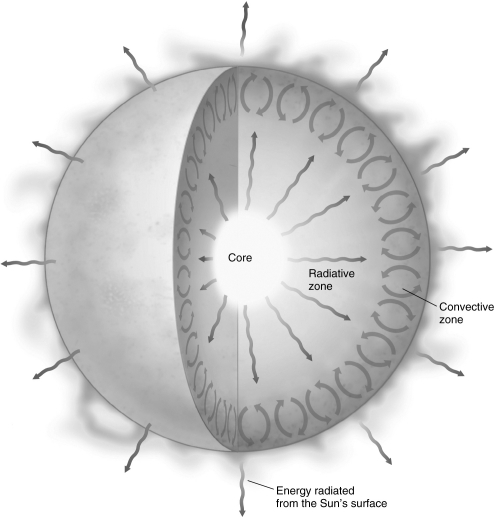
(Multiple Choice)
4.9/5 (70)
(70) Examine the figure below.Show where in the Sun nuclear fusion occurs,and explain why fusion occurs there.
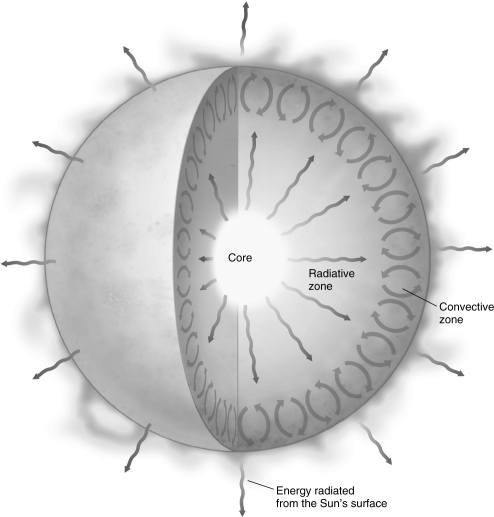
(Essay)
4.7/5 (86)
(86) Why is hydrogen burning the main energy source for main-sequence stars? Give at least two reasons.
(Essay)
4.9/5 (83)
(83) The best wavelength to use to observe a solar prominence or flare is:
(Multiple Choice)
5.0/5 (81)
(81) Approximately how long does it take the photons released in nuclear reactions in the core of the Sun to exit the photosphere?
(Multiple Choice)
4.8/5 (64)
(64) In the proton-proton chain,the net reaction is that four protons are converted into one helium nucleus.What other by-products are released in this reaction,and why?
(Essay)
4.8/5 (72)
(72) The variations in the Sun's luminosity by solar activity accounts for a change in Earth's average temperature by 0.1 K,which is:
(Multiple Choice)
4.9/5 (82)
(82) If a coronal mass ejection occurs on the Sun that expels material at a speed of 800 km/s,how long will it take these charged particles to reach Earth?
(Multiple Choice)
4.8/5 (81)
(81) If the Sun converts 5 × 10¹¹ kg of H to He per second,and the mass of a single hydrogen nucleus is 1.7 × 10⁻²⁷ kg,how many net proton-proton reactions go on per second in the Sun? What is the luminosity produced if the mass difference between a single helium nucleus and four hydrogen nuclei is 4 × 10⁻²⁹ kg? Note that 1 watt (W)= 1 m² kg/s³.
(Multiple Choice)
4.8/5 (70)
(70) Examine the figure below.By studying how the surface of the Sun vibrates like a struck bell,we can determine its: 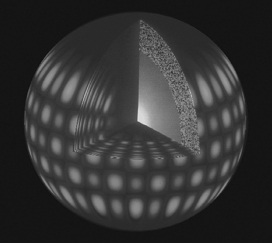
(Multiple Choice)
4.8/5 (87)
(87) How do periods of strong solar activity affect near-Earth orbiting spacecraft?
(Essay)
4.8/5 (78)
(78) 
Filters
- Essay(0)
- Multiple Choice(0)
- Short Answer(0)
- True False(0)
- Matching(0)