



 Chat with AI
Exam 11: Our Star: the Sun

Exam 1: Thinking Like an Astronomer54 Questions
Exam 2: Patterns in the Skymotions of Earth and the Moon65 Questions
Exam 3: Laws of Motion59 Questions
Exam 4: Light and Telescopes62 Questions
Exam 5: The Formation of Stars and Planets50 Questions
Exam 6: Terrestrial Worlds in the Inner Solar System53 Questions
Exam 7: Atmospheres of Venus, earth, and Mars54 Questions
Exam 8: The Giant Planets62 Questions
Exam 9: Small Bodies of the Solar System64 Questions
Exam 10: Measuring the Stars57 Questions
Exam 11: Our Star: the Sun58 Questions
Exam 12: Evolution of Low-Mass Stars64 Questions
Exam 13: Evolution of High-Mass Stars60 Questions
Exam 14: Measuring Galaxies51 Questions
Exam 15: Our Galaxy: the Milky Way53 Questions
Exam 16: The Evolution of the Universe55 Questions
Exam 17: Formation of Structure50 Questions
Exam 18: Life in the Universe55 Questions
Select questions type


Illustrate the steps by which hydrogen is fused into helium in the Sun in the proton-proton chain.
(Essay)
4.9/5  (84)
(84) If a sunspot appears one-third as bright as the surrounding photosphere,and the average temperature of the photosphere is 5800 K,what is the temperature of the gas in this sunspot?
(Multiple Choice)
4.9/5 (83)
(83) Explain why hydrostatic equilibrium results in the center of the Sun having the highest pressure and temperature.
(Essay)
4.9/5 (76)
(76) Which of the following are manifestations of solar magnetic activity?
(Multiple Choice)
4.8/5 (71)
(71) Which of the following layers of the Sun makes up the majority of its interior?
(Multiple Choice)
4.9/5 (79)
(79) Show that a star with the same mass,composition,radius,and luminosity as the Sun,but with a higher temperature (that is,a "too-hot" Sun),leads to a contradiction.
(Essay)
4.9/5 (83)
(83) The bulk of the Sun's energy generation is contained within a region of:
(Multiple Choice)
4.9/5 (82)
(82) Approximately what is the temperature at the center of the Sun?
(Multiple Choice)
4.8/5 (86)
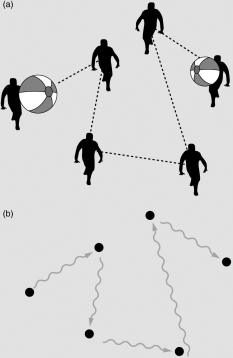
(86) Examine the figure below.Explain why it takes so long for gamma-ray energy to find its way to the outer layers of the Sun.
(Essay)
4.9/5 (89)
(89) When two atomic nuclei come together to form a new species of atom,it is called:
(Multiple Choice)
4.7/5 (70)
(70) 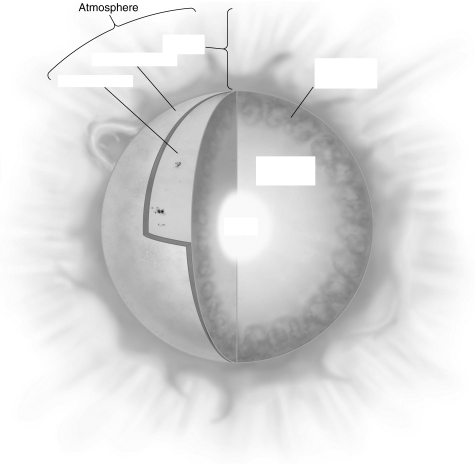
Density,temperature,and pressure ________ as you move inward in the interior of the Sun.
(Multiple Choice)
4.9/5 (82)
(82) Through hydrogen fusion,the Sun loses approximately 4 million tons of mass each second.If it burns hydrogen at this rate for 10 billion years,what percentage of its original mass will it lose in all? (Note: The mass of the Sun is 1.99 × 10³⁰ kg,and 1 ton = 1,000 kg.)
(Essay)
4.8/5 (81)
(81) Why is hydrogen burning the main energy source for main-sequence stars?
(Multiple Choice)
4.7/5 (84)
(84) Observations of sunspots led to the discovery of the Sun's:
(Multiple Choice)
4.8/5 (71)
(71) Explain why magnetic fields trap coronal gas over much of the solar surface but allow it to escape in coronal holes.
(Essay)
4.9/5 (80)
(80) We can determine how the density changes with radius in the Sun using:
(Multiple Choice)
4.9/5 (71)
(71) 
Filters
- Essay(0)
- Multiple Choice(0)
- Short Answer(0)
- True False(0)
- Matching(0)