



 Chat with AI
Exam 8: The Giant Planets

Exam 1: Thinking Like an Astronomer54 Questions
Exam 2: Patterns in the Skymotions of Earth and the Moon65 Questions
Exam 3: Laws of Motion59 Questions
Exam 4: Light and Telescopes62 Questions
Exam 5: The Formation of Stars and Planets50 Questions
Exam 6: Terrestrial Worlds in the Inner Solar System53 Questions
Exam 7: Atmospheres of Venus, earth, and Mars54 Questions
Exam 8: The Giant Planets62 Questions
Exam 9: Small Bodies of the Solar System64 Questions
Exam 10: Measuring the Stars57 Questions
Exam 11: Our Star: the Sun58 Questions
Exam 12: Evolution of Low-Mass Stars64 Questions
Exam 13: Evolution of High-Mass Stars60 Questions
Exam 14: Measuring Galaxies51 Questions
Exam 15: Our Galaxy: the Milky Way53 Questions
Exam 16: The Evolution of the Universe55 Questions
Exam 17: Formation of Structure50 Questions
Exam 18: Life in the Universe55 Questions
Select questions type


What clues do the differences in the masses of the giant planets give about conditions in the early Solar System?

Free
(Essay)
4.8/5  (95)
(95) Correct Answer: Verified
(1)The farther from the protosun a planet formed,the lower the density of the gas available for accretion.Gas density decreased with distance in the solar nebula.Saturn may be less massive than Jupiter because less gas was available at its distance from the Sun.Uranus and Neptune were at an even greater disadvantage.
(2)There was a cutoff time to the accretion period.Planets whose cores formed later had less time to accrete gas and therefore ended as less massive planets.Saturn's core probably formed later than Jupiter's,and Uranus's and Neptune's cores much later,due to the lower gas density.The more space between icy planetesimals,the longer it took to accumulate a core that had enough gravity to hold onto the atmospheric gases.
Where do Uranus's and Neptune's high magnetic fields originate?
Free
(Multiple Choice)
4.7/5 (84)
(84) Correct Answer:Verified
VerifiedB
The strongest magnetic fields in the Solar System are found on which planet?
Free
(Multiple Choice)
4.8/5 (68)
(68) Correct Answer:Verified
VerifiedA
Uranus and Neptune are bluish green because they contain large amounts of:
(Multiple Choice)
4.8/5 (86)
(86) Particles that make up the rings of Uranus and Neptune are composed of:
(Multiple Choice)
4.9/5 (87)
(87) Why are auroras visible mostly at the north or south magnetic poles of the giant planets?
(Essay)
4.8/5 (77)
(77) Suppose Neptune moves with an average orbital speed of 3.5 km/s.If it takes Neptune 4 hours to pass directly in front of a star,what is Neptune's diameter? Give Neptune's radius in units of Earth diameters,where the diameter of Earth is 12,800 km.
(Essay)
4.7/5 (72)
(72) What gives rise to the large magnetic fields of Uranus and Neptune? How does this source help explain why the axes of their magnetic fields are misaligned and significantly offset from their rotational axes?
(Essay)
4.9/5 (79)
(79) The giant planet atmospheric vortices are created by a combination of the Coriolis effect and:
(Multiple Choice)
4.9/5 (72)
(72) All the giant planets radiate more energy into space than they receive from the Sun EXCEPT:
(Multiple Choice)
4.8/5 (81)
(81) What causes the horizontal bands on Jupiter and Saturn to have different colors? How can they be used to probe different altitudes in their atmospheres?
(Essay)
4.9/5 (86)
(86) Band systems on Saturn,Uranus,and Neptune are most prominent when viewed in which wavelength regime?
(Multiple Choice)
4.9/5 (82)
(82) The fact that Jupiter's radius is contracting at a rate of 1 mm/year results in:
(Multiple Choice)
4.8/5 (81)
(81) On which of the giant planets do we think we can find deep oceans of water? Why do we think this?
(Essay)
4.9/5 (80)
(80) Based on the flux of sunlight that it gets,Jupiter should have a temperature of 109 K.However,its temperature is observed to be 124 K.How much more energy is Jupiter radiating out into space compared to what it gets from the Sun?
(Essay)
4.7/5 (77)
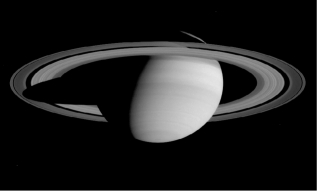
(77) If Saturn's rotational period is 11 hours and its radius is 6 × 10⁷ meters,what is the average speed of a cloud in its atmosphere that is rotating with Saturn? (Neglect differential speeds due to winds.)
(Essay)
4.8/5 (84)
(84) How has Jupiter retained a significant portion of its heat since it formed?
(Essay)
4.8/5 (87)
(87) How do Saturn's shepherd moons help maintain the stability of Saturn's rings?
(Multiple Choice)
4.8/5 (88)
(88) 
Filters
- Essay(0)
- Multiple Choice(0)
- Short Answer(0)
- True False(0)
- Matching(0)