



 Chat with AI
Exam 9: Small Bodies of the Solar System

Exam 1: Thinking Like an Astronomer54 Questions
Exam 2: Patterns in the Skymotions of Earth and the Moon65 Questions
Exam 3: Laws of Motion59 Questions
Exam 4: Light and Telescopes62 Questions
Exam 5: The Formation of Stars and Planets50 Questions
Exam 6: Terrestrial Worlds in the Inner Solar System53 Questions
Exam 7: Atmospheres of Venus, earth, and Mars54 Questions
Exam 8: The Giant Planets62 Questions
Exam 9: Small Bodies of the Solar System64 Questions
Exam 10: Measuring the Stars57 Questions
Exam 11: Our Star: the Sun58 Questions
Exam 12: Evolution of Low-Mass Stars64 Questions
Exam 13: Evolution of High-Mass Stars60 Questions
Exam 14: Measuring Galaxies51 Questions
Exam 15: Our Galaxy: the Milky Way53 Questions
Exam 16: The Evolution of the Universe55 Questions
Exam 17: Formation of Structure50 Questions
Exam 18: Life in the Universe55 Questions
Select questions type


Which of the following can be used as an indicator of the age of a moon's surface?
(Multiple Choice)
5.0/5  (79)
(79) Why is Io,a moon that is smaller and farther from the Sun than our own Moon,still geologically active?
(Essay)
4.8/5 (78)
(78) The minimum size of a meteoroid that is capable of surviving its passage through Earth's atmosphere and hitting the ground is about as big as:
(Multiple Choice)
4.8/5 (75)
(75) Which of the following moons is thought to have a vast ocean of water beneath its thin frozen surface?
(Multiple Choice)
4.8/5 (92)
(92) Ganymede is one of the largest moons in the Solar System.It shows some terrain that is ancient and heavily cratered,younger terrain with less craters,but no terrain that is free of craters.Why would Ganymede's geological activity stop?
(Essay)
4.8/5 (78)
(78) What does the existence of M-type asteroids tell us about their origin?
(Essay)
4.8/5 (77)
(77) The varied colors found on Io's surface are due to the presence of various molecules containing:
(Multiple Choice)
4.9/5 (83)
(83) What might cause a moon to be geologically active while its planet is not?
(Multiple Choice)
4.7/5 (68)
(68) The chronological description of an asteroidal fragment that falls to Earth would be:
(Multiple Choice)
4.8/5 (71)
(71) The nucleus of the typical comet is approximately ________ in size.
(Multiple Choice)
5.0/5 (79)
(79) The mass of all the known asteroids combined would be as much as:
(Multiple Choice)
4.9/5 (87)
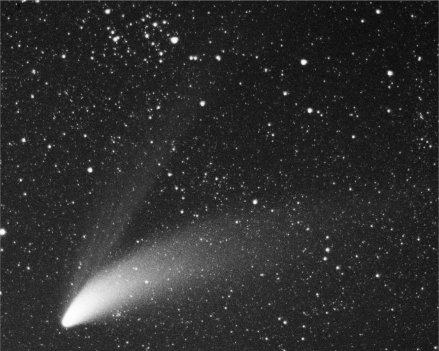
(87) Examine the image below.Why does a comet usually have two tails,one that is straight and one that is curved? What materials compose each tail,and why do they have different shapes?
(Essay)
4.9/5 (62)
(62) 
Filters
- Essay(0)
- Multiple Choice(0)
- Short Answer(0)
- True False(0)
- Matching(0)