



 Chat with AI
Exam 5: The Formation of Stars and Planets

Exam 1: Thinking Like an Astronomer54 Questions
Exam 2: Patterns in the Skymotions of Earth and the Moon65 Questions
Exam 3: Laws of Motion59 Questions
Exam 4: Light and Telescopes62 Questions
Exam 5: The Formation of Stars and Planets50 Questions
Exam 6: Terrestrial Worlds in the Inner Solar System53 Questions
Exam 7: Atmospheres of Venus, earth, and Mars54 Questions
Exam 8: The Giant Planets62 Questions
Exam 9: Small Bodies of the Solar System64 Questions
Exam 10: Measuring the Stars57 Questions
Exam 11: Our Star: the Sun58 Questions
Exam 12: Evolution of Low-Mass Stars64 Questions
Exam 13: Evolution of High-Mass Stars60 Questions
Exam 14: Measuring Galaxies51 Questions
Exam 15: Our Galaxy: the Milky Way53 Questions
Exam 16: The Evolution of the Universe55 Questions
Exam 17: Formation of Structure50 Questions
Exam 18: Life in the Universe55 Questions
Select questions type


The difference in composition between the giant planets and the terrestrial planets is most likely caused by the fact that:
(Multiple Choice)
4.8/5  (67)
(67) Examine the figure below.What causes molecular clouds to collapse? 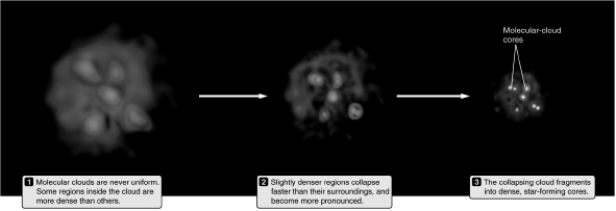
(Multiple Choice)
4.7/5 (82)
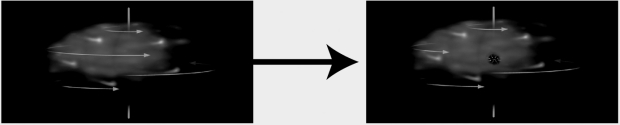
(82) Explain the process of protostar formation shown in the figure below.
(Essay)
4.8/5 (87)
(87) You record the spectrum of a star and find that the calcium absorption line,whose rest wavelength is 393.3 nm,has an observed wavelength of 394.0 nm.What is the radial velocity of this star?
(Multiple Choice)
4.8/5 (86)
(86) The increasing temperature of the core of a collapsing cloud of gas is due to:
(Multiple Choice)
5.0/5 (78)
(78) Examine the figure below.What method of looking for extrasolar planets requires the planet to pass in front of the star? 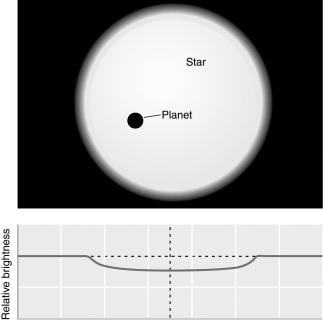
(Multiple Choice)
4.8/5 (85)
(85) When astronomers began searching for extrasolar planets,they were surprised to discover Jupiter-sized planets much closer than 1 AU to their parent stars.Why is this surprising?
(Multiple Choice)
4.8/5 (72)
(72) Why are most of the planets composed of refractory materials found in the inner solar system?
(Multiple Choice)
4.9/5 (81)
(81) For a star that lies in the plane of Earth's orbit around the Sun,how does the observed wavelength of a hydrogen absorption line in its spectrum change in wavelength (if at all)with the time of year?
(Essay)
4.9/5 (84)
(84) 
Filters
- Essay(0)
- Multiple Choice(0)
- Short Answer(0)
- True False(0)
- Matching(0)