



 Chat with AI
Exam 14: The Digestive System and Body Metabolism

Exam 1: The Human Body: An Orientation128 Questions
Exam 2: Basic Chemistry118 Questions
Exam 3: Cells and Tissues142 Questions
Exam 4: Skin and Body Membranes108 Questions
Exam 5: The Skeletal System124 Questions
Exam 6: The Muscular System129 Questions
Exam 7: The Nervous System161 Questions
Exam 8: Special Senses128 Questions
Exam 9: The Endocrine System149 Questions
Exam 10: Blood116 Questions
Exam 11: The Cardiovascular System160 Questions
Exam 12: The Lymphatic System and Body Defenses135 Questions
Exam 13: The Respiratory System150 Questions
Exam 14: The Digestive System and Body Metabolism162 Questions
Exam 15: The Urinary System138 Questions
Exam 16: The Reproductive System169 Questions
Select questions type


What is the difference between the basal metabolic rate (BMR) and the total metabolic rate (TMR)? Which one should dieters focus on for weight loss?
(Essay)
4.8/5  (78)
(78) The anal canal has a voluntary sphincter formed by smooth muscle only.
(True/False)
4.8/5 (82)
(82) The three subdivisions of the small intestine are duodenum, jejunum, and ileum.
(True/False)
4.9/5 (85)
(85) 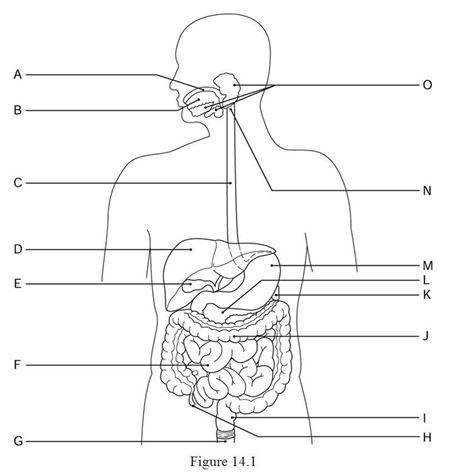 Using Figure 14.1, identify the following:
-The rectum is indicated by ________.
Using Figure 14.1, identify the following:
-The rectum is indicated by ________. (Multiple Choice)
4.7/5 (69)
(69) What organs are targeted by the hormones secretin and cholecystokinin (CCK) to release pancreatic juice and bile into the small intestine for digestion?
(Multiple Choice)
4.9/5 (77)
(77) Adenosine triphosphate (ATP) is produced in greatest quantity during ________.
(Multiple Choice)
4.9/5 (82)
(82) Absence of either bile or pancreatic juice indicates that no fat digestion or absorption is occurring. This can lead to blood-clotting problems because the liver needs vitamin K to make prothrombin.
(True/False)
4.8/5 (86)
(86) The process by which larger molecules or structures are built up from smaller ones is called ________.
(Multiple Choice)
4.8/5 (85)
(85) The submucosal and myenteric nerve plexuses that help regulate the mobility and secretory activity of the GI tract organs are both part of the ________.
(Multiple Choice)
4.8/5 (90)
(90) Which two hormones promote the release of bile and pancreatic juice into the small intestine?
(Multiple Choice)
4.8/5 (85)
(85) Predict the effect on digestion if the pancreas is unable to make and release pancreatic juices.
(Essay)
4.9/5 (78)
(78) The energy value of foods is measured in units called ________.
(Multiple Choice)
4.9/5 (89)
(89) What is the first digestive process, which involves placing food in the mouth, to occur?
(Multiple Choice)
4.8/5 (86)
(86) The process of eliminating indigestible residues from the GI tract is called ________.
(Multiple Choice)
5.0/5 (77)
(77) The two major phases of swallowing include an involuntary buccal phase and a voluntary pharyngeal-esophageal phase.
(True/False)
4.9/5 (69)
(69) The enzyme responsible for converting milk protein in an infant's stomach to a substance that looks like sour milk is ________.
(Multiple Choice)
4.9/5 (92)
(92) Identify the digestive organ that is primarily associated with each of the following functions:
A) mouth
B) esophagus
C) stomach
D) small intestine
E) large intestine
-Organ where starch digestion begins
(Essay)
4.7/5 (80)
(80) 
Filters
- Essay(0)
- Multiple Choice(0)
- Short Answer(0)
- True False(0)
- Matching(0)