



 Chat with AI
Exam 14: The Digestive System and Body Metabolism

Exam 1: The Human Body: An Orientation128 Questions
Exam 2: Basic Chemistry118 Questions
Exam 3: Cells and Tissues142 Questions
Exam 4: Skin and Body Membranes108 Questions
Exam 5: The Skeletal System124 Questions
Exam 6: The Muscular System129 Questions
Exam 7: The Nervous System161 Questions
Exam 8: Special Senses128 Questions
Exam 9: The Endocrine System149 Questions
Exam 10: Blood116 Questions
Exam 11: The Cardiovascular System160 Questions
Exam 12: The Lymphatic System and Body Defenses135 Questions
Exam 13: The Respiratory System150 Questions
Exam 14: The Digestive System and Body Metabolism162 Questions
Exam 15: The Urinary System138 Questions
Exam 16: The Reproductive System169 Questions
Select questions type


The area in the mouth contained by the teeth is known as ________.
(Multiple Choice)
4.9/5  (80)
(80) Hydrochloric acid is necessary in the stomach for the conversion of pepsinogen to ________.
(Multiple Choice)
4.8/5 (85)
(85) Mass movements are slow-moving contractile waves that move over large areas of the colon three or four times each day.
(True/False)
4.9/5 (72)
(72) The process of making glucose from non-carbohydrate sources, such as fats and proteins, is known as ________.
(Multiple Choice)
4.9/5 (75)
(75) A stabbing victim sustained a perforation to his large intestine. From the outermost layer to the innermost layer, what is the order in which the knife penetrated his intestine?
(Multiple Choice)
4.8/5 (82)
(82) The portion of the tooth embedded in the jawbone is the ________.
(Multiple Choice)
4.9/5 (79)
(79) Digestive activities are mostly controlled by reflexes of the parasympathetic nervous system.
(True/False)
4.7/5 (79)
(79) 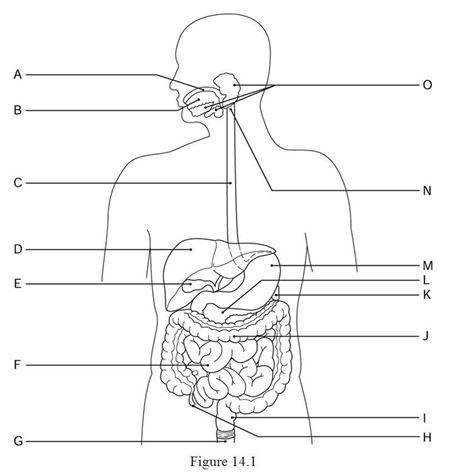 Using Figure 14.1, identify the following:
-The liver is indicated by ________.
Using Figure 14.1, identify the following:
-The liver is indicated by ________. (Multiple Choice)
4.9/5 (86)
(86) Which sphincter, or valve, controls food movement from the stomach into the small intestine?
(Multiple Choice)
4.9/5 (94)
(94) Which one of the following is NOT a subdivision of the large intestine?
(Multiple Choice)
4.9/5 (72)
(72) Match the following phrases with the appropriate process:
-Chewing and segmentation are examples of this process
(Multiple Choice)
4.8/5 (79)
(79) ________ refers to all chemical reactions necessary to maintain life.
(Multiple Choice)
4.8/5 (75)
(75) Which set of salivary glands are situated anterior to the ear?
(Multiple Choice)
4.8/5 (84)
(84) What is the reflex that helps an infant hold on to the nipple and swallow?
(Multiple Choice)
4.9/5 (72)
(72) Which one of the following alimentary segments has NO digestive function?
(Multiple Choice)
4.9/5 (74)
(74) Describe how these chemical reactions assist with blood sugar homeostasis: gluconeogenesis, glycogenolysis, and glycogenesis.
(Essay)
4.7/5 (86)
(86) Secretin and cholecystokinin influence the release of both pancreatic juice and bile.
(True/False)
5.0/5 (80)
(80) Bacteria in the small intestine make some vitamins, such as some B and K.
(True/False)
4.9/5 (89)
(89) Which condition prevents pancreatic juices from reaching the small intestine to break down fats and fat-soluble vitamins?
(Multiple Choice)
4.9/5 (84)
(84) The process by which food within the small intestine is mixed with digestive juices by backward and forward movement across the internal wall of the organ is called ________.
(Multiple Choice)
4.9/5 (79)
(79) 
Filters
- Essay(0)
- Multiple Choice(0)
- Short Answer(0)
- True False(0)
- Matching(0)