



 Chat with AI
Exam 15: The Urinary System

Exam 1: The Human Body: An Orientation128 Questions
Exam 2: Basic Chemistry118 Questions
Exam 3: Cells and Tissues142 Questions
Exam 4: Skin and Body Membranes108 Questions
Exam 5: The Skeletal System124 Questions
Exam 6: The Muscular System129 Questions
Exam 7: The Nervous System161 Questions
Exam 8: Special Senses128 Questions
Exam 9: The Endocrine System149 Questions
Exam 10: Blood116 Questions
Exam 11: The Cardiovascular System295 Questions
Exam 13: The Respiratory System150 Questions
Exam 14: The Digestive System and Body Metabolism162 Questions
Exam 15: The Urinary System138 Questions
Exam 16: The Reproductive System169 Questions
Select questions type


Extracellular fluid is found everywhere in the body EXCEPT ________.
(Multiple Choice)
4.8/5  (67)
(67) The bicarbonate buffer system prevents changes in blood pH through the action of carbonic acid and its salt, sodium bicarbonate.
(True/False)
4.9/5 (77)
(77) Urine is transported from the urinary bladder to the outside of the body by the ________.
(Multiple Choice)
4.9/5 (78)
(78) The need to urinate frequently at night, which plagues over 50% of the elderly, is called ________.
(Multiple Choice)
5.0/5 (84)
(84) 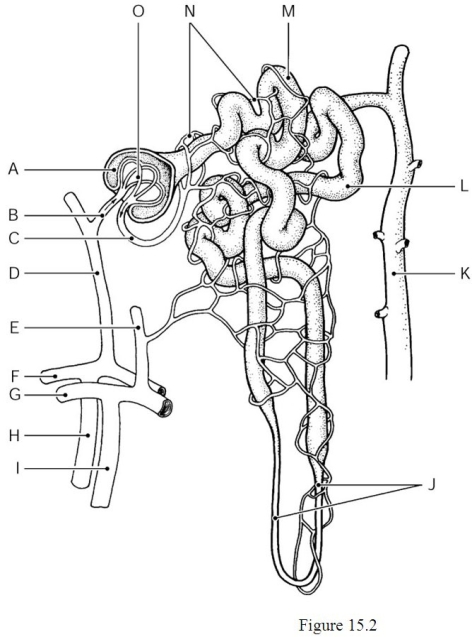 Using Figure 15.2, identify the following:
-The glomerulus is indicated by ________.
Using Figure 15.2, identify the following:
-The glomerulus is indicated by ________. (Multiple Choice)
4.9/5 (82)
(82) Trace the pathway of a red blood cell through the kidney from the renal artery to the renal vein.
(Essay)
4.9/5 (82)
(82) Which one of the following is NOT a substance typically reabsorbed by the tubules under normal healthy conditions?
(Multiple Choice)
4.9/5 (77)
(77) Filtrate formed during glomerular filtration is captured by the ________.
(Multiple Choice)
4.8/5 (73)
(73) The capillary bed surrounding the renal tubule is the ________.
(Multiple Choice)
4.8/5 (76)
(76) The tube connecting each kidney to the urinary bladder is the ________.
(Multiple Choice)
4.8/5 (78)
(78) Identify the urinary structure with its associated description:
A) renal vein
B) renal medulla
C) calyces
D) renal pelvis
E) renal (medullary) pyramids
F) renal columns
G) renal cortex
-Cup-shaped extensions of the pelvis that enclose the tips of the renal (medullary) pyramids
(Essay)
4.9/5 (81)
(81) 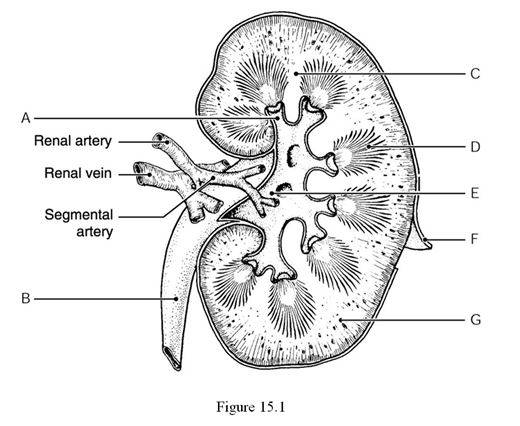 Using Figure 15.1, identify the following:
-The renal pelvis is indicated by ________.
Using Figure 15.1, identify the following:
-The renal pelvis is indicated by ________. (Multiple Choice)
4.8/5 (77)
(77) Antidiuretic hormone (ADH) causes increased water loss through the urine.
(True/False)
4.7/5 (82)
(82) When blood pH becomes too acidic, the tubule cells of the kidneys excrete bicarbonate ions and retain hydrogen ions.
(True/False)
4.8/5 (77)
(77) Most reabsorption occurs in the proximal convoluted tubule of the nephron.
(True/False)
4.9/5 (79)
(79) Identify the urinary structure with its associated description:
A) renal vein
B) renal medulla
C) calyces
D) renal pelvis
E) renal (medullary) pyramids
F) renal columns
G) renal cortex
-Darker, reddish-brown internal area of the kidney
(Essay)
4.8/5 (73)
(73) Antidiuretic hormone prevents excessive water loss by promoting water reabsorption in the ________.
(Multiple Choice)
4.7/5 (90)
(90) 
Filters
- Essay(0)
- Multiple Choice(0)
- Short Answer(0)
- True False(0)
- Matching(0)