



 Chat with AI
Exam 10: Blood

Exam 1: The Human Body: An Orientation128 Questions
Exam 2: Basic Chemistry118 Questions
Exam 3: Cells and Tissues142 Questions
Exam 4: Skin and Body Membranes108 Questions
Exam 5: The Skeletal System124 Questions
Exam 6: The Muscular System129 Questions
Exam 7: The Nervous System161 Questions
Exam 8: Special Senses128 Questions
Exam 9: The Endocrine System149 Questions
Exam 10: Blood116 Questions
Exam 11: The Cardiovascular System295 Questions
Exam 13: The Respiratory System150 Questions
Exam 14: The Digestive System and Body Metabolism162 Questions
Exam 15: The Urinary System138 Questions
Exam 16: The Reproductive System169 Questions
Select questions type


Match the following blood types:
-The most common blood type

Free
(Multiple Choice)
4.7/5  (80)
(80) Correct Answer: Verified
B
Match the following blood types:
-The blood type that forms both anti-A and anti-B antibodies
Free
(Multiple Choice)
4.9/5 (87)
(87) Correct Answer:Verified
VerifiedB
The series of reactions that stop blood flow following a cut is called ________.
Free
(Multiple Choice)
4.9/5 (87)
(87) Correct Answer:Verified
VerifiedC
Megakaryocytes are classified as agranulocytes since they lack visible granules in the cytoplasm.
(True/False)
4.8/5 (70)
(70) A total white blood cell count above 11,000 cells/mm³ is a condition known as ________.
(Multiple Choice)
4.8/5 (89)
(89) If you carry the Rh antigen, you are referred to as Rh ________.
(Multiple Choice)
4.9/5 (77)
(77) Compatibility testing for agglutination of donor RBCs by the recipients' serum is called ________.
(Multiple Choice)
4.8/5 (71)
(71) 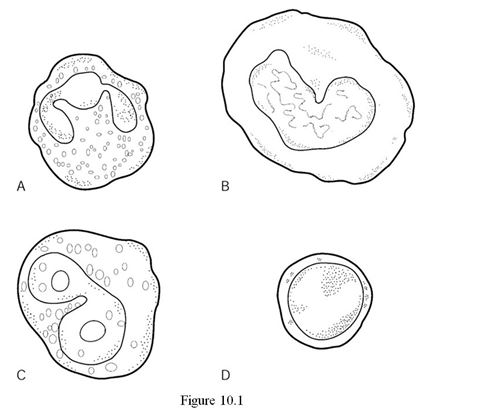 Using Figure 10.1, identify the following:
-The neutrophil is indicated by ________.
Using Figure 10.1, identify the following:
-The neutrophil is indicated by ________. (Multiple Choice)
4.8/5 (89)
(89) Discuss why Martina, who has blood type A, cannot receive blood type B during a transfusion.
(Essay)
4.8/5 (85)
(85) Match the following blood types:
-The blood type that can receive blood types B and AB
(Multiple Choice)
4.8/5 (68)
(68) Cross matching prevents transfusion reactions by testing for agglutination between donor and recipient blood prior to the transfusion.
(True/False)
4.9/5 (87)
(87) The condition in which fetal RBCs are destroyed faster than the infant liver can rid the body of the breakdown products of hemoglobin is called ________.
(Multiple Choice)
4.9/5 (73)
(73) The percentage of erythrocytes in blood is known as the ________.
(Multiple Choice)
4.8/5 (88)
(88) Match the following function with its blood cell:
-Excess of these cells cause polycythemia
(Multiple Choice)
4.8/5 (80)
(80) Normal blood pH falls in a range between ________ to ________.
(Multiple Choice)
4.9/5 (76)
(76)
Using Figure 10.1, identify the following:
-The granulocytes are indicated by ________ and ________.
Using Figure 10.1, identify the following:
-The granulocytes are indicated by ________ and ________. (Multiple Choice)
4.8/5 (69)
(69) Which of the following cells are classified as granulocytes?
(Multiple Choice)
4.8/5 (81)
(81) 
Filters
- Essay(0)
- Multiple Choice(0)
- Short Answer(0)
- True False(0)
- Matching(0)