



 Chat with AI
Exam 3: Cells and Tissues


Match the following:
-Cleavage furrow squeezes the cell into two parts

 (82)
 Verified
D
Discuss the three steps in protein synthesis.
(76) Verified1. Uncoiling of DNA-the DNA segment or gene that specifies one polypeptide or protein uncoils.
2. Transcription (DNA-directed synthesis of mRNA)-one strand of DNA acts as a template for the synthesis of the complementary mRNA molecule, and there is a transfer of information from the DNA's base sequence (cod.Einto the complementary base sequence of mRNA (codon).
3. Translation (RNA-directed synthesis of a polypeptide or protein) involves five steps. First, mRNA leaves the nucleus and attaches to ribosomes. Second, tRNA (anticodon) transports an amino acid to the mRNA strand and recognizes a mRNA molecule (codon). Third, the codon and the anticodon bind. Fourth, the ribosome moves the mRNA strand along as each codon is read sequentially. Finally, as each amino acid is bound to the next by a polypeptide bond, its tRNA is released. The polypeptide or protein chain is released when the termination (stop) codon is read.
The two major phases of protein synthesis are ________.
(83) VerifiedD
Anaphase is the stage of cell division when the cleavage furrow first appears.
(69) ________ glands possess ducts that transport secretions onto epithelial surfaces.
(77) Match the following:
-Type of tissue whose two functional characteristics are irritability and conductivity
(81) Match the following:
-Type of tissue that is specialized to contract and produce movement
(80) The ________ is a network of proteins that forms an internal framework for the cell.
(73) Which of the following is NOT considered a cytoplasmic organelle?
(84) Passive processes that move substances across membranes ________.
(92) The passive process that involves the movement of water through aquaporins is ________.
(76) Match the following:
-Type of tissue that can be classified as loose or dense
(69) In cell division, the term that refers to division of the cytoplasm is ________.
(70) 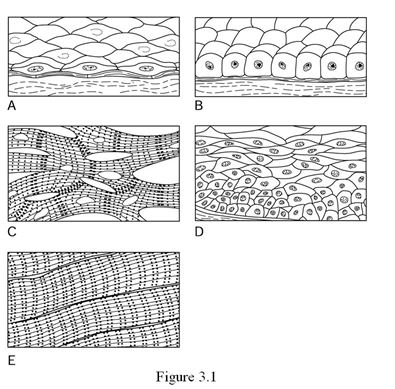 Using Figure 3.1, match the following:
-The illustration of skeletal muscle tissue is ________.
Using Figure 3.1, match the following:
-The illustration of skeletal muscle tissue is ________. (85)
Using Figure 3.1, match the following:
-The illustration of simple squamous epithelium is ________.
Using Figure 3.1, match the following:
-The illustration of simple squamous epithelium is ________. (74) Match the following:
-Nucleoli appear in each daughter cell
(60)
Using Figure 3.1, match the following:
-The illustration of simple cuboidal epithelium is ________.
Using Figure 3.1, match the following:
-The illustration of simple cuboidal epithelium is ________. (85) ________, a type of cell junction, anchor adjacent cells together and prevent cells from being pulled apart.
(70) Looking into a microscope, you notice cells swimming, propelled by a long tail. What cell structure must these cells have in order to be mobile?
(77) 
Filters
- Essay(0)
- Multiple Choice(0)
- Short Answer(0)
- True False(0)
- Matching(0)