



 Chat with AI
Exam 13: The Respiratory System

Exam 1: The Human Body: An Orientation128 Questions
Exam 2: Basic Chemistry118 Questions
Exam 3: Cells and Tissues142 Questions
Exam 4: Skin and Body Membranes108 Questions
Exam 5: The Skeletal System124 Questions
Exam 6: The Muscular System129 Questions
Exam 7: The Nervous System161 Questions
Exam 8: Special Senses128 Questions
Exam 9: The Endocrine System149 Questions
Exam 10: Blood116 Questions
Exam 11: The Cardiovascular System295 Questions
Exam 13: The Respiratory System150 Questions
Exam 14: The Digestive System and Body Metabolism162 Questions
Exam 15: The Urinary System138 Questions
Exam 16: The Reproductive System169 Questions
Select questions type


Match the following structure with its description:
-Smallest conducting passageways in the lungs

Free
(Multiple Choice)
4.9/5  (78)
(78) Correct Answer: Verified
D
Which one of the following is NOT a feature of chronic obstructive pulmonary disease (COPD)?
Free
(Multiple Choice)
4.9/5 (79)
(79) Correct Answer:Verified
VerifiedA
Explain the roles of mucus and cilia in the respiratory system.
Free
(Essay)
4.8/5 (88)
(88) Correct Answer:Verified
VerifiedRespiratory mucosa lines the nasal cavity which produces sticky mucus. This mucus moistens the air and traps incoming bacteria and other foreign debris entering the nasal cavity. The ciliated cells of the nasal mucosa move this contaminated mucus posteriorly toward the pharynx where it can be swallowed. The trachea is also lined with ciliated mucosa. These cilia move contaminated mucus toward the throat where it either can be swallowed or spat out.
List the three regions of the pharynx and identify their relative superior and inferior endpoints in the respiratory passageway.
(Essay)
4.8/5 (83)
(83) Alveolar macrophages patrol the alveoli to engulf and remove bacteria, carbon particles, and other debris.
(True/False)
4.9/5 (92)
(92) Match the following with the four events of respiration:
-Oxygen loading and carbon dioxide unloading
(Multiple Choice)
4.7/5 (73)
(73) 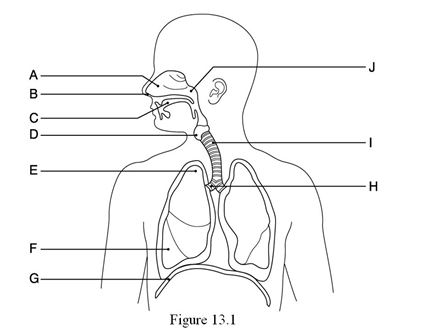 Using Figure 13.1, identify the following:
-The nasal cavity is indicated by ________.
Using Figure 13.1, identify the following:
-The nasal cavity is indicated by ________. (Multiple Choice)
4.9/5 (88)
(88) Normal quiet breathing, known as tidal volume, is around 500 mL of air.
(True/False)
5.0/5 (81)
(81) Air from the nasal cavity enters the superior portion of the pharynx called the ________.
(Multiple Choice)
4.7/5 (77)
(77) Match the following definitions with their associated respiratory volume or capacity:
-Amount of air that can be inhaled forcibly over the tidal volume
(Multiple Choice)
4.9/5 (83)
(83) Which respiratory disease in which sufferers are often called "pink puffers," is characterized by enlarged alveoli, lung inflammation, and fibrosis of the lungs?
(Multiple Choice)
4.8/5 (79)
(79) Following the removal of the larynx, a person would be unable to ________.
(Multiple Choice)
4.7/5 (74)
(74) Identify the two pleural membranes and describe them under normal and disease conditions.
(Essay)
5.0/5 (77)
(77) Match the following with the four events of respiration:
-Breathing in and out while at rest
(Multiple Choice)
4.8/5 (70)
(70)
Using Figure 13.1, identify the following:
-The trachea is indicated by ________.
Using Figure 13.1, identify the following:
-The trachea is indicated by ________. (Multiple Choice)
4.8/5 (70)
(70) The opening between the vocal cords is called the ________.
(Multiple Choice)
4.9/5 (78)
(78) The portion of the pharynx continuous with the mouth is termed the oropharynx.
(True/False)
4.8/5 (84)
(84) The bronchioles are the smallest of the conducting passageways in the lungs.
(True/False)
4.8/5 (82)
(82) Air moving in and out of the lungs during normal quiet breathing is called ________.
(Multiple Choice)
4.8/5 (87)
(87) ________ volume is the air moved into and out of the lungs during normal quiet breathing and is approximately 500 mL of air.
(Multiple Choice)
4.9/5 (86)
(86) 
Filters
- Essay(0)
- Multiple Choice(0)
- Short Answer(0)
- True False(0)
- Matching(0)