



 Chat with AI
Exam 13: The Respiratory System

Exam 1: The Human Body: An Orientation128 Questions
Exam 2: Basic Chemistry118 Questions
Exam 3: Cells and Tissues142 Questions
Exam 4: Skin and Body Membranes108 Questions
Exam 5: The Skeletal System124 Questions
Exam 6: The Muscular System129 Questions
Exam 7: The Nervous System161 Questions
Exam 8: Special Senses128 Questions
Exam 9: The Endocrine System149 Questions
Exam 10: Blood116 Questions
Exam 11: The Cardiovascular System295 Questions
Exam 13: The Respiratory System150 Questions
Exam 14: The Digestive System and Body Metabolism162 Questions
Exam 15: The Urinary System138 Questions
Exam 16: The Reproductive System169 Questions
Select questions type


The larynx routes air and food into their proper channel and plays an important role in speech production.
(True/False)
4.8/5  (71)
(71) Surfactant is usually present in fetal lungs in adequate quantities by ________.
(Multiple Choice)
4.9/5 (80)
(80) The three mucosa-covered projections into the nasal cavity that greatly increase surface area of mucosa exposed to air are called ________.
(Multiple Choice)
4.9/5 (86)
(86) The pharynogotympanic tubes, which drain the middle ear, open into the ________.
(Multiple Choice)
4.8/5 (82)
(82) The process of moving air into and out of the lungs is commonly called breathing or ________.
(Multiple Choice)
4.9/5 (75)
(75) Which one of the following bones does NOT contain paranasal sinuses?
(Multiple Choice)
4.8/5 (84)
(84) Oxygen is unloaded from the blood stream and diffuses into surrounding cells and tissues during ________.
(Multiple Choice)
4.8/5 (72)
(72) Chronically inflamed, hypersensitive bronchial passages that respond to many irritants are characteristic of ________.
(Multiple Choice)
4.8/5 (66)
(66) The serous membrane that surrounds each lung is created by a parietal and visceral ________.
(Multiple Choice)
4.8/5 (78)
(78) 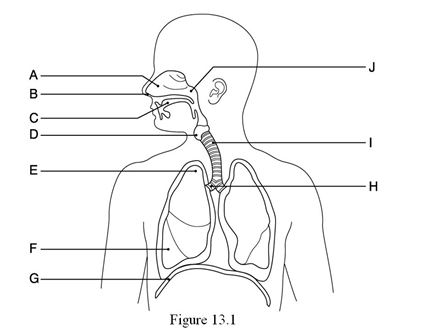 Using Figure 13.1, identify the following:
-The inferior lobe of the right lung is indicated by ________.
Using Figure 13.1, identify the following:
-The inferior lobe of the right lung is indicated by ________. (Multiple Choice)
4.8/5 (79)
(79) The surface of each lung is covered by pulmonary, or visceral pleura.
(True/False)
4.8/5 (66)
(66) Hyperventilation leads to all of the following except ________.
(Multiple Choice)
5.0/5 (90)
(90) Which one of the following structures is NOT part of the respiratory zone?
(Multiple Choice)
4.7/5 (88)
(88) The respiratory movement representing the total amount of exchangeable air is the ________.
(Multiple Choice)
4.8/5 (84)
(84)
Using Figure 13.1, identify the following:
-The pharynx is indicated by ________.
Using Figure 13.1, identify the following:
-The pharynx is indicated by ________. (Multiple Choice)
4.7/5 (81)
(81) The gas exchange that occurs between blood and tissue cells at systemic capillaries is called ________.
(Multiple Choice)
4.9/5 (76)
(76) The nasal cavity is separated from the oral cavity by the nasal conchae.
(True/False)
4.9/5 (70)
(70)
Using Figure 13.1, identify the following:
-The larynx is indicated by ________.
Using Figure 13.1, identify the following:
-The larynx is indicated by ________. (Multiple Choice)
4.8/5 (81)
(81) Match the following definitions with their associated respiratory volume or capacity:
-Amount of air that can be forcibly exhaled after a normal tidal expiration
(Multiple Choice)
4.9/5 (83)
(83) 
Filters
- Essay(0)
- Multiple Choice(0)
- Short Answer(0)
- True False(0)
- Matching(0)