



 Chat with AI
Exam 10: Blood

Exam 1: The Human Body: An Orientation128 Questions
Exam 2: Basic Chemistry118 Questions
Exam 3: Cells and Tissues142 Questions
Exam 4: Skin and Body Membranes108 Questions
Exam 5: The Skeletal System124 Questions
Exam 6: The Muscular System129 Questions
Exam 7: The Nervous System161 Questions
Exam 8: Special Senses128 Questions
Exam 9: The Endocrine System149 Questions
Exam 10: Blood116 Questions
Exam 11: The Cardiovascular System295 Questions
Exam 13: The Respiratory System150 Questions
Exam 14: The Digestive System and Body Metabolism162 Questions
Exam 15: The Urinary System138 Questions
Exam 16: The Reproductive System169 Questions
Select questions type


The process whereby the binding of antibodies to antigens causes RBCs to clump is called ________.
(Multiple Choice)
4.7/5  (79)
(79) A persistent clot in an unbroken blood vessel is known as ________.
(Multiple Choice)
4.9/5 (89)
(89) The condition in which maternal antibodies cross the placenta and destroy the baby's RBCs is called ________.
(Multiple Choice)
5.0/5 (77)
(77) Which blood type(s) can a person with blood type O receive?
(Multiple Choice)
4.9/5 (88)
(88) Life at a high altitude can lead to a red blood cell disorder known as ________.
(Multiple Choice)
4.8/5 (80)
(80) Physiologic jaundice occurring in newborns results from ________.
(Multiple Choice)
4.8/5 (91)
(91) The most common type of blood in the U.S. population is ________.
(Multiple Choice)
4.9/5 (79)
(79) Match the following function with its blood cell:
-Granulocytes and agranulocytes are classified as types of these cells
(Multiple Choice)
4.9/5 (72)
(72) The rate of erythrocyte production is controlled by a hormone known as ________.
(Multiple Choice)
4.7/5 (80)
(80) Place these leukocytes in order from the most common to the least common:
1) basophil
2) eosinophil
3) lymphocyte
4) monocyte
5) neutrophil
(Multiple Choice)
4.8/5 (83)
(83) During coagulation, long, hairlike molecules known as ________ form the basis for a clot.
(Multiple Choice)
4.7/5 (95)
(95) What enzyme joins soluble fibrinogen proteins into long molecules of fibrin during coagulation?
(Multiple Choice)
4.8/5 (82)
(82) A decrease in the oxygen-carrying ability of the blood, for any reason, is a condition known as ________.
(Multiple Choice)
4.9/5 (88)
(88) 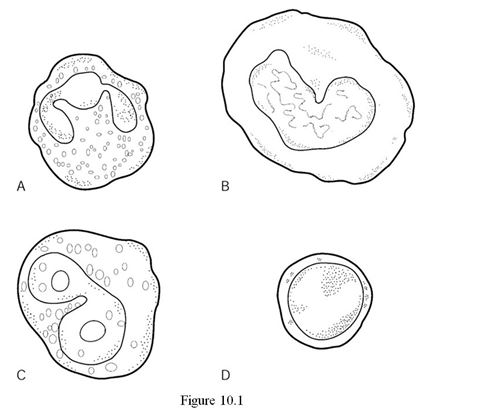 Using Figure 10.1, identify the following:
-The lymphocyte is indicated by ________.
Using Figure 10.1, identify the following:
-The lymphocyte is indicated by ________. (Multiple Choice)
4.9/5 (62)
(62) The organ largely responsible for the synthesis of clotting factors is the ________.
(Multiple Choice)
4.8/5 (89)
(89) Severe shock that can be fatal occurs with blood loss exceeding ________.
(Multiple Choice)
4.9/5 (76)
(76) 
Filters
- Essay(0)
- Multiple Choice(0)
- Short Answer(0)
- True False(0)
- Matching(0)