



 Chat with AI
Exam 15: The Urinary System

Exam 1: The Human Body: An Orientation128 Questions
Exam 2: Basic Chemistry118 Questions
Exam 3: Cells and Tissues142 Questions
Exam 4: Skin and Body Membranes108 Questions
Exam 5: The Skeletal System124 Questions
Exam 6: The Muscular System129 Questions
Exam 7: The Nervous System161 Questions
Exam 8: Special Senses128 Questions
Exam 9: The Endocrine System149 Questions
Exam 10: Blood116 Questions
Exam 11: The Cardiovascular System295 Questions
Exam 13: The Respiratory System150 Questions
Exam 14: The Digestive System and Body Metabolism162 Questions
Exam 15: The Urinary System138 Questions
Exam 16: The Reproductive System169 Questions
Select questions type


In males, the urethra is part of both the urinary system and ________.
(Multiple Choice)
4.9/5  (69)
(69) 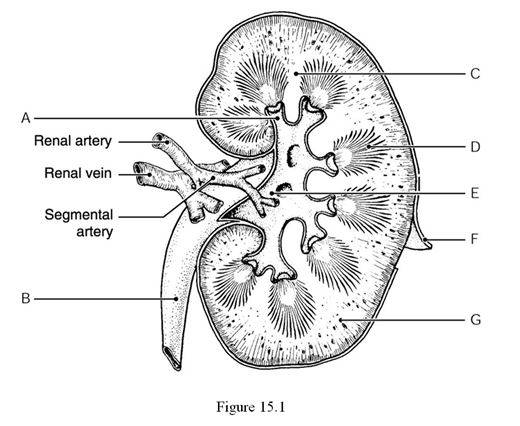 Using Figure 15.1, identify the following:
-The renal cortex is indicated by ________.
Using Figure 15.1, identify the following:
-The renal cortex is indicated by ________. (Multiple Choice)
4.8/5 (67)
(67) The kidneys are situated in a retroperitoneal position and found between the T₁₂ and L₃ vertebrae.
(True/False)
4.9/5 (76)
(76) Which one of the following is NOT one of the major roles of the kidneys in normal healthy adults?
(Multiple Choice)
4.8/5 (79)
(79) Identify the process that occurs in the kidney.
A) tubular reabsorption
B) glomerular filtration
C) tubular secretion
-Opposite process to tubular reabsorption
(Essay)
4.7/5 (75)
(75) The micturition reflex forces urine into the upper part of the ________.
(Multiple Choice)
4.9/5 (77)
(77) 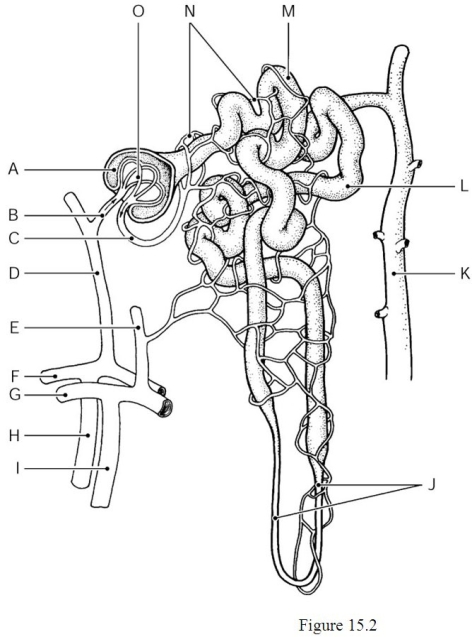 Using Figure 15.2, identify the following:
-The glomerular capsule (Bowman's capsule) is indicated by ________.
Using Figure 15.2, identify the following:
-The glomerular capsule (Bowman's capsule) is indicated by ________. (Multiple Choice)
4.9/5 (63)
(63) The urethra, which carries urine exiting the urinary bladder by peristalsis, is typically shorter in females than in males.
(True/False)
4.9/5 (75)
(75) Urine has a specific gravity closest to 1.001 when excessive fluids are consumed.
(True/False)
4.8/5 (80)
(80) Tubular secretion moves items from the blood of the peritubular capillaries to the filtrate for elimination in the urine.
(True/False)
4.8/5 (80)
(80) Describe how the bicarbonate buffer system functions to maintain pH.
(Essay)
4.8/5 (79)
(79) Identify the urinary structure with its associated description:
A) renal vein
B) renal medulla
C) calyces
D) renal pelvis
E) renal (medullary) pyramids
F) renal columns
G) renal cortex
-Triangular regions with a striped appearance
(Essay)
4.8/5 (77)
(77) Highly sensitive cells within the hypothalamus that react to changes in blood composition and cause the release of antidiuretic hormone (ADH) when appropriate are called ________.
(Multiple Choice)
4.8/5 (81)
(81) The functional unit of the kidney that filters blood and forms urine is the ________.
(Multiple Choice)
4.8/5 (89)
(89) Renal (medullary) pyramids are separated by extensions of cortex-like tissue called the ________.
(Multiple Choice)
4.9/5 (73)
(73) Why is the trigone of the urinary bladder clinically important?
(Multiple Choice)
4.9/5 (69)
(69) Identify the process that occurs in the kidney.
A) tubular reabsorption
B) glomerular filtration
C) tubular secretion
-Antidiuretic hormone (ADH) promotes the movement of water from the filtrate back into the blood of the peritubular capillaries
(Essay)
4.8/5 (82)
(82) The peritubular capillary bed arises from the afferent arteriole.
(True/False)
4.9/5 (77)
(77) 
Filters
- Essay(0)
- Multiple Choice(0)
- Short Answer(0)
- True False(0)
- Matching(0)