



 Chat with AI
Exam 11: Eukaryotic Microorganisms and Parasites

Exam 1: Scope and History of Microbiology55 Questions
Exam 2: Fundamentals of Chemistry63 Questions
Exam 3: Microscopy and Staining56 Questions
Exam 4: Characteristics of Prokaryotic and Eukaryotic Cells63 Questions
Exam 5: Essential Concepts of Metabolism56 Questions
Exam 6: Growth and Culturing of Bacteria58 Questions
Exam 7: Microbial Genetics60 Questions
Exam 8: Gene Transfer and Genetic Engineering57 Questions
Exam 9: An Introduction to Taxonomy: the Bacteria58 Questions
Exam 10: Viruses56 Questions
Exam 11: Eukaryotic Microorganisms and Parasites58 Questions
Exam 12: Sterilization and Disinfection60 Questions
Exam 13: Antimicrobial Therapy56 Questions
Exam 14: Host-Microbe Relationships and Disease Processes55 Questions
Exam 15: Epidemiology and Nosocomial Infections55 Questions
Exam 16: Innate Host Defenses56 Questions
Exam 17: Immunology I: Basic Principles of Adaptive Immunity and Immunization56 Questions
Exam 18: Immunology Ii: Immunological Disorders and Tests60 Questions
Exam 19: Diseases of the Skin and Eyes; Wounds and Bites56 Questions
Exam 20: Urogenital and Sexually Transmitted Diseases57 Questions
Exam 21: Diseases of the Respiratory System58 Questions
Exam 22: Oral and Gastrointestinal Diseases57 Questions
Exam 23: Cardiovascular, lymphatic and Systemic Disease57 Questions
Exam 24: Diseases of the Nervous System56 Questions
Exam 25: Environmental Microbiology55 Questions
Exam 26: Applied Microbiology57 Questions
Select questions type


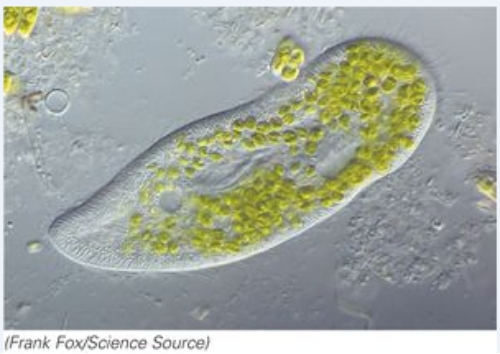

The major characteristic used to divide protozoans into four major groups is _____.
(Multiple Choice)
4.9/5  (67)
(67) Outline or illustrate in detailed form the life cycle of the malaria parasite,naming the stages and the various host organisms involved.Describe another protozoan that causes human diseases.
(Essay)
4.8/5 (82)
(82) Protists may be described according to whether they resemble organisms in each of the following kingdoms except:
(Multiple Choice)
4.8/5 (74)
(74) Parasites having both male and female reproductive organs are known as _____.
(Multiple Choice)
4.8/5 (88)
(88) Human fungal diseases are known by the general name _______.
(Multiple Choice)
4.8/5 (88)
(88) Organisms that are normally free living but can also obtain nutrients from a host are called _____.
(Multiple Choice)
4.9/5 (76)
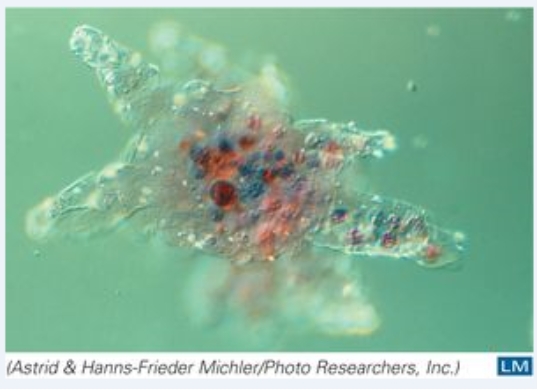
(76) 
Parasites are dependent on their hosts for survival. Which organism do you think is better adapted to a parasitic lifestyle,one that is virulent and often kills its host,or one that only causes mild chronic illness in its host? For vector-transmitted parasites there are two hosts involved in the lifecycle,how does that complicate adaptation to the human host?
(Essay)
4.8/5 (76)
(76) Fungal hyphae are sometimes separated into smaller compartments by cross walls called _____.
(Multiple Choice)
4.7/5 (81)
(81) Fungi with no known sexual stage (in their life cycle)are assigned to the phylum _____.
(Multiple Choice)
4.7/5 (81)
(81) 
Filters
- Essay(0)
- Multiple Choice(0)
- Short Answer(0)
- True False(0)
- Matching(0)