



 Chat with AI
Exam 13: Monopolistic Competition and Oligopoly

Exam 1: Getting Started337 Questions
Exam 2: The Us and Global Economies201 Questions
Exam 3: The Economic Problem273 Questions
Exam 4: Demand and Supply322 Questions
Exam 5: Elasticities of Demand and Supply335 Questions
Exam 6: Efficiency and Fairness of Markets352 Questions
Exam 7: Government Actions in Markets349 Questions
Exam 8: Global Markets in Action276 Questions
Exam 9: Externalities: Pollution, Education, and Health Care290 Questions
Exam 10: Production and Cost266 Questions
Exam 11: Perfect Competition275 Questions
Exam 12: Monopoly377 Questions
Exam 13: Monopolistic Competition and Oligopoly316 Questions
Exam 14: Gdp: a Measure of Total Production and Income253 Questions
Exam 15: Jobs and Unemployment283 Questions
Exam 16: The Cpi and the Cost of Living263 Questions
Exam 17: Potential Gdp and Economic Growth328 Questions
Exam 18: Money and the Monetary System360 Questions
Exam 19: Aggregate Supply and Aggregate Demand301 Questions
Exam 20: Fiscal Policy and Monetary Policy223 Questions
Select questions type


Monopolistic competition is defined as a type of market structure in which
(Multiple Choice)
5.0/5  (94)
(94) What do demand and marginal revenue curves look like in monopolistic competition?
How do they compare to the demand and marginal revenue curves in perfect competition and monopoly?
(Essay)
4.9/5 (85)
(85) If all firms in the industry have similar demand, marginal revenue, and cost curves as the firm in the figure above, in the long run
(Multiple Choice)
4.9/5 (88)
(88) For a firm in monopolistic competition, define efficient scale and excess capacity. Briefly explain each.
(Essay)
4.9/5 (78)
(78)  -Suppose MCI and AT&T can each charge either 3¢ or 4¢ a minute for a long distance call. The above table illustrates the payoffs, in millions of dollars, from each of the four possible outcomes that could occur in their duopoly setting. If MCI charges 4¢ a minute and AT&T charges 4¢ a minute, then MCI's profit will be ________ million and AT&T's profit will be ________ million.
 (Multiple Choice)
4.9/5 (81)
(81) If the four-firm concentration ratio for the market for diapers is 73 percent, then this industry is best characterized as
(Multiple Choice)
4.9/5 (78)
(78) For a firm in monopolistic competition, innovation and product development are
(Multiple Choice)
5.0/5 (80)
(80) The Herfindahl-Hirschman Index is the ________ of the percentage market share of each firm summed over the largest 50 firms in a market.
(Multiple Choice)
4.9/5 (71)
(71) In the long-run, a firm in monopolistic competition produces at an output level where
(Multiple Choice)
4.7/5 (85)
(85) How do product development and marketing affect a firm in monopolistic competition?
(Essay)
4.8/5 (96)
(96) To maintain their economic profits, firms in monopolistic competition must continually engage in
(Multiple Choice)
4.9/5 (81)
(81) Suppose two companies, Sony and Magnavox, are competing in a duopoly. If both companies charge a high price, they each earn $700 million in economic profit. If both companies charge a low price, they each earn $500 million in economic profit. If one company charges a high price and the other a low price, the company charging the higher price earns $450 million in economic profit and the company charging the lower price earns $800 million in economic profit.
a. Complete the payoff matrix below for Sony and Magnavox.
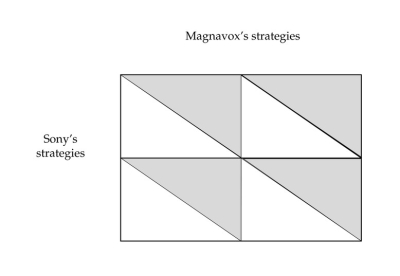 b. Find the Nash equilibrium.
 (Essay)
4.8/5 (88)
(88) A market in which the Herfindahl-Hirschman Index exceeds 1,800 is considered to be
(Multiple Choice)
4.9/5 (81)
(81) 
Filters
- Essay(0)
- Multiple Choice(0)
- Short Answer(0)
- True False(0)
- Matching(0)