



 Chat with AI
Exam 17: The Special Senses

Exam 1: An Introduction to Anatomy and Physiology95 Questions
Exam 2: The Chemical Level of Organization183 Questions
Exam 3: The Cellular Level of Organization190 Questions
Exam 4: The Tissue Level of Organization139 Questions
Exam 5: The Integumentary System118 Questions
Exam 6: Bones and Bone Structure165 Questions
Exam 7: The Axial Skeleton146 Questions
Exam 8: The Appendicular Skeleton119 Questions
Exam 9: Joints134 Questions
Exam 10: Muscle Tissue137 Questions
Exam 11: The Muscular System152 Questions
Exam 12: Nervous Tissue158 Questions
Exam 13: The Spinal Cord, Spinal Nerves, and Spinal Reflexes115 Questions
Exam 14: The Brain and Cranial Nerves187 Questions
Exam 15: Sensory Pathways and the Somatic Nervous System125 Questions
Exam 16: The Autonomic Nervous System and Higher-Order Functions129 Questions
Exam 17: The Special Senses170 Questions
Exam 18: The Endocrine System188 Questions
Exam 19: Blood162 Questions
Exam 20: The Heart178 Questions
Exam 21: Blood Vessels and Circulation225 Questions
Exam 22: The Lymphatic System and Immunity167 Questions
Exam 23: The Respiratory System200 Questions
Exam 24: The Digestive System213 Questions
Exam 25: Metabolism, Nutrition, and Energetics140 Questions
Exam 26: The Urinary System137 Questions
Exam 27: Fluid, Electrolyte, and Acid-Base Balance66 Questions
Exam 28: The Reproductive System203 Questions
Exam 29: Development and Inheritance146 Questions
Select questions type


Jonathan received a strong blow to the eye. The eyeball remained intact but he suddenly could not see. Thishas likely caused
(Multiple Choice)
4.9/5  (83)
(83) Damage to the insula is most likely to affect which of the following senses?
(Multiple Choice)
4.9/5 (74)
(74) ________ deafness results from conditions in the outer or middle ear that block the transfer of vibrationsfrom the environment to the tympanic membrane or to the oval window.
(Multiple Choice)
4.8/5 (80)
(80) The following is a list of the steps that occur in the production of an auditory sensation. What is the proper sequence for these steps?
1) The pressure wave distorts the basilar membrane on its way to the round window.
2) Movement of the tympanic membrane causes displacement of the malleus.
3) Displacement of the stereocilia stimulates sensory neurons of the cochlear nerve.
4) Movement of the malleus causes movement of the incus and stapes.
5) Distortion of the basilar membrane forces the hair cells of the spiral organ to vibrate against the tectorial membrane.
6) Movement of the oval window establishes pressure waves in the perilymph of the scala vestibuli.
(Multiple Choice)
4.8/5 (84)
(84) During accommodation, the ciliary muscle ________ causing the ciliary body to move ________ and apply ________ tension on the lens.
(Multiple Choice)
4.9/5 (81)
(81) What structure regulates the amount of light that passes to the photoreceptors of the eye?
(Multiple Choice)
4.8/5 (73)
(73) A typical gustatory cell survives for only about ________ day(s) before it is replaced.
(Multiple Choice)
4.8/5 (69)
(69) The elevated ridges within the semicircular canals that support the hair cells are known as
(Multiple Choice)
4.8/5 (88)
(88) Which of the following produces a lipid-rich secretion that prevents the upper and lower eyelids from sticking together at their edges?
(Multiple Choice)
4.8/5 (72)
(72) Which structure of the brain does not receive any auditory input?
(Multiple Choice)
4.8/5 (85)
(85) Figure 17-2 The Ear
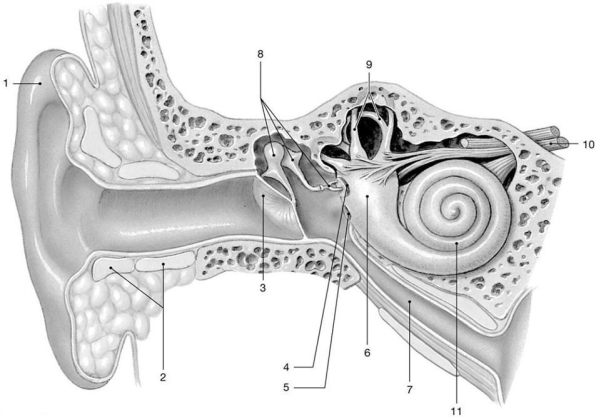 Use Figure 17-2 to answer the following questions:
-Which structure is known as the vestibule?
Use Figure 17-2 to answer the following questions:
-Which structure is known as the vestibule? (Multiple Choice)
4.8/5 (69)
(69) Each gustatory cell extends ________ (called taste hairs) into the surrounding fluids through a narrow taste pore.
(Multiple Choice)
4.9/5 (82)
(82) A period of adjustment is required when moving from a dark room into bright light because
(Multiple Choice)
4.7/5 (85)
(85) 
Filters
- Essay(0)
- Multiple Choice(0)
- Short Answer(0)
- True False(0)
- Matching(0)