



 Chat with AI
Exam 17: The Special Senses

Exam 1: An Introduction to Anatomy and Physiology95 Questions
Exam 2: The Chemical Level of Organization183 Questions
Exam 3: The Cellular Level of Organization190 Questions
Exam 4: The Tissue Level of Organization139 Questions
Exam 5: The Integumentary System118 Questions
Exam 6: Bones and Bone Structure165 Questions
Exam 7: The Axial Skeleton146 Questions
Exam 8: The Appendicular Skeleton119 Questions
Exam 9: Joints134 Questions
Exam 10: Muscle Tissue137 Questions
Exam 11: The Muscular System152 Questions
Exam 12: Nervous Tissue158 Questions
Exam 13: The Spinal Cord, Spinal Nerves, and Spinal Reflexes115 Questions
Exam 14: The Brain and Cranial Nerves187 Questions
Exam 15: Sensory Pathways and the Somatic Nervous System125 Questions
Exam 16: The Autonomic Nervous System and Higher-Order Functions129 Questions
Exam 17: The Special Senses170 Questions
Exam 18: The Endocrine System188 Questions
Exam 19: Blood162 Questions
Exam 20: The Heart178 Questions
Exam 21: Blood Vessels and Circulation225 Questions
Exam 22: The Lymphatic System and Immunity167 Questions
Exam 23: The Respiratory System200 Questions
Exam 24: The Digestive System213 Questions
Exam 25: Metabolism, Nutrition, and Energetics140 Questions
Exam 26: The Urinary System137 Questions
Exam 27: Fluid, Electrolyte, and Acid-Base Balance66 Questions
Exam 28: The Reproductive System203 Questions
Exam 29: Development and Inheritance146 Questions
Select questions type


The ________ convey(s) information about head position with respect to gravity.
(Multiple Choice)
4.8/5  (90)
(90) Stimulation of receptors within the trigeminal nerve might produce a perception of
(Multiple Choice)
4.8/5 (80)
(80) Our taste buds are most receptive to which of the following types of compounds?
(Multiple Choice)
4.9/5 (57)
(57) Which of the following is a function of the pigmented layer of the retina?
(Multiple Choice)
4.8/5 (79)
(79) Figure 17-1 The Sectional Anatomy of the Eye
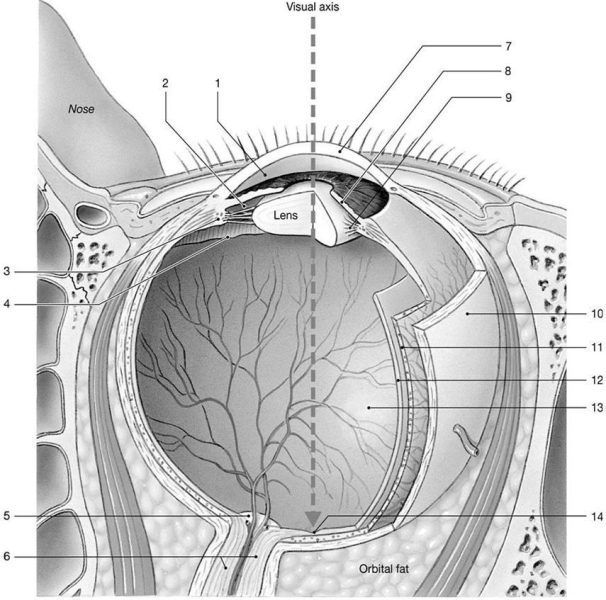 Use Figure 17-1 to answer the following questions:
-Identify the structure labeled "7."
Use Figure 17-1 to answer the following questions:
-Identify the structure labeled "7." (Multiple Choice)
4.9/5 (68)
(68) ________ deafness occurs because of a problem in the cochlea or somewhere along the auditory pathway.
(Multiple Choice)
4.8/5 (76)
(76) The vestibular nuclei at the boundary of the pons and the medulla function in all of the following except
(Multiple Choice)
4.9/5 (69)
(69) Low frequency sounds stimulate hair cells on which part of the basilar membrane?
(Multiple Choice)
4.9/5 (77)
(77) A structure that is located at the medial angle and contains glands that contribute to a gritty depositisthe
(Multiple Choice)
4.8/5 (71)
(71) Where are the visual pigments located in the rods and cones?
(Multiple Choice)
4.8/5 (78)
(78) Amacrine and ________ cells facilitate or inhibit communication between photoreceptors and ganglion cells.
(Multiple Choice)
4.9/5 (66)
(66) When odorant molecules contact the dendritic processes of olfactory receptors the initial response is
(Multiple Choice)
4.8/5 (75)
(75) Figure 17-1 The Sectional Anatomy of the Eye
Use Figure 17-1 to answer the following questions:
-Identify the structure labeled "14."
Use Figure 17-1 to answer the following questions:
-Identify the structure labeled "14." (Multiple Choice)
4.7/5 (81)
(81) Shaking your head "no" will stimulate the hair cells of the
(Multiple Choice)
4.9/5 (88)
(88) Which of the following is false concerning lacrimal glands?
(Multiple Choice)
4.8/5 (79)
(79) The structure attached to the oval window that transmits vibrations from the tympanic membrane to the inner ear is the
(Multiple Choice)
4.8/5 (77)
(77) 
Filters
- Essay(0)
- Multiple Choice(0)
- Short Answer(0)
- True False(0)
- Matching(0)