



 Chat with AI
Exam 17: The Special Senses

Exam 1: An Introduction to Anatomy and Physiology95 Questions
Exam 2: The Chemical Level of Organization183 Questions
Exam 3: The Cellular Level of Organization190 Questions
Exam 4: The Tissue Level of Organization139 Questions
Exam 5: The Integumentary System118 Questions
Exam 6: Bones and Bone Structure165 Questions
Exam 7: The Axial Skeleton146 Questions
Exam 8: The Appendicular Skeleton119 Questions
Exam 9: Joints134 Questions
Exam 10: Muscle Tissue137 Questions
Exam 11: The Muscular System152 Questions
Exam 12: Nervous Tissue158 Questions
Exam 13: The Spinal Cord, Spinal Nerves, and Spinal Reflexes115 Questions
Exam 14: The Brain and Cranial Nerves187 Questions
Exam 15: Sensory Pathways and the Somatic Nervous System125 Questions
Exam 16: The Autonomic Nervous System and Higher-Order Functions129 Questions
Exam 17: The Special Senses170 Questions
Exam 18: The Endocrine System188 Questions
Exam 19: Blood162 Questions
Exam 20: The Heart178 Questions
Exam 21: Blood Vessels and Circulation225 Questions
Exam 22: The Lymphatic System and Immunity167 Questions
Exam 23: The Respiratory System200 Questions
Exam 24: The Digestive System213 Questions
Exam 25: Metabolism, Nutrition, and Energetics140 Questions
Exam 26: The Urinary System137 Questions
Exam 27: Fluid, Electrolyte, and Acid-Base Balance66 Questions
Exam 28: The Reproductive System203 Questions
Exam 29: Development and Inheritance146 Questions
Select questions type


In-Text Figure Based Questions
-The tympanic cavity and auditory ossicles are found in which anatomical region of the ear? (Figure 17-21)
(Multiple Choice)
4.9/5  (68)
(68) In-Text Figure Based Questions
-Amacrine cells are found where what other types of cells synapse? Horizontal cells are found where what other types of cells synapse? (Figure 17-7)
(Multiple Choice)
4.9/5 (79)
(79) Figure 17-2 The Ear
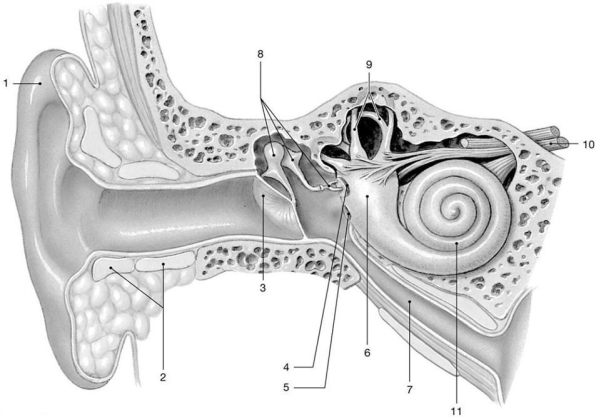 Use Figure 17-2 to answer the following questions:
-Which structure contains the receptors for hearing?
Use Figure 17-2 to answer the following questions:
-Which structure contains the receptors for hearing? (Multiple Choice)
4.9/5 (76)
(76) Which of the following is true of olfactory discrimination?
(Multiple Choice)
4.9/5 (63)
(63) Abnormal jumpy eye movements that may appear after brain stem or inner ear damage are called
(Multiple Choice)
4.9/5 (69)
(69) Some neural tissues retain stem cells and thus the capacity to divide and replace lost neurons. Which ofthese special senses can replace its damaged neural receptors?
(Multiple Choice)
4.8/5 (80)
(80) Modified sebaceous glands located along the margin of the eyelid that secrete a lipid-rich product are called ________ glands.
(Multiple Choice)
4.9/5 (96)
(96) Which of the following descriptions best matches the term stereocilia?
(Multiple Choice)
4.9/5 (78)
(78) The following steps occur in rods when they are excited by photons of light. What is the proper sequence for these steps?
1) Membrane sodium channels close.
2) Increased phosphodiesterase breaks down cGMP.
3) Retinal changes from the 11-cis form to the 11-trans form.
4) The membrane hyperpolarizes and the rate of neurotransmitter release declines.
5) Opsin activates transducin.
6) Opsin activation occurs.
(Multiple Choice)
4.9/5 (83)
(83) As the stapes vibrates the oval window, pressure waves first begin
(Multiple Choice)
4.9/5 (89)
(89) What structure changes the shape of the lens for far and near vision?
(Multiple Choice)
4.9/5 (82)
(82) Each of the special senses can be expected to decline in some way over time. Describe some of the changescommonly seen in the function of the special senses with age.
(Essay)
4.8/5 (77)
(77) 
Filters
- Essay(0)
- Multiple Choice(0)
- Short Answer(0)
- True False(0)
- Matching(0)