



 Chat with AI
Exam 17: The Special Senses

Exam 1: An Introduction to Anatomy and Physiology95 Questions
Exam 2: The Chemical Level of Organization183 Questions
Exam 3: The Cellular Level of Organization190 Questions
Exam 4: The Tissue Level of Organization139 Questions
Exam 5: The Integumentary System118 Questions
Exam 6: Bones and Bone Structure165 Questions
Exam 7: The Axial Skeleton146 Questions
Exam 8: The Appendicular Skeleton119 Questions
Exam 9: Joints134 Questions
Exam 10: Muscle Tissue137 Questions
Exam 11: The Muscular System152 Questions
Exam 12: Nervous Tissue158 Questions
Exam 13: The Spinal Cord, Spinal Nerves, and Spinal Reflexes115 Questions
Exam 14: The Brain and Cranial Nerves187 Questions
Exam 15: Sensory Pathways and the Somatic Nervous System125 Questions
Exam 16: The Autonomic Nervous System and Higher-Order Functions129 Questions
Exam 17: The Special Senses170 Questions
Exam 18: The Endocrine System188 Questions
Exam 19: Blood162 Questions
Exam 20: The Heart178 Questions
Exam 21: Blood Vessels and Circulation225 Questions
Exam 22: The Lymphatic System and Immunity167 Questions
Exam 23: The Respiratory System200 Questions
Exam 24: The Digestive System213 Questions
Exam 25: Metabolism, Nutrition, and Energetics140 Questions
Exam 26: The Urinary System137 Questions
Exam 27: Fluid, Electrolyte, and Acid-Base Balance66 Questions
Exam 28: The Reproductive System203 Questions
Exam 29: Development and Inheritance146 Questions
Select questions type


________, or pinkeye, results from damage to or irritation of the conjunctival surface.
(Multiple Choice)
4.9/5  (89)
(89) Olfactory information is first received by which part of the brain?
(Multiple Choice)
4.9/5 (86)
(86) Which of the following descriptions best matches the term basilar membrane?
(Multiple Choice)
4.8/5 (72)
(72) All of the following are true of the fibrous layer of the eye except that it
(Multiple Choice)
4.8/5 (78)
(78) When all three cone populations are stimulated equally, we perceive
(Multiple Choice)
4.9/5 (69)
(69) The abnormality that develops when a lens loses its transparency is known as
(Multiple Choice)
4.8/5 (74)
(74) In-Text Figure Based Questions
-Choose the correct word from each pairing: The lacrimal gland is located (inferior, superior) and (lateral,medial) to the eye. (Figure 17-4)
(Multiple Choice)
4.7/5 (89)
(89) Which structure of the eye is the most sensitive but contains no blood vessels?
(Multiple Choice)
4.8/5 (80)
(80) Sally's driver's license indicates that she must wear glasses when she drives. She does not need glassestosee objects that are close. What type of lenses is in Sally's eyeglasses? How do they work?
(Essay)
4.9/5 (80)
(80) The superficial hard part of the inner ear is called the ________ and contains ________.
(Multiple Choice)
4.7/5 (86)
(86) Destruction to your left glossopharyngeal nerve would result in
(Multiple Choice)
4.8/5 (78)
(78) The ________ covers most of the exposed surface of the eye.
(Multiple Choice)
4.9/5 (86)
(86) An area of the retina that contains only cones and is the site of sharpest vision is the
(Multiple Choice)
4.9/5 (93)
(93) Olfactory organs are located in the nasal cavity inferior to the perforated bony structure known as the
(Multiple Choice)
4.8/5 (81)
(81) Figure 17-2 The Ear
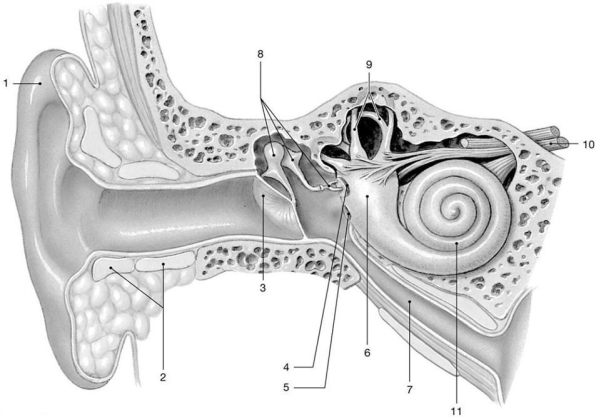 Use Figure 17-2 to answer the following questions:
-Identify the structures labeled "8."
Use Figure 17-2 to answer the following questions:
-Identify the structures labeled "8." (Multiple Choice)
4.9/5 (79)
(79) Figure 17-1 The Sectional Anatomy of the Eye
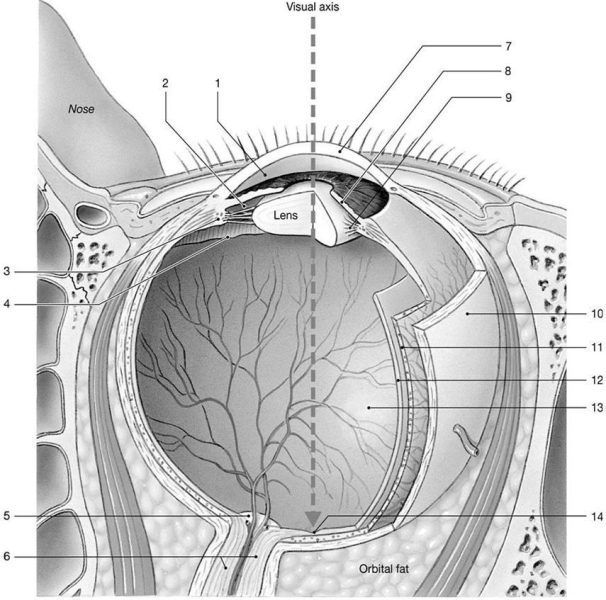 Use Figure 17-1 to answer the following questions:
-Which structure is commonly called the blind spot?
Use Figure 17-1 to answer the following questions:
-Which structure is commonly called the blind spot? (Multiple Choice)
4.8/5 (81)
(81) 
Filters
- Essay(0)
- Multiple Choice(0)
- Short Answer(0)
- True False(0)
- Matching(0)