



 Chat with AI
Exam 12: Nervous Tissue

Exam 1: An Introduction to Anatomy and Physiology95 Questions
Exam 2: The Chemical Level of Organization183 Questions
Exam 3: The Cellular Level of Organization190 Questions
Exam 4: The Tissue Level of Organization139 Questions
Exam 5: The Integumentary System118 Questions
Exam 6: Bones and Bone Structure165 Questions
Exam 7: The Axial Skeleton146 Questions
Exam 8: The Appendicular Skeleton119 Questions
Exam 9: Joints134 Questions
Exam 10: Muscle Tissue137 Questions
Exam 11: The Muscular System152 Questions
Exam 12: Nervous Tissue158 Questions
Exam 13: The Spinal Cord, Spinal Nerves, and Spinal Reflexes115 Questions
Exam 14: The Brain and Cranial Nerves187 Questions
Exam 15: Sensory Pathways and the Somatic Nervous System125 Questions
Exam 16: The Autonomic Nervous System and Higher-Order Functions129 Questions
Exam 17: The Special Senses170 Questions
Exam 18: The Endocrine System188 Questions
Exam 19: Blood162 Questions
Exam 20: The Heart178 Questions
Exam 21: Blood Vessels and Circulation225 Questions
Exam 22: The Lymphatic System and Immunity167 Questions
Exam 23: The Respiratory System200 Questions
Exam 24: The Digestive System213 Questions
Exam 25: Metabolism, Nutrition, and Energetics140 Questions
Exam 26: The Urinary System137 Questions
Exam 27: Fluid, Electrolyte, and Acid-Base Balance66 Questions
Exam 28: The Reproductive System203 Questions
Exam 29: Development and Inheritance146 Questions
Select questions type


Which of the following is the primary second messenger in G-protein coupled post-synaptic cells?
(Multiple Choice)
4.8/5  (83)
(83) Which of the following neurotransmitters are known to bind to G-protein coupled receptors?
(Multiple Choice)
4.8/5 (71)
(71) Functions of astrocytes include all of the following except
(Multiple Choice)
4.9/5 (77)
(77) Figure 12-1 The Neuron
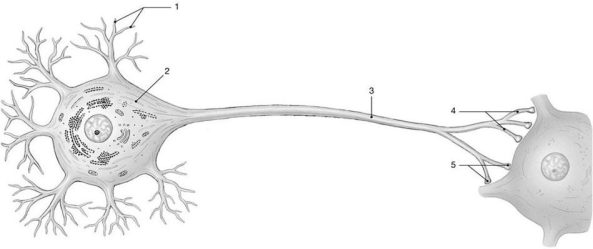 Use Figure 12-1 to answer the following questions:
-The structure labeled "2" is a(n)
Use Figure 12-1 to answer the following questions:
-The structure labeled "2" is a(n) (Multiple Choice)
4.8/5 (77)
(77) If the permeability of a resting axon to sodium ion increases,
(Multiple Choice)
4.9/5 (68)
(68) Which of the following is the most important excitatory neurotransmitter in the brain that is importantinlearning and memory?
(Multiple Choice)
4.8/5 (72)
(72) Ion channels that are always open are called ________ channels.
(Multiple Choice)
4.9/5 (75)
(75) When a second EPSP (excitatory postsynaptic potential) arrives at a single synapse before the effects of the first have disappeared, what occurs?
(Multiple Choice)
4.7/5 (78)
(78) Figure 12-1 The Neuron
Use Figure 12-1 to answer the following questions:
-The structures labeled "1" are dendrites. Their membranes contain numerous chemically-gated ion channels.
Use Figure 12-1 to answer the following questions:
-The structures labeled "1" are dendrites. Their membranes contain numerous chemically-gated ion channels. (Multiple Choice)
4.8/5 (73)
(73) Which of the following is not a recognized structural classification for neurons?
(Multiple Choice)
4.8/5 (85)
(85) In a(n) ________ synapse, current flows directly between cells.
(Multiple Choice)
4.8/5 (84)
(84) Figure 12-2 The Nerve Action Potential
 Use Figure 12-2 to answer the following questions:
-Which area of the graph shows when chemically gated sodium channels are open?
Use Figure 12-2 to answer the following questions:
-Which area of the graph shows when chemically gated sodium channels are open? (Multiple Choice)
4.7/5 (83)
(83) Figure 12-1 The Neuron
Use Figure 12-1 to answer the following questions:
-What is contained inside the structure labeled "5"?
Use Figure 12-1 to answer the following questions:
-What is contained inside the structure labeled "5"? (Multiple Choice)
4.7/5 (85)
(85) Which of the following does not influence the time necessary for a nerve impulse to be transmitted?
(Multiple Choice)
4.9/5 (81)
(81) The sum of the electrical and chemical forces acting on an ion is known as its
(Multiple Choice)
4.9/5 (64)
(64) Which of the following is not a function of the neuroglia?
(Multiple Choice)
4.8/5 (76)
(76) Adrug that blocks ATP production is introduced into an isolated axon preparation. The axon is then repeatedly stimulated, and recordings are made of the response. What effects would you expect to observe?
(Essay)
4.9/5 (67)
(67) 
Filters
- Essay(0)
- Multiple Choice(0)
- Short Answer(0)
- True False(0)
- Matching(0)