



 Chat with AI
Exam 12: Nervous Tissue

Exam 1: An Introduction to Anatomy and Physiology95 Questions
Exam 2: The Chemical Level of Organization183 Questions
Exam 3: The Cellular Level of Organization190 Questions
Exam 4: The Tissue Level of Organization139 Questions
Exam 5: The Integumentary System118 Questions
Exam 6: Bones and Bone Structure165 Questions
Exam 7: The Axial Skeleton146 Questions
Exam 8: The Appendicular Skeleton119 Questions
Exam 9: Joints134 Questions
Exam 10: Muscle Tissue137 Questions
Exam 11: The Muscular System152 Questions
Exam 12: Nervous Tissue158 Questions
Exam 13: The Spinal Cord, Spinal Nerves, and Spinal Reflexes115 Questions
Exam 14: The Brain and Cranial Nerves187 Questions
Exam 15: Sensory Pathways and the Somatic Nervous System125 Questions
Exam 16: The Autonomic Nervous System and Higher-Order Functions129 Questions
Exam 17: The Special Senses170 Questions
Exam 18: The Endocrine System188 Questions
Exam 19: Blood162 Questions
Exam 20: The Heart178 Questions
Exam 21: Blood Vessels and Circulation225 Questions
Exam 22: The Lymphatic System and Immunity167 Questions
Exam 23: The Respiratory System200 Questions
Exam 24: The Digestive System213 Questions
Exam 25: Metabolism, Nutrition, and Energetics140 Questions
Exam 26: The Urinary System137 Questions
Exam 27: Fluid, Electrolyte, and Acid-Base Balance66 Questions
Exam 28: The Reproductive System203 Questions
Exam 29: Development and Inheritance146 Questions
Select questions type


Figure 12-2 The Nerve Action Potential
 Use Figure 12-2 to answer the following questions:
-Which point of the graph shows when potassium ion outflow exceeds sodium ion inflow?
Use Figure 12-2 to answer the following questions:
-Which point of the graph shows when potassium ion outflow exceeds sodium ion inflow? (Multiple Choice)
4.7/5  (84)
(84) The effect that a neurotransmitter has on the postsynaptic membrane depends on the
(Multiple Choice)
4.7/5 (89)
(89) The following are the main steps in the generation of an action potential.
1) Sodium channels are inactivated.
2) Voltage-gated potassium channels open and potassium moves out of the cell, initiating repolarization.
3) Sodium channels regain their normal properties.
4) A graded depolarization brings an area of an excitable membrane to threshold.
5) A temporary hyperpolarization occurs.
6) Sodium channel activation occurs.
7) Sodium ions enter the cell and depolarization occurs.
What is the proper sequence of these events?
(Multiple Choice)
4.9/5 (85)
(85) Figure 12-1 The Neuron
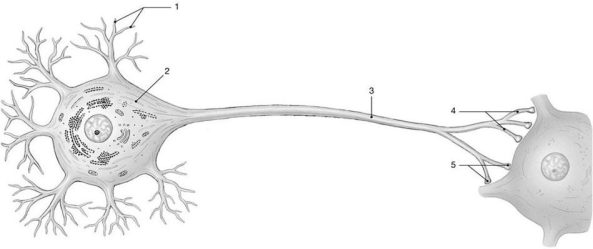 Use Figure 12-1 to answer the following questions:
-On which structure do most neuron to neuron communications occur?
Use Figure 12-1 to answer the following questions:
-On which structure do most neuron to neuron communications occur? (Multiple Choice)
4.9/5 (69)
(69) ________ provide information about the external environment.
(Multiple Choice)
4.8/5 (87)
(87) A neuron whose membrane potential shifts closer to threshold is said to be
(Multiple Choice)
4.9/5 (85)
(85) Which of the following neurotransmitters is a dissolved gas?
(Multiple Choice)
4.9/5 (79)
(79) Figure 12-2 The Nerve Action Potential
Use Figure 12-2 to answer the following questions:
-When is the neuron in the relative refractory period?
Use Figure 12-2 to answer the following questions:
-When is the neuron in the relative refractory period? (Multiple Choice)
4.8/5 (82)
(82) Rabies is caused by a virus that attacks the central nervous system. The virus is normally introduced byananimal bite that breaks the surface of the skin. Since the virus is not motile, how does it travel to the central nervous system?
(Essay)
4.9/5 (80)
(80) A neuron that receives neurotransmitter from another neuron is called
(Multiple Choice)
4.8/5 (72)
(72) Summation that results from the cumulative effect of multiple synapses at multiple places on the neuronisdesignated
(Multiple Choice)
4.8/5 (78)
(78) The ________ nervous system provides involuntary regulation of smooth muscle, cardiac muscle, and glandularactivity.
(Multiple Choice)
4.8/5 (66)
(66) In-Text Figure Based Questions
-Which neuroglia myelinate CNS axons and which neuroglia myelinate PNS axons? (Figure 12-4)
(Multiple Choice)
4.7/5 (86)
(86) 
Filters
- Essay(0)
- Multiple Choice(0)
- Short Answer(0)
- True False(0)
- Matching(0)