



 Chat with AI
Exam 15: Monopoly and Antitrust Policy

Exam 1: Economics: Foundations and Models234 Questions
Exam 2: Trade-Offs, Comparative Advantage, and the Market System258 Questions
Exam 3: Where Prices Come From: the Interaction of Demand and Supply242 Questions
Exam 4: Economic Efficiency, Government Price Setting, and Taxes208 Questions
Exam 5: Externalities, Environmental Policy, and Public Goods263 Questions
Exam 6: Elasticity: the Responsiveness of Demand and Supply295 Questions
Exam 7: The Economics of Health Care171 Questions
Exam 8: Firms, the Stock Market, and Corporate Governance264 Questions
Exam 9: Comparative Advantage and the Gains From International Trade188 Questions
Exam 10: Consumer Choice and Behavioral Economics300 Questions
Exam 11: Technology, Production, and Costs328 Questions
Exam 12: Firms in Perfectly Competitive Markets296 Questions
Exam 13: Monopolistic Competition: the Competitive Model in a More Realistic Setting274 Questions
Exam 14: Oligopoly: Firms in Less Competitive Markets259 Questions
Exam 15: Monopoly and Antitrust Policy279 Questions
Exam 16: Pricing Strategy261 Questions
Exam 17: The Markets for Labor and Other Factors of Production281 Questions
Exam 18: Public Choice, Taxes, and the Distribution of Income258 Questions
Select questions type


In 2014, the NCAA was the subject of two antitrust lawsuits related to video games.The NCAA reached a settlement in which it agreed to
(Multiple Choice)
4.9/5  (85)
(85) A monopoly is defined as a firm that has the largest market share in an industry.
(True/False)
4.9/5 (84)
(84) In 1935, the U.S.Patent and Trademark Office issued Parker Brothers a trademark on the
Use of the name Monopoly for a board game.Hasbro bought Parker Brothers in 1991.Which of the following statements is true regarding the trademark on the name Monopoly for a board game?
(Multiple Choice)
4.8/5 (70)
(70) A monopolist's demand curve is the same as the marginal revenue curve for the product.
(True/False)
4.7/5 (85)
(85) What is a monopoly? Can a firm be a monopoly if close substitutes for its product exists?
(Essay)
4.8/5 (74)
(74) If a restaurant was a natural monopoly, dividing the restaurant equally into two separate restaurants would
(Multiple Choice)
4.7/5 (79)
(79) If a monopolist's marginal revenue is $35 per unit and its marginal cost is $25, then
(Multiple Choice)
4.9/5 (91)
(91) Whenever a firm can charge a price greater than marginal cost
(Multiple Choice)
4.8/5 (71)
(71) An example of a monopoly based on control of a key resource is
(Multiple Choice)
4.7/5 (76)
(76) Figure 15-11
 In 2011, Verizon was granted permission to enter the market for cable TV in Upstate New York, ending the virtual monopoly that Time Warner Cable had in most local communities in the region.Figure 15-11 shows the cable television market in Upstate New York.
-Refer to Figure 15-11.Suppose the local government imposes a $2.50 per month tax on cable companies.What happens to the price charged by the cable company following the imposition of this tax?
In 2011, Verizon was granted permission to enter the market for cable TV in Upstate New York, ending the virtual monopoly that Time Warner Cable had in most local communities in the region.Figure 15-11 shows the cable television market in Upstate New York.
-Refer to Figure 15-11.Suppose the local government imposes a $2.50 per month tax on cable companies.What happens to the price charged by the cable company following the imposition of this tax? (Multiple Choice)
4.9/5 (79)
(79) Microsoft hires marketing and sales specialists to decide what prices it should set for its products, whereas a wealthy corn farmer in Iowa, who sells his output in the world commodity market, does not.Why is this so?
(Multiple Choice)
4.9/5 (81)
(81) Figure 15-4
 Figure 15-4 shows the demand and cost curves for a monopolist.
-Refer to Figure 15-4.What is likely to happen to this monopoly in the long run?
Figure 15-4 shows the demand and cost curves for a monopolist.
-Refer to Figure 15-4.What is likely to happen to this monopoly in the long run? (Multiple Choice)
4.7/5 (73)
(73) Figure 15-12
 Figure 15-12 shows the cost and demand curves for a monopolist.
-Refer to Figure 15-12.Assume the firm maximizes its profits.What is the amount of consumer surplus?
Figure 15-12 shows the cost and demand curves for a monopolist.
-Refer to Figure 15-12.Assume the firm maximizes its profits.What is the amount of consumer surplus? (Multiple Choice)
4.7/5 (82)
(82) If a theatre company expects $250,000 in ticket revenue from five performances and $288,000 in ticket revenue if it adds a sixth performance, the
(Multiple Choice)
5.0/5 (78)
(78) What is a public franchise? Are all public franchises natural monopolies?
(Essay)
4.8/5 (76)
(76) Experience with patents in the pharmaceutical industry shows that when patents on drugs expire
(Multiple Choice)
4.7/5 (77)
(77) What gives rise to a natural monopoly? How do consumers benefit from a natural monopoly?
(Essay)
4.8/5 (85)
(85) Arnold Harberger was the first economist to estimate the loss of economic efficiency due to market power.Harberger found that
(Multiple Choice)
5.0/5 (85)
(85) If a per-unit tax on output sold is imposed on a monopoly's product, the monopolist will increase its market price by the full amount of the tax.
(True/False)
4.8/5 (92)
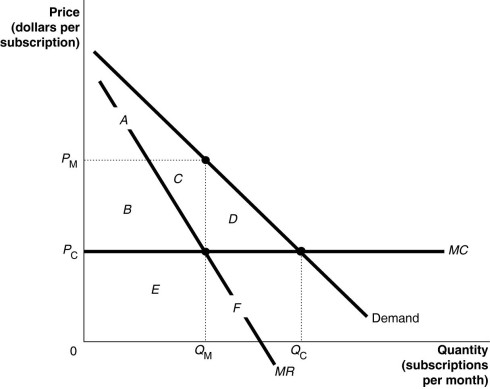
(92) 
Filters
- Essay(0)
- Multiple Choice(0)
- Short Answer(0)
- True False(0)
- Matching(0)