



 Chat with AI
Exam 15: Monopoly and Antitrust Policy

Exam 1: Economics: Foundations and Models234 Questions
Exam 2: Trade-Offs, Comparative Advantage, and the Market System258 Questions
Exam 3: Where Prices Come From: the Interaction of Demand and Supply242 Questions
Exam 4: Economic Efficiency, Government Price Setting, and Taxes208 Questions
Exam 5: Externalities, Environmental Policy, and Public Goods263 Questions
Exam 6: Elasticity: the Responsiveness of Demand and Supply295 Questions
Exam 7: The Economics of Health Care171 Questions
Exam 8: Firms, the Stock Market, and Corporate Governance264 Questions
Exam 9: Comparative Advantage and the Gains From International Trade188 Questions
Exam 10: Consumer Choice and Behavioral Economics300 Questions
Exam 11: Technology, Production, and Costs328 Questions
Exam 12: Firms in Perfectly Competitive Markets296 Questions
Exam 13: Monopolistic Competition: the Competitive Model in a More Realistic Setting274 Questions
Exam 14: Oligopoly: Firms in Less Competitive Markets259 Questions
Exam 15: Monopoly and Antitrust Policy279 Questions
Exam 16: Pricing Strategy261 Questions
Exam 17: The Markets for Labor and Other Factors of Production281 Questions
Exam 18: Public Choice, Taxes, and the Distribution of Income258 Questions
Select questions type


Figure 15-19
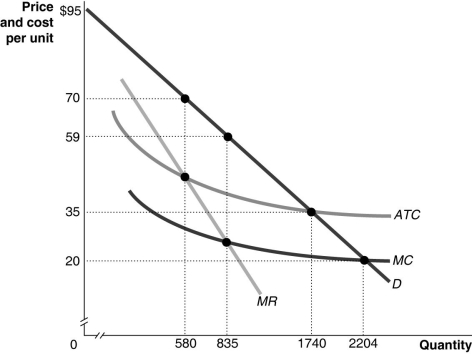 -Refer to Figure 15-19 to answer the following questions.
a.What quantity will this monopoly produce and what price will it charge?
b.Suppose the monopoly is regulated.If the regulatory agency wants to achieve economic efficiency, what price should it require the monopoly to charge?
c.To achieve economic efficiency, what quantity will the regulated monopoly produce?
d.Will the regulated monopoly make a profit if it charges the price that will achieve economic efficiency?
e.Suppose the government decides to regulate the monopoly by imposing a price ceiling of $35.What quantity will the monopoly produce and what price will the monopoly charge?
f.With the price ceiling of $35, what profit will the monopoly earn?
-Refer to Figure 15-19 to answer the following questions.
a.What quantity will this monopoly produce and what price will it charge?
b.Suppose the monopoly is regulated.If the regulatory agency wants to achieve economic efficiency, what price should it require the monopoly to charge?
c.To achieve economic efficiency, what quantity will the regulated monopoly produce?
d.Will the regulated monopoly make a profit if it charges the price that will achieve economic efficiency?
e.Suppose the government decides to regulate the monopoly by imposing a price ceiling of $35.What quantity will the monopoly produce and what price will the monopoly charge?
f.With the price ceiling of $35, what profit will the monopoly earn? (Essay)
4.7/5  (86)
(86) Firms do not have market power in which of the following market structures?
(Multiple Choice)
4.9/5 (69)
(69) Figure 15-17
 Your college decides to offer a psychology course as a MOOC that can be taken by students anywhere in the world, whether they are actually enrolled in your college or not.The demand and cost situation for the MOOC is shown in the figure.
-Refer to Figure 15-17.An economics professor argues: "I think the course should be priced so as to achieve economic efficiency." Which price should this faculty member favor?
Your college decides to offer a psychology course as a MOOC that can be taken by students anywhere in the world, whether they are actually enrolled in your college or not.The demand and cost situation for the MOOC is shown in the figure.
-Refer to Figure 15-17.An economics professor argues: "I think the course should be priced so as to achieve economic efficiency." Which price should this faculty member favor? (Multiple Choice)
4.8/5 (79)
(79) A snack shop inside a hotel in a busy city has a monopoly on food sales if it is the only food vendor in the hotel that is open 24 hours a day.
(True/False)
4.9/5 (79)
(79) Table 15-1
 A monopoly producer of foreign language translation software faces a demand and cost structure as given in Table 15-1.
-Refer to Table 15-1.What is the marginal revenue from the sale of the 12th unit?
A monopoly producer of foreign language translation software faces a demand and cost structure as given in Table 15-1.
-Refer to Table 15-1.What is the marginal revenue from the sale of the 12th unit? (Multiple Choice)
4.9/5 (67)
(67) Because a monopoly's demand curve is the same as the market demand curve for its product
(Multiple Choice)
4.9/5 (88)
(88) The reason that the Fisherman's Friend restaurant in Stonington, Maine had a monopoly on selling seafood dinners in that town is most likely due to
(Multiple Choice)
4.9/5 (86)
(86) Article Summary
In an attempt to get approval for a $6.3 billion merger with Office Depot, Staples met with FTC regulators to discuss the possible sale of assets so the merger can proceed. The Competition Bureau of the FTC had previously indicated that it would not approve the merger as initially structured, but Staples expressed optimism that it would be able to reach a settlement with the FTC. Critics have argued that a merger of Staples and Office Depot will result in higher prices for office supplies.
Source: Josh Kosman, "Staples still angling for Office Max merger," New York Post, October 14, 2015.
-Refer to the Article Summary above.A merger between two competitors such as Staples and Office Depot may ultimately be approved by the Department of Justice and the FTC if the two companies can substantiate ________ as a result of the merger.
(Multiple Choice)
4.8/5 (73)
(73) Which of following is the best example of a monopoly if we use a broader definition of monopoly?
(Multiple Choice)
4.8/5 (70)
(70) In a natural monopoly, throughout the range of market demand
(Multiple Choice)
4.9/5 (63)
(63) Table 15-3
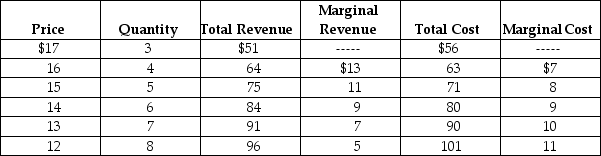 Assume Table 15-3 gives the monthly demand and costs for subscriptions to basic cable for Comcast, a cable television monopoly in Philadelphia.
-Refer to Table 15-3.If Comcast wants to maximize its profits, what price (P)should it charge and how many cable subscriptions per month (Q)should it sell?
Assume Table 15-3 gives the monthly demand and costs for subscriptions to basic cable for Comcast, a cable television monopoly in Philadelphia.
-Refer to Table 15-3.If Comcast wants to maximize its profits, what price (P)should it charge and how many cable subscriptions per month (Q)should it sell? (Multiple Choice)
4.8/5 (99)
(99) If a natural monopoly regulatory commission sets a price where marginal cost is equal to demand
(Multiple Choice)
4.9/5 (83)
(83) Figure 15-17
Your college decides to offer a psychology course as a MOOC that can be taken by students anywhere in the world, whether they are actually enrolled in your college or not.The demand and cost situation for the MOOC is shown in the figure.
-Refer to Figure 15-17.You are a member of a student government and are asked to recommend a price for the course and you argue: "I think the college should charge a price so that it just breaks even on the course." How much profit (or loss)will the college make on the course if it charges this price?
Your college decides to offer a psychology course as a MOOC that can be taken by students anywhere in the world, whether they are actually enrolled in your college or not.The demand and cost situation for the MOOC is shown in the figure.
-Refer to Figure 15-17.You are a member of a student government and are asked to recommend a price for the course and you argue: "I think the college should charge a price so that it just breaks even on the course." How much profit (or loss)will the college make on the course if it charges this price? (Multiple Choice)
4.8/5 (83)
(83) 
Filters
- Essay(0)
- Multiple Choice(0)
- Short Answer(0)
- True False(0)
- Matching(0)