



 Chat with AI
Exam 15: Monopoly and Antitrust Policy

Exam 1: Economics: Foundations and Models234 Questions
Exam 2: Trade-Offs, Comparative Advantage, and the Market System258 Questions
Exam 3: Where Prices Come From: the Interaction of Demand and Supply242 Questions
Exam 4: Economic Efficiency, Government Price Setting, and Taxes208 Questions
Exam 5: Externalities, Environmental Policy, and Public Goods263 Questions
Exam 6: Elasticity: the Responsiveness of Demand and Supply295 Questions
Exam 7: The Economics of Health Care171 Questions
Exam 8: Firms, the Stock Market, and Corporate Governance264 Questions
Exam 9: Comparative Advantage and the Gains From International Trade188 Questions
Exam 10: Consumer Choice and Behavioral Economics300 Questions
Exam 11: Technology, Production, and Costs328 Questions
Exam 12: Firms in Perfectly Competitive Markets296 Questions
Exam 13: Monopolistic Competition: the Competitive Model in a More Realistic Setting274 Questions
Exam 14: Oligopoly: Firms in Less Competitive Markets259 Questions
Exam 15: Monopoly and Antitrust Policy279 Questions
Exam 16: Pricing Strategy261 Questions
Exam 17: The Markets for Labor and Other Factors of Production281 Questions
Exam 18: Public Choice, Taxes, and the Distribution of Income258 Questions
Select questions type


If a firm's average total cost is less than price where MR = MC,
(Multiple Choice)
4.9/5  (81)
(81) Which antitrust law prohibited firms from buying stock in competitors and from having directors serve on the boards of competing firms?
(Multiple Choice)
5.0/5 (89)
(89) U.S.antitrust laws are designed to prohibit monopolization and encourage competition.Why, then, does the government erect barriers to entry and create monopoly power by granting firms patents?
(Essay)
4.8/5 (82)
(82) If a monopolist's marginal revenue is $25 a unit and its marginal cost is $25, then
(Multiple Choice)
4.9/5 (74)
(74) Table 15-2
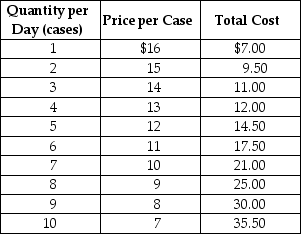 The government of a small developing country has granted exclusive rights to Linden Enterprises for the production of plastic syringes.Table 15-2 shows the cost and demand data for this government-protected monopolist.
-Refer to Table 15-2.What is the profit-maximizing quantity and price for the monopolist?
The government of a small developing country has granted exclusive rights to Linden Enterprises for the production of plastic syringes.Table 15-2 shows the cost and demand data for this government-protected monopolist.
-Refer to Table 15-2.What is the profit-maximizing quantity and price for the monopolist? (Multiple Choice)
4.7/5 (85)
(85) A monopolist's profit-maximizing price and output correspond to the point on a graph
(Multiple Choice)
4.9/5 (78)
(78) Figure 15-3
 Figure 15-3 above shows the demand and cost curves facing a monopolist.
-Refer to Figure 15-3.Suppose the monopolist represented in the diagram above produces positive output.What is the profit-maximizing/loss-minimizing output level?
Figure 15-3 above shows the demand and cost curves facing a monopolist.
-Refer to Figure 15-3.Suppose the monopolist represented in the diagram above produces positive output.What is the profit-maximizing/loss-minimizing output level? (Multiple Choice)
4.9/5 (66)
(66) Arnold Harberger was the first economist to estimate the loss of economic efficiency due to market power.Since Harberger's findings were published, other researchers have studied this same issue.How do the results of these researchers compare to Harberger's results?
(Multiple Choice)
4.8/5 (86)
(86) A narrow definition of monopoly is that a firm is a monopoly if it can ignore
(Multiple Choice)
4.9/5 (81)
(81) Although some economists believe network externalities are important barriers to entry, other economists disagree because
(Multiple Choice)
4.9/5 (73)
(73) Economic efficiency requires that a natural monopoly's price be
(Multiple Choice)
4.8/5 (71)
(71) In the United States, government policies with respect to monopolies and collusion are embodied in
(Multiple Choice)
4.7/5 (86)
(86) The ability of a firm to charge a price greater than marginal cost is called
(Multiple Choice)
4.8/5 (75)
(75) Holding everything else constant, government approval of horizontal mergers is more likely to be granted if the "market" that firms are in are broadly defined rather than narrowly defined.
(True/False)
4.9/5 (71)
(71) Network externalities refer to the situation where the usefulness of a product increases with the number of consumers who use it.
(True/False)
4.8/5 (75)
(75) The U.S.Congress has given two government entities the authority to police mergers.These two entities are
(Multiple Choice)
4.8/5 (82)
(82) Figure 15-15
 Figure 15-15 shows the cost and demand curves for the Erickson Power Company.
-Refer to Figure 15-15.What is the economically efficient output level and what is the price at that level?
Figure 15-15 shows the cost and demand curves for the Erickson Power Company.
-Refer to Figure 15-15.What is the economically efficient output level and what is the price at that level? (Multiple Choice)
4.8/5 (82)
(82) Long-run economic profits would most likely exist in which market structure?
(Multiple Choice)
4.8/5 (67)
(67) 
Filters
- Essay(0)
- Multiple Choice(0)
- Short Answer(0)
- True False(0)
- Matching(0)