



 Chat with AI
Exam 15: Monopoly and Antitrust Policy

Exam 1: Economics: Foundations and Models234 Questions
Exam 2: Trade-Offs, Comparative Advantage, and the Market System258 Questions
Exam 3: Where Prices Come From: the Interaction of Demand and Supply242 Questions
Exam 4: Economic Efficiency, Government Price Setting, and Taxes208 Questions
Exam 5: Externalities, Environmental Policy, and Public Goods263 Questions
Exam 6: Elasticity: the Responsiveness of Demand and Supply295 Questions
Exam 7: The Economics of Health Care171 Questions
Exam 8: Firms, the Stock Market, and Corporate Governance264 Questions
Exam 9: Comparative Advantage and the Gains From International Trade188 Questions
Exam 10: Consumer Choice and Behavioral Economics300 Questions
Exam 11: Technology, Production, and Costs328 Questions
Exam 12: Firms in Perfectly Competitive Markets296 Questions
Exam 13: Monopolistic Competition: the Competitive Model in a More Realistic Setting274 Questions
Exam 14: Oligopoly: Firms in Less Competitive Markets259 Questions
Exam 15: Monopoly and Antitrust Policy279 Questions
Exam 16: Pricing Strategy261 Questions
Exam 17: The Markets for Labor and Other Factors of Production281 Questions
Exam 18: Public Choice, Taxes, and the Distribution of Income258 Questions
Select questions type


Figure 15-15
 Figure 15-15 shows the cost and demand curves for the Erickson Power Company.
-Refer to Figure 15-15.Why won't regulators require that Erickson Power produce the economically efficient output level?
Figure 15-15 shows the cost and demand curves for the Erickson Power Company.
-Refer to Figure 15-15.Why won't regulators require that Erickson Power produce the economically efficient output level? (Multiple Choice)
4.8/5  (90)
(90) Article Summary
In an attempt to get approval for a $6.3 billion merger with Office Depot, Staples met with FTC regulators to discuss the possible sale of assets so the merger can proceed. The Competition Bureau of the FTC had previously indicated that it would not approve the merger as initially structured, but Staples expressed optimism that it would be able to reach a settlement with the FTC. Critics have argued that a merger of Staples and Office Depot will result in higher prices for office supplies.
Source: Josh Kosman, "Staples still angling for Office Max merger," New York Post, October 14, 2015.
-Refer to the Article Summary above.The standards used by the Department of Justice and the FTC to evaluate a potential merger such as the one between Staples and Office Depot are based on market concentration as determined by the
(Multiple Choice)
4.8/5 (85)
(85) Figure 15-9
 Figure 15-9 shows the demand and cost curves for a monopolist.
-Refer to Figure 15-9.What is the difference between the monopoly output and the perfectly competitive output?
Figure 15-9 shows the demand and cost curves for a monopolist.
-Refer to Figure 15-9.What is the difference between the monopoly output and the perfectly competitive output? (Multiple Choice)
4.8/5 (73)
(73) Figure 15-12
 Figure 15-12 shows the cost and demand curves for a monopolist.
-Refer to Figure 15-12.If this industry was organized as a perfectly competitive industry, the market output and market price would be
Figure 15-12 shows the cost and demand curves for a monopolist.
-Refer to Figure 15-12.If this industry was organized as a perfectly competitive industry, the market output and market price would be (Multiple Choice)
4.8/5 (95)
(95) Suppose an industry is made up of 25 firms, all with equal market share.The four-firm concentration ratio of this industry is
(Multiple Choice)
4.9/5 (89)
(89) Unlike a perfect competitor, a monopolist faces the market demand curve.
(True/False)
4.9/5 (83)
(83) A monopoly is a firm that is the only seller of a good or service that does not have a close substitute.
(True/False)
4.9/5 (77)
(77) A natural monopoly is characterized by large fixed costs relative to variable costs.
(True/False)
5.0/5 (83)
(83) Figure 15-10
 -Refer to Figure 15-10.The deadweight loss due to a monopoly is represented by the area
 (Multiple Choice)
5.0/5 (74)
(74) The International Nickel Company of Canada is often cited as an example of monopoly.What was the source of the barrier to entry that gave this firm monopoly power?
(Multiple Choice)
4.9/5 (78)
(78) Figure 15-6
 Figure 15-6 shows the cost and demand curves for a monopolist.
-Refer to Figure 15-6.The profit-maximizing output and price for the monopolist are
Figure 15-6 shows the cost and demand curves for a monopolist.
-Refer to Figure 15-6.The profit-maximizing output and price for the monopolist are (Multiple Choice)
4.8/5 (76)
(76) Relative to a perfectly competitive market, a monopoly results in
(Multiple Choice)
4.7/5 (83)
(83) Natural monopolies in the United States are generally regulated by
(Multiple Choice)
4.8/5 (74)
(74) a.What is the defining characteristic of a natural monopoly?
b.Should the government break up a natural monopoly into two or more firms to make the industry more competitive?
c.Suppose the government wants to ensure that some of the benefits of declining average total cost are passed on to consumers.To achieve this goal, it requires that the natural monopoly set its price equal to marginal cost.Is this a feasible goal? Explain.
d.What is an alternative to marginal cost pricing that ensures that consumers reap some of the benefits of declining average total cost?
(Essay)
4.9/5 (76)
(76) Figure 15-7
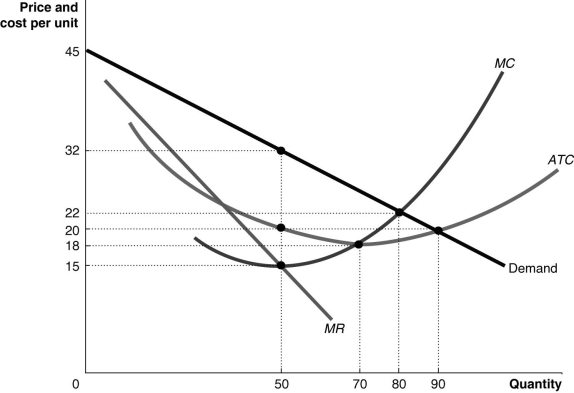 -Refer to Figure 15-7.Use the figure above to answer the following questions.
a.What is the profit-maximizing quantity and what price will the monopolist charge?
b.What is the total revenue at the profit-maximizing output level?
c.What is the total cost at the profit-maximizing output level?
d.What is the profit?
e.What is the profit per unit (average profit)at the profit-maximizing output level?
f.If this industry was organized as a perfectly competitive industry, what would be the profit-maximizing price and quantity?
-Refer to Figure 15-7.Use the figure above to answer the following questions.
a.What is the profit-maximizing quantity and what price will the monopolist charge?
b.What is the total revenue at the profit-maximizing output level?
c.What is the total cost at the profit-maximizing output level?
d.What is the profit?
e.What is the profit per unit (average profit)at the profit-maximizing output level?
f.If this industry was organized as a perfectly competitive industry, what would be the profit-maximizing price and quantity? (Essay)
4.9/5 (84)
(84) The U.S.government would never approve a proposed merger between two firms that could significantly increase the newly merged firm's market power even if the efficiency gains from the newly merged firm could make consumers better off.
(True/False)
4.7/5 (82)
(82) Assume a hypothetical case where an industry begins as perfectly competitive and then becomes a monopoly.As a result of this change
(Multiple Choice)
4.8/5 (63)
(63) Figure 15-17
 Your college decides to offer a psychology course as a MOOC that can be taken by students anywhere in the world, whether they are actually enrolled in your college or not.The demand and cost situation for the MOOC is shown in the figure.
-Refer to Figure 15-17.The faculty member who designed the course argues: "I think the course should be priced so that the maximum number of students enroll." How much profit (or loss)will the college make on the course if it charges this price?
Your college decides to offer a psychology course as a MOOC that can be taken by students anywhere in the world, whether they are actually enrolled in your college or not.The demand and cost situation for the MOOC is shown in the figure.
-Refer to Figure 15-17.The faculty member who designed the course argues: "I think the course should be priced so that the maximum number of students enroll." How much profit (or loss)will the college make on the course if it charges this price? (Multiple Choice)
4.9/5 (63)
(63) 
Filters
- Essay(0)
- Multiple Choice(0)
- Short Answer(0)
- True False(0)
- Matching(0)