



 Chat with AI
Exam 15: Monopoly and Antitrust Policy

Exam 1: Economics: Foundations and Models234 Questions
Exam 2: Trade-Offs, Comparative Advantage, and the Market System258 Questions
Exam 3: Where Prices Come From: the Interaction of Demand and Supply242 Questions
Exam 4: Economic Efficiency, Government Price Setting, and Taxes208 Questions
Exam 5: Externalities, Environmental Policy, and Public Goods263 Questions
Exam 6: Elasticity: the Responsiveness of Demand and Supply295 Questions
Exam 7: The Economics of Health Care171 Questions
Exam 8: Firms, the Stock Market, and Corporate Governance264 Questions
Exam 9: Comparative Advantage and the Gains From International Trade188 Questions
Exam 10: Consumer Choice and Behavioral Economics300 Questions
Exam 11: Technology, Production, and Costs328 Questions
Exam 12: Firms in Perfectly Competitive Markets296 Questions
Exam 13: Monopolistic Competition: the Competitive Model in a More Realistic Setting274 Questions
Exam 14: Oligopoly: Firms in Less Competitive Markets259 Questions
Exam 15: Monopoly and Antitrust Policy279 Questions
Exam 16: Pricing Strategy261 Questions
Exam 17: The Markets for Labor and Other Factors of Production281 Questions
Exam 18: Public Choice, Taxes, and the Distribution of Income258 Questions
Select questions type


Economic efficiency requires that a natural monopoly's price be set corresponding to the quantity where marginal revenue equals marginal cost.
(True/False)
4.9/5  (71)
(71) Figure 15-16
 Figure 15-16 shows the market demand and cost curves facing a natural monopoly.
-Refer to Figure 15-16.Which of the following would be true if government regulators require the natural monopoly to produce at the economically efficient output level?
Figure 15-16 shows the market demand and cost curves facing a natural monopoly.
-Refer to Figure 15-16.Which of the following would be true if government regulators require the natural monopoly to produce at the economically efficient output level? (Multiple Choice)
4.8/5 (82)
(82) Figure 15-5
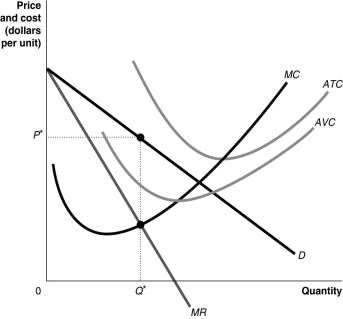 -Refer to Figure 15-5.If the monopolist charges price P* for output Q*, in order to maximize profit or minimize loss in the short run, it should
 (Multiple Choice)
4.9/5 (76)
(76) When the government makes a firm the exclusive legal provider of a good or service, it grants the firm
(Multiple Choice)
4.8/5 (75)
(75) For which of the following firms is patent protection of vital importance?
(Multiple Choice)
4.9/5 (89)
(89) A monopoly is a firm that is the only seller of a good or service that does not have
(Multiple Choice)
4.8/5 (78)
(78) Equilibrium in a perfectly competitive market results in the greatest amount of economic surplus, or total benefit to society, from the production of a good.Why, then, did Joseph Schumpeter argue that an economy may benefit more from firms that have market power than from firms that are perfectly competitive?
(Essay)
4.9/5 (81)
(81) Table 15-4
 Shakti Inc.has been granted a patent for its Arnica toothache balm.Table 15-4 shows the demand and the total cost schedule for the firm.
-Refer to Table 15-4.What is the amount of the deadweight loss generated by Shakti when it produces the monopoly output?
Shakti Inc.has been granted a patent for its Arnica toothache balm.Table 15-4 shows the demand and the total cost schedule for the firm.
-Refer to Table 15-4.What is the amount of the deadweight loss generated by Shakti when it produces the monopoly output? (Multiple Choice)
4.8/5 (76)
(76) Figure 15-2
 Figure 15-2 above shows the demand and cost curves facing a monopolist.
-Refer to Figure 15-2.To maximize profit, the firm will produce at output level
Figure 15-2 above shows the demand and cost curves facing a monopolist.
-Refer to Figure 15-2.To maximize profit, the firm will produce at output level (Multiple Choice)
4.9/5 (95)
(95) After having a monopoly in the diamond market for many years, by 2000 the De Beers company faced competition from other companies.To maintain its market share, De Beers
(Multiple Choice)
4.8/5 (76)
(76) Figure 15-17
 Your college decides to offer a psychology course as a MOOC that can be taken by students anywhere in the world, whether they are actually enrolled in your college or not.The demand and cost situation for the MOOC is shown in the figure.
-Refer to Figure 15-17.An economics professor argues: "I think the course should be priced so as to achieve economic efficiency." How much profit (or loss)will the college make on the course if it charges this price?
Your college decides to offer a psychology course as a MOOC that can be taken by students anywhere in the world, whether they are actually enrolled in your college or not.The demand and cost situation for the MOOC is shown in the figure.
-Refer to Figure 15-17.An economics professor argues: "I think the course should be priced so as to achieve economic efficiency." How much profit (or loss)will the college make on the course if it charges this price? (Multiple Choice)
4.9/5 (76)
(76) Figure 15-12
 Figure 15-12 shows the cost and demand curves for a monopolist.
-Refer to Figure 15-12.What is the amount of consumer surplus if, instead of monopoly, the industry was organized as a perfectly competitive industry?
Figure 15-12 shows the cost and demand curves for a monopolist.
-Refer to Figure 15-12.What is the amount of consumer surplus if, instead of monopoly, the industry was organized as a perfectly competitive industry? (Multiple Choice)
4.7/5 (73)
(73) Some economists believe that the economy benefits from firms having market power.Which of the following is an argument that has been made to support this position?
(Multiple Choice)
4.8/5 (79)
(79) Figure 15-9
 Figure 15-9 shows the demand and cost curves for a monopolist.
-Refer to Figure 15-9.What is the difference between the monopoly's price and perfectly competitive industry's price?
Figure 15-9 shows the demand and cost curves for a monopolist.
-Refer to Figure 15-9.What is the difference between the monopoly's price and perfectly competitive industry's price? (Multiple Choice)
4.8/5 (88)
(88) A virtuous cycle refers to the development of new products that follows when a monopoly earns economic profits.
(True/False)
4.7/5 (87)
(87) Table 15-2
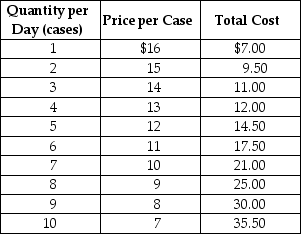 The government of a small developing country has granted exclusive rights to Linden Enterprises for the production of plastic syringes.Table 15-2 shows the cost and demand data for this government-protected monopolist.
-Refer to Table 15-2.What is the amount of profit that the firm earns?
The government of a small developing country has granted exclusive rights to Linden Enterprises for the production of plastic syringes.Table 15-2 shows the cost and demand data for this government-protected monopolist.
-Refer to Table 15-2.What is the amount of profit that the firm earns? (Multiple Choice)
4.9/5 (79)
(79) 
Filters
- Essay(0)
- Multiple Choice(0)
- Short Answer(0)
- True False(0)
- Matching(0)